15 Free Concrete & Foundation Calculators — Slab, Sidewalk, Weight, Footing, Wall, Pier, Stairs, Column, Cylinder and Ready-Mix Tools (2026)
Thirteen calculators covering every concrete pour — slabs, footings, foundations, piers, block walls, stairs, columns, cylinders — with rebar grid design, ACI 318 reinforcement check, and ready-mix truck / short-load fee planning. Edited by Sarah Miller and checked by the Concrete & Foundations review desk against ACI, ASTM and IRC specifications.
- 9Concrete calculators
- 7US regional cost bands
- 6Climate & soil-specific zones
- 10Field mistakes catalogued
- 4,500+Engineer-reviewed words
4 Concrete Calculators to Open First
If you are estimating a real job right now, open these four first. They answer cubic yards, bag counts, footing volume and rebar layout — the four questions that decide your ready-mix order before you call a supplier.
When to Use Concrete vs. Alternatives
Concrete is the most-used man-made material on Earth — by mass, we pour more concrete every year than all steel, aluminum, copper, and plastics combined. The reason: it's cheap, strong in compression, forms to any shape, and lasts decades with minimal maintenance.
Concrete wins for:
- Foundations and footings — heavy bearing loads, frost protection
- Slabs > 100 ft² — patios, driveways, garage floors, basement slabs
- Columns and piers — point-load support
- Retaining walls — earth pressure resistance
- Long-lifespan applications — 50+ years expected
Use alternatives when:
- Asphalt for paved surfaces — cheaper, faster, easier to repair
- Aggregate base for drainage layers — no concrete needed
- Precast for modular foundations — delivered ready to set
- Helical piles for remote-site footings — no concrete at all
All 15 Concrete Calculators — Browse by Use Case
Choose by what you're pouring — slab, footing, foundation wall, pier, or block wall.
How Concrete Actually Cures (Not Dries) — The 28-Day Hydration Curve
‘Cure’ isn't ‘dry.’ It's a chemical reaction called hydration:
- Portland cement powder + water starts hydrating immediately
- Within 30-90 minutes: initial set — concrete stiffens, no longer workable
- Within 2-4 hours: final set — can't screed or finish anymore
- Within 24 hours: 70% of final strength — foot traffic OK
- At 7 days: 75-80% of design strength — vehicle traffic OK
- At 28 days: 100% design strength — fully cured for structural loading
Hydration requires water. If concrete dries before 7 days, the reaction stops prematurely and strength is permanently reduced. That's why commercial concrete is cured (kept moist) for 3-7 days with sheeting, curing compound, or continuous wet burlap.
For DIY residential work: spray down the slab twice daily for 3-5 days, or cover with plastic sheeting. This simple step can increase 28-day strength by 15-20%.
10 Concrete Field Mistakes I've Seen Repeat
These are failures I've either witnessed, investigated, or inherited. Most aren't in textbooks because they're craft-level errors that textbook-educated engineers don't anticipate.
- Adding water at the chute. The driver drops slump from a 4 in to a 6.5 in with the hose because the crew complains it's hard to finish. Every gallon of added water reduces 28-day strength by 150 to 250 psi. I've seen 4,000 psi mix tested at 2,400 psi because of 8 gallons of ‘just a little water’ added across a 10-yard pour. The fix: order higher slump (5 to 6 in) up front, or use a superplasticizer admixture.
- One slump test per truck. ASTM C143 technically allows one, but for any pour over 20 yards I take a slump and air-content test from every fourth truck. The off-spec mix is almost always truck #3 or #5 of the day, not truck #1.
- Curing shut down at 24 hours. Homeowners remove the burlap after one day because ‘it looks fine.’ Concrete reaches 65% of 28-day strength by day 7 only if it stays moist. Tarps, soaker hoses, or a spray-applied curing compound (ASTM C309) for a minimum of 7 days, 14 days on high-strength pours. I've watched slabs dry-crack in a 3x4 ft grid pattern because of day-2 tarp removal.
- Rebar set directly on the soil or vapor barrier. Cover failure. Bars must be on chairs (plastic or concrete dobies) at the specified cover depth (3 in bottom, 2 in sides, 1.5 in top for residential slabs). No exceptions. A slab I inspected in 2022 had #4 bars sitting on the polyethylene vapor barrier; corrosion-induced spalling was visible by year 5.
- No control joints or joints cut too late. Every 10 to 12 feet on a slab, cut 1/4 of the slab depth within 6 to 12 hours of placement. Skip this and the slab will pick its own crack locations, usually diagonal across the middle. I cut joints at 8 hours routinely; by 14 hours on a hot day you're chasing cracks you've already lost.
- Finishing too early. Bleed water must evaporate before hard troweling. Troweling while bleed water is on the surface pushes water back into the matrix, weakening the top 1/4 in. The symptom is a surface that dusts under foot traffic in year 2. Wait for the sheen to disappear.
- Pouring over a frozen or mud subgrade. The slab bottom loses 20 to 35% of design bearing when sub-base is saturated or frozen. I walk the sub-base at pour time with a 1 in rod; anything that punches in more than 1 in under 100 lb of my weight is unacceptable.
- Forgetting vapor barrier under interior slabs. 10 mil polyethylene below the slab, seams taped, edges sealed to footings. Skip it and humidity inside the house rises, hardwood floors cup, and mold risk climbs. A $140 vapor barrier saves $8,000 in floor refinishing.
- Ready-mix in the drum too long. ASTM C94 limits mix time in the truck to 90 minutes or 300 drum revolutions, whichever comes first. Haul distance matters. I refuse any truck stamped past 90 minutes; the crew has to remix or come back.
- No test cylinders cast. On pours over 25 yards, cast 6 cylinders (two for 7-day break, two for 28-day, two for contingency). A cylinder break costs $35; disputes about whether the mix met spec cost $40,000+. I've testified on two cases where the lack of cylinders cost the homeowner the case.
PSI Strength Ratings & Bag Yields
Concrete strength is quoted in pounds per square inch (psi) of compressive strength at 28 days. For the full application-by-application breakdown with code references, see our concrete PSI by application reference table (ACI 318 + IRC 2024):
- 2,500 psi — General non-structural slabs (older spec, now rare)
- 3,000 psi — Standard residential slabs, patios, walkways
- 3,500 psi — Better-grade residential, driveways
- 4,000 psi — Garage floors, foundation walls, footings (IRC minimum for most applications)
- 4,500-5,000 psi — Heavy loading, industrial, commercial floors
- 6,000+ psi — High-strength commercial, post-tensioned slabs, columns
To pick the right cement : sand : gravel ratio (and the matching water-cement ratio) for any of the PSI targets above, use our concrete mix ratio guide (PSI × W/C × slump) with bagged-mix equivalents.
Bag yields to memorize:
- 80-lb bag = 0.60 ft³
- 60-lb bag = 0.45 ft³
- 45 × 80-lb bags = 1 cubic yard
- 60 × 60-lb bags = 1 cubic yard
Cure-time decisions (when can I walk on it / drive on it / strip the form) follow the day-by-day strength curve documented in the concrete curing time chart (ASTM C39 + ACI 308R) — with separate columns for 50°F / 70°F / 90°F so you can read the right gate for the actual jobsite temperature.
Concrete Section, PSI & 2026 Ready-Mix Pricing Reference
| Application | Thickness | PSI | Reinforcement |
|---|---|---|---|
| Walkway | 3-4 in | 3,000 psi | Fiber mesh |
| Patio | 4 in | 3,000-3,500 | Fiber + 6×6 wire mesh |
| Driveway | 4-5 in | 4,000 | #4 rebar 24 in o.c. |
| Garage floor | 5 in | 4,000 | #4 rebar 16 in o.c. |
| Basement slab | 4 in | 3,500-4,000 | Wire mesh or #3 rebar |
| Foundation walls | 8-12 in | 3,500-4,000 | Vertical #4/#5 |
| Continuous footings | 8-12 in deep | 3,000-3,500 | 2 × #4 horizontal |
| RV pad | 6 in | 4,500 | #5 rebar 12 in o.c. |
| Commercial slab | 6-8+ in | 4,500-5,000+ | Engineered |
Per IRC/ACI 318 minimums. Local engineers may specify higher for specific site conditions.
| PSI | Price/yd³ | Typical Use |
|---|---|---|
| 3,000 psi | $145-165 | Walkways, patios, non-structural |
| 3,500 psi | $150-170 | Residential slabs, driveways |
| 4,000 psi | $160-180 | Foundations, garage floors, footings (IRC standard) |
| 4,500 psi | $170-195 | Commercial, heavy-loading residential |
| 5,000 psi | $180-210 | Industrial, specialty |
| High-early (3-day strength) | +$15-25 | Fast-track projects |
| Fiber-reinforced (synthetic) | +$8-12 | Shrinkage crack control |
| Polymer-modified | +$30-60 | Chemical resistance, bonded overlays |
Prices exclude delivery (typically included within 20 miles), short-load fees (under 4 yd³), overtime (weekends), and material surcharges.
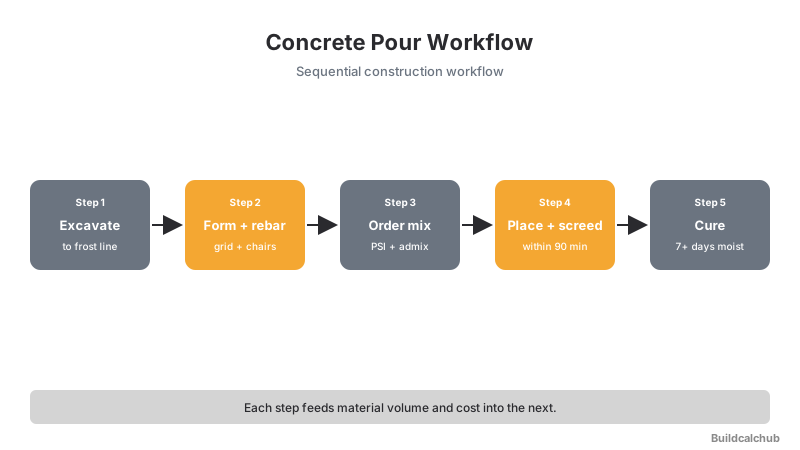
The Concrete Pour Workflow
- Site prep — excavate to correct grade, compact sub-base (95% Proctor density), install vapor barrier for interior slabs
- Forms and reinforcement — set forms at proper elevation, install rebar grid with chairs
- Order concrete — use the main calculator for total yards; add 10% waste
- Pour sequencing — start at far end, work toward access point; continuous placement to avoid cold joints
- Screed and bull-float — strike off to grade, then smooth surface
- Edge and joint — edge slab perimeter, cut control joints within 12 hours
- Finish — broom finish for grip (exterior) or trowel smooth (interior)
- Cure — moist-cure for 3-7 days; protect from freezing/hot sun
Timing is non-negotiable on steps 5-7. Miss the window and you can't recover.
When the estimate includes steel, pair the Rebar Calculator with the rebar spacing guide so quantity, spacing, cover, chairs, and lap assumptions stay aligned.
For a full slab workflow, the concrete patio project path ties area, excavation, gravel base, slab volume, PSI, reinforcement, and curing into one sequence.
Real-World Example Calculations
Full Foundation + Slab Project: 30 × 40 ft Full Basement
New construction residential foundation with poured walls and basement slab.
- Footings (140 ft × 16 × 10 in)
- 5.8 yd³
- Walls (140 ft × 8 ft × 8 in)
- 27.6 yd³
- Basement slab (30 × 40 × 4 in)
- 14.8 yd³
Takeaway: Three separate pours spanning 2-3 weeks. Total concrete cost $7,500-9,000; total project with labor and reinforcement $22,000-30,000.
2026 Concrete Pricing & 3-Year Cost Trend
Concrete prices have climbed 12–18% over 2024–2025, driven by:
- Cement production costs — cement is energy-intensive; fuel surcharges pass through directly
- Aggregate costs — sand and gravel supply constraints in urban markets
- Trucking — driver shortage forces higher delivery fees
- Carbon pricing — some states (CA, WA) adding surcharges for high-carbon mixes
| Year | National avg $/yd³ | YoY change | Primary driver |
|---|---|---|---|
| 2024 | $145–$175 | baseline | Cement supply normalization |
| 2025 | $160–$195 | +10–14% | Energy & aggregate inflation, trucking shortage |
| 2026 | $175–$220 | +8–13% | Cement energy pass-through, carbon-pricing premium in CA/WA |
Mitigation strategies:
- Schedule in off-season — March–April or October–November when plants have capacity
- Lock-in contracts — written quotes valid for 30–60 days on large orders
- Supplementary cementitious materials (SCMs) — fly ash, slag and silica fume replace 10–30% of Portland cement at 50–80% of the cost. The same swap also cuts embodied CO2 by roughly 15–30% per yd³: 1 yd³ of conventional 4,000 psi concrete embodies about 400–560 lb CO2e (driven almost entirely by clinker production); 25% fly-ash replacement typically pulls that to 320–430 lb CO2e per PCA & NRMCA EPD ranges.
- Combine orders with neighbors — avoid short-load fees by sharing a truck
Before ordering footing concrete, verify depth and bearing assumptions with the how deep should footings be guide, especially in frost zones or soft soil.
Regional Climate, Soil & Code Variations
Concrete is the one material where the right answer in Delaware is absolutely the wrong answer in Phoenix. Frost depth, expansive soil, sulfate exposure, alkali-silica reactivity, and humidity all push the mix design in different directions. The first question in any residential mix spec is where the pour is happening. Here's the regional picture that actually affects residential footings, slabs, and foundation walls.
Frost depth: the single biggest regional variable
IRC Table R403.1.4.1 gives the floor value, but the state amendments matter more. Florida footings can legally be 12 inches deep. In the driveway I poured last October in Vermont, the footings went to 54 inches. That is a 4.5x variance for the same structural load.
- Zone 1 (Gulf Coast, FL, South TX): no frost requirement, 12 in minimum, but expansive soil usually dictates 18 to 24 in pier-and-beam or post-tensioned slabs.
- Zone 2 (mid-South, LA, GA, SC): 12 to 24 in frost line; 18 in is the most common residential spec I see.
- Zone 3 (Mid-Atlantic including my home state Delaware): 24 to 36 in. I write 30 in as the default and 36 in for garage slabs because the slab transfers heaving load to the footing edge.
- Zone 4 (PA, OH, IN, MD northern parts): 32 to 42 in. I spec 42 in here because the variance between surveyed vs actual frost can be 6 inches in a cold winter.
- Zone 5+ (MN, ND, ME, northern MT): 48 to 60 in. At this depth, excavation alone is a meaningful cost; contractors sometimes want to "just pour 36 in and add insulation." I refuse. Insulation supplements frost protection in frost-protected shallow foundation (FPSF) designs but does not substitute for it.
Expansive soil (CSR, CH, high-PI clays): TX, OK, CO, UT, parts of CA
I've seen a 40 by 60 foundation wall crack diagonally in 11 months on an expansive clay site outside Dallas because the contractor used a standard 8 in frost-free footing. Expansive soil doesn't freeze; it swells when wet. The fix is either pier-and-beam (load transferred to stable deeper soil) or a post-tensioned slab with void forms on the perimeter. My personal spec on anything with a Plasticity Index above 25 is pier-and-beam at 8 ft piers with grade beams. The cost is 35 to 50% higher than a slab-on-grade but avoids $18,000+ underpinning repair in year 3.
Alkali-Silica Reactivity (ASR) zones: Upper Midwest, parts of Canada, pockets in the Northeast
Certain aggregates (reactive chert, volcanic glass, some quartzites) will expand within concrete over years, cracking the matrix from inside. On a commercial pour in upstate Wisconsin in 2019, I specified 25% Class F fly ash replacement to suppress ASR after the aggregate source flagged reactive. Supplementary cementitious materials (SCMs) — fly ash, slag cement, silica fume — are the answer anywhere ASTM C1260 or C1567 tests flag reactive aggregate.
Sulfate exposure (S classes): high-salt groundwater in TX, southern CA, AZ
Sulfate concentrations above 0.2% in soil or 1,500 ppm in groundwater require Type V (sulfate-resistant) cement or Type II with SCM replacement. I specify Type V by default on any foundation within 1,500 ft of the Gulf coast or in the high-sulfate belt of the San Joaquin Valley. The material premium is $12 to $22 per cubic yard.
Hot-weather placement: AZ, TX, NV, FL summers
ACI 305 defines hot weather as 90°F+ ambient, low humidity, or high wind. Mix water demand jumps; setting time drops; the risk of plastic-shrinkage cracks multiplies. I spec evaporation retarder (Sika MonoTop or equivalent) on any slab pour when the ambient is above 85°F with wind above 8 mph. I also move pour start to 4 AM in July in Phoenix. Clients complain about the start time — they don't complain about the finished slab.
Cold-weather placement: MN, ND, ME, upper NY, northern PA from October through April
ACI 306 requires mix delivered at 55°F minimum, protected from freezing for at least 72 hours, and cured until a compressive strength of 500 psi is reached (typically 48 to 72 hours). Blankets, heated enclosures, and calcium chloride accelerators are the tools. I avoid calcium chloride on any reinforced pour because it corrodes rebar. Non-chloride accelerators add $8 to $14 per yd but don't rust the steel.
Ready-Mix & Placement Cost by Region (2026)
Below is the spread I see in delivered ready-mix pricing and typical installed costs for a 4-inch residential slab. "Installed" includes form work, rebar or mesh, placement labor, finishing, and control-joint cutting; it does not include excavation, base prep, or vapor barrier.
| Region | 3,000 psi delivered $/yd³ | 4-in slab installed $/ft² | Local cost drivers |
|---|---|---|---|
| Northeast (NY/NJ/CT/MA) | $205–$245 | $9.50–$13.00 | Labor, union finishing rates, haul |
| Mid-Atlantic (DE/MD/PA/VA) | $175–$215 | $7.75–$10.50 | Moderate labor, competitive supplier market |
| Southeast (FL/GA/NC/SC) | $160–$195 | $6.50–$9.00 | High demand, hot-weather admixture |
| Midwest (OH/IN/IL/MI) | $170–$205 | $7.00–$9.75 | Short season, winter-mix premium |
| Texas / high sulfate zones | $170–$220 | $7.25–$10.00 | Type V cement premium, heat |
| Mountain West (CO/UT/AZ/NM) | $195–$235 | $8.75–$11.50 | Aggregate haul, altitude curing |
| West Coast (CA/OR/WA) | $215–$270 | $10.50–$14.50 | Emission regs, labor, SCM mandates |
Where the money actually goes on an installed residential slab
On a 400 ft² 4-inch slab (roughly 5 yd³) in the Mid-Atlantic in 2026, I see this cost structure in honest itemized bids:
- Ready-mix delivery: $195 × 5 yd³ = $975 (23% of the total)
- Rebar and mesh: $0.30 to $0.55 per ft² installed = $120 to $220 (3 to 5%)
- Form work lumber and setup: $1.50 to $2.50 per linear ft of perimeter = $135 to $225 (3 to 5%)
- Placement labor and finishing: $2.75 to $4.25 per ft² = $1,100 to $1,700 (26 to 40%)
- Control joints, curing, saw cutting: $0.50 to $0.90 per ft² = $200 to $360 (5 to 8%)
- Overhead, insurance, profit: typically 18 to 25% of subtotal = $500 to $800
Add 15 to 25% on top of all of this for excavation, base prep, and vapor barrier if the site isn't already prepared. That is why a "slab" bid of $11/ft² in the Northeast is not unreasonable when site work is included, even though the ready-mix delivery itself is under $3/ft².
Three savings strategies I consistently recommend
- Pour same-day if possible. Splitting a 7-yard pour across two days doubles the mobilization cost by $600 to $1,000 and introduces a cold joint.
- Specify mesh for interior residential slabs, not rebar grid. Welded wire reinforcement (6x6 W2.9) at $0.18/ft² is adequate for 99% of residential slabs on grade and saves $200 to $400 on a mid-sized slab versus #4 rebar at 16 in on center. For structural slabs or driveways with heavy vehicle traffic, stick with rebar.
- Batch orders across multiple trades on site. Patio + sidewalk + equipment pad on the same day shares the short-load charge (typically $45 to $70 per yard below 3 yd minimum) and reduces per-yard cost 15 to 25%.
For any residential slab or footing, run the scenario in our concrete calculator first to verify cubic yards, then price against the regional range above. A bid inside the range is normal; a bid well above it deserves a line-item review. Considering concrete specifically for a driveway? Read our cross-cluster comparison — asphalt vs concrete driveway, 5-dimension verdict — before committing; the climate-fit and 20-year cost-of-ownership math flips the recommendation for a meaningful share of homeowners.
Engineering References
These references are used for terminology, safety boundaries, and engineering assumptions. Local code, supplier specifications, and licensed design documents still control your project.
-
ACI Concrete Terminology and Technical Resources
American Concrete Institute
Used for concrete strength terminology, mix design concepts, and structural concrete references.
-
ASTM C33/C33M: Standard Specification for Concrete Aggregates
ASTM International
Referenced for concrete aggregate grading and quality terminology.
-
NRMCA Ready-Mix Industry & Sustainability Resources
National Ready Mixed Concrete Association
Referenced for ready-mix delivery, batching, EPD (Environmental Product Declaration) and embodied-carbon ranges.
-
PCA Cement Industry & Concrete Lifecycle Resources
Portland Cement Association
Referenced for cement chemistry, SCM replacement effects and lifecycle CO2 context.
-
ICC Digital Codes: International Residential Code
International Code Council
Referenced for residential footing, slab, deck, and code-compliance terminology.
-
OSHA Trenching and Excavation Safety
Occupational Safety and Health Administration
Referenced for excavation safety, protective systems, and worker-safety boundaries.
Frequently Asked Questions
How much concrete do I need for a typical house foundation?
For a 30 × 40 ft full basement: 30-35 cubic yards of walls + 6-8 yards of footings + 15 yards of slab = total 50-60 yd³. Crawl space: 15-20 yd³. Concrete slab-on-grade: 15-20 yd³.
What's the difference between cement and concrete?
Cement is the binder — powdered limestone + clay, fired. Concrete is cement + sand + aggregate (stone) + water. Cement alone can't build anything structural; it's the glue in the concrete mix. When someone says ‘bags of cement,’ they almost always mean premixed concrete.
How long does concrete take to dry?
Concrete doesn't ‘dry’ — it chemically cures. Foot traffic OK at 24 hours. Vehicle traffic at 7 days. Full design strength at 28 days. Keep the concrete moist for 3-7 days during cure for best strength.
What is PSI in concrete?
Pounds per square inch — the compressive strength concrete reaches at 28 days. 3,000 psi for general residential slabs, 4,000 psi for driveways and foundations, 5,000+ for commercial. Higher PSI costs more but resists cracking and loading better.
Do I need rebar in all concrete?
Not always. Slabs under 100 ft² can use fiber mesh. Walkways can use wire mesh. Anything structural (foundations, driveways, garage floors) needs rebar. Concrete without tension reinforcement cracks under any pulling force — shrinkage, settling, or loading.
Can I pour concrete in cold weather?
Yes with precautions. Below 40°F: hot mix water, accelerator additive, insulated blankets on fresh pour. Below 20°F: heaters and enclosures typically required. Concrete must stay above 40°F for at least 48 hours after pour to prevent freeze damage.
What is the minimum thickness for a concrete slab?
Plain concrete: 3 inches for walking surfaces, 4 inches for anything with wheels. Below 3 inches, concrete cracks during cure from shrinkage alone. IRC requires 4-inch minimum for residential slabs-on-grade.