Asphalt Calculator — Hot-Mix Tons, Cubic Yards and Material Cost
Estimate hot-mix asphalt (HMA) tonnage from length × width × compacted thickness. Defaults use 145 lb/ft³ density and a visible waste factor so the supplier ticket matches the math.
Asphalt Calculator
Enter project dimensions below — results update instantly. Switch units freely.
Estimates assume typical industry density and waste factors. Always verify with your supplier and local building code before purchasing material.
Why Estimating Hot Mix Asphalt by Square Feet Alone Costs You Money
What Hot Mix Asphalt (HMA) Is — and Why You Want It
Hot Mix Asphalt (HMA) is aggregate (crushed stone + sand) blended with asphalt binder at 275–325°F at a central plant, hauled to the site in insulated trucks, and laid + compacted while still at 250°F+. HMA is the only asphalt product that bonds chemically with the substrate; the binder flows into the surface pores while still hot and cools into a continuous wear layer. Cold-mix products, by contrast, sit mechanically in the cavity — that's why HMA driveways last 20–25 years and cold-patch pothole repairs last 1–3 years.
The calculator above gives you HMA tonnage. If you are pricing a maintenance repair instead of a new pour, use the asphalt repair calculator; for the 1.20 compaction factor between loose plant tons and in-place compacted tons, see our asphalt compaction rate guide.
Why Asphalt Is Sold by the Ton, Not the Square Foot
Asphalt is sold by the ton, not by the square foot. The same 600 ft² driveway can need anywhere from 4 tons to 9 tons depending on compacted thickness and mix density — a 200%+ swing in your bill.
Three things drive the real number:
- Compacted thickness — loose mix compresses ~25% during rolling. A 4-inch loose lift becomes ~3 inches compacted (the loose-to-compacted ratio for HMA is 1.18–1.22; see compaction rate chart).
- Mix density — standard hot mix asphalt is ~145 lb/ft³, but coarse-graded mixes can run 150 lb/ft³ and recycled mixes drop to 130 lb/ft³ (full density table in asphalt density chart).
- Waste & spillage — pavers leave overspill at edges and in transitions. Ordering 5–10% extra prevents a return-trip charge.
This calculator builds all three into a single tonnage figure so the supplier’s ticket matches what you ordered.
The Hot Mix Asphalt Tonnage Formula (Plain English)
All measurements in feet. Convert thickness from inches to feet (divide by 12) before multiplying.
Walk through it:
- Surface area = Length × Width — gives you square feet (ft²).
- Volume = Surface area × thickness in feet — gives you cubic feet (ft³).
- Weight = Volume × density in pounds-per-cubic-foot — gives you total pounds.
- Tons = Weight ÷ 2000 — converts to short tons (the unit suppliers quote in the US).
For metric: divide kilograms by 1000 to get metric tonnes, or use the unit toggle in the calculator above.
The default density of 145 lb/ft³ matches typical Marshall hot-mix designs used across the US Northeast and Midwest. See the density calculator for variations by mix type.
HMA vs Warm Mix Asphalt vs Cold Mix — Which Should You Specify?
The three asphalt families differ in mixing temperature, energy cost, placement window and lifetime. Pick the wrong family and you either overpay 8–20% (specifying WMA when HMA was fine) or get a 3-year repair where you wanted a 25-year pavement (cold mix for new build).
| Mix family | Mix temperature | Placement window | 2026 cost | Typical use | Service life |
|---|---|---|---|---|---|
| Hot Mix Asphalt (HMA) | 275–325°F at plant; placed 250°F+ | Ambient 50–90°F; calm wind | $110–$150/ton | Driveways, parking lots, highways — the default for new build | 15–25 yrs |
| Warm Mix Asphalt (WMA) | 225–275°F (~50°F lower than HMA) | Ambient 40–95°F; better cold-weather window | $115–$165/ton (+4–8% vs HMA) | Late-season paving, urban work where lower emissions are required | 15–22 yrs |
| Polymer-Modified HMA | 290–325°F | Same as HMA | $170–$210/ton | Highway, heavy commercial, intersections | 20–30 yrs |
| Stone Matrix Asphalt (SMA) | 290–325°F | Same as HMA | $180–$230/ton | Interstate surface course, runways | 20–30 yrs |
| Cold Mix | Ambient (no heating) | 35°F+; works in light rain | $300–$700/ton (bagged) or $130–$180/ton (bulk) | Pothole patching, emergency repair only | 1–3 yrs |
HMA Mix Selection by Application
Within the HMA family, the surface-course mix design changes by application. Use this reference before ordering:
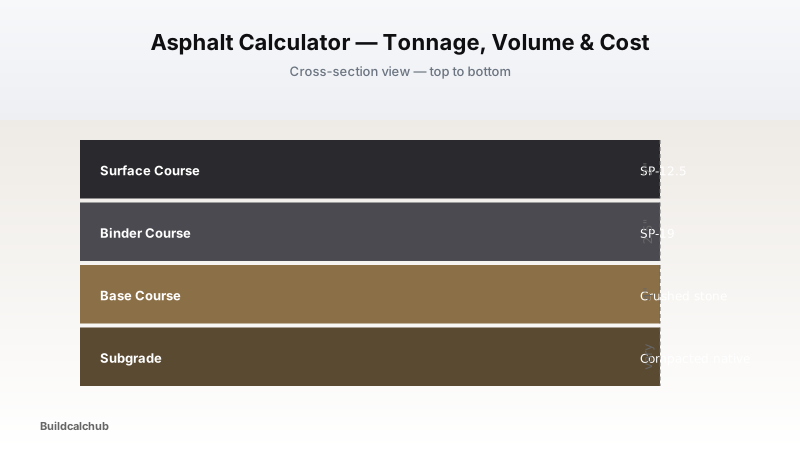
- SP-9.5 (fine-graded, 9.5mm nominal max aggregate) — residential driveways, light parking; smoothest finish; 1.5–2 in lift
- SP-12.5 (intermediate, 12.5mm) — commercial parking, two-car driveways, RV pads; better rut resistance; 2–2.5 in lift
- SP-19.0 (coarse, 19mm) — binder course on roads, highway base layers; 2–4 in lift
- SP-25.0 (coarse, 25mm) — deep highway base on heavy-traffic interstates; 4–6 in lift
- OGFC (Open-Graded Friction Course) — drainage-critical surfaces (airport runways, wet-climate highways); 105–115 lb/ft³ density — use 110 lb/ft³ in this calculator
What Most Online Calculators Get Wrong Reviewed by the Asphalt & Aggregates Review Desk
Most online “asphalt calculators” give one tonnage number that is wrong by 8–25% before you place an order. Four pitfalls cause virtually all of the gap between calculator output and supplier delivery ticket:
- Single-density assumption ignores mix family. 90% of online HMA calculators hardcode 145 lb/ft³ as if it applied to every mix. That's correct only for dense-graded standard HMA. SMA runs 150–152, polymer-modified 148–150, OGFC drops to 105–115, and 100%-RAP recycled mix to 122–128. Picking a mix family at the plant and using 145 anyway gives you a 5–30% tonnage error. Always confirm the density off your supplier's mix design submittal — the calculator above lets you override 145 with the actual value.
- Loose tons quoted, compacted tons calculated. Plant trucks weigh in loose tonnage — the mix as-delivered. The calculator gives compacted tonnage. The ratio is 1.18–1.25 for HMA (NAPA QIP-128). If you order “exactly the calculator output” you'll run short by 18–25% because compaction takes weight that the loose pile doesn't have. The fix is in our compaction rate guide: order compacted tons × 1.20 for HMA, × 1.14 for SMA, × 1.25 for RAP.
- Thermal segregation loss isn't on the bag. Mix that hits the paver at 290°F lays correctly. Mix in the back of an over-haul truck (60+ minute trip) hits the paver at 250°F or below in cold-fringe pockets — that mix won't compact to 92% of theoretical maximum density and 4–8% of the tonnage you paid for is structurally dead weight on the mat. Pittsburgh-area DOT cores from 2022 documented up to 11% density gap from thermal segregation on long-haul HMA. Your fix: spec a transfer machine (Shuttle Buggy / MTV) or limit haul time to 45 min — not in any online calculator but the #1 cause of premature pavement failure.
- Asphalt Institute’s contrarian take on residential HMA spec. Asphalt Institute Director of Engineering Mark Buncher has argued (NAPA 2024 Winter Conference, public session) that most residential driveways are over-specified on surface mix and under-specified on base. The standard residential spec (2 in HMA over 4 in base) routes 60% of the budget to surface work but the base is what carries the load. Spending the same dollar on 6 in base + 1.5 in HMA gives a 15–25% longer service life on most subgrades — not the answer most calculators or contractors will give you.
Hot Mix Asphalt Coverage Table and Material Reference
| Compacted Thickness | ft² per Ton | yd² per Ton | m² per Ton |
|---|---|---|---|
| 1 in | 165 | 18.3 | 15.3 |
| 2 in | 82 | 9.1 | 7.6 |
| 3 in | 55 | 6.1 | 5.1 |
| 4 in | 41 | 4.6 | 3.8 |
| 5 in | 33 | 3.7 | 3.1 |
| 6 in | 27 | 3.0 | 2.5 |
Coverage decreases as thickness increases; thicker lifts trade square footage for structural capacity.
| Use Case | Surface Course | Base Course | Total Compacted |
|---|---|---|---|
| Residential walkway | 1.5 in | 0 in | 1.5 in |
| Single-family driveway | 2 in | 2 in | 4 in |
| Two-car driveway / RV pad | 2 in | 3 in | 5 in |
| Light commercial parking | 2 in | 4 in | 6 in |
| Heavy commercial / truck | 2 in | 6 in | 8 in |
| State highway lane | 2 in | 8 in | 10 in |
Add a 4-6 in compacted aggregate sub-base under all load-bearing pavement.
Real-World Example Calculations
Residential Driveway 20 × 30 ft @ 3 in
Standard suburban single-family driveway, two cars parked end-to-end.
- Length
- 30 ft
- Width
- 20 ft
- Thickness
- 3 in
- Density
- 145 lb/ft³
Takeaway: Plan one half-day pour with one tri-axle delivery (22-ton capacity).
Office Parking Lot 100 × 80 ft @ 4 in
Mid-size office parking with daily passenger-vehicle traffic.
- Length
- 100 ft
- Width
- 80 ft
- Thickness
- 4 in
- Density
- 145 lb/ft³
Takeaway: Schedule 9 truck deliveries; coordinate continuous pour to keep mat temperature above 250°F.
Half-Mile Highway Lane 2,640 × 12 ft @ 6 in
Single 12-ft travel lane, full structural depth on prepared sub-base.
- Length
- 2,640 ft
- Width
- 12 ft
- Thickness
- 6 in
- Density
- 145 lb/ft³
Takeaway: Multi-day project. Order in 24-ton batches; reserve 5% additional for tapers and joint construction.
Step 5 of 6 in the Asphalt Driveway Project Path
- Measure AreaSquare Footage Calculator
- ExcavationExcavation Calculator
- Road BaseCrusher Run Calculator
- ThicknessAsphalt Thickness Calculator
- TonnageHot Mix Asphalt Calculator
- CostAsphalt Cost Calculator
Whole sequence with costs and ordering notes: Asphalt Driveway Project Path.
Sources & Standards
These references are used for terminology, safety boundaries, and engineering assumptions. Local code, supplier specifications, and licensed design documents still control your project.
-
NAPA QIP-128: HMA Construction Quality
National Asphalt Pavement Association
Referenced for 145 lb/ft³ compacted HMA density and waste-factor assumptions used in this calculator.
-
Asphalt Institute MS-22 — Construction of HMA Pavements
Asphalt Institute
Referenced for compaction shrinkage and lift-thickness guidance.
-
AASHTO M323 — Superpave Volumetric Mix Design
AASHTO
Referenced for mix-density range (130–152 lb/ft³) by gradation.
-
FHWA Pavement Performance — Asphalt
Federal Highway Administration
Referenced for long-term-service economics and waste-factor justification.
-
USGS Mineral Commodity Summaries — Asphalt
U.S. Geological Survey
Referenced for liquid-asphalt-binder price trend used in cost outputs.
Frequently Asked Questions
How many tons of asphalt do I need per square foot?
For 3-inch compacted asphalt at 145 lb/ft³ density, you need 0.018 tons per square foot — or about 55 ft² of coverage per ton. The exact ratio depends on thickness: 2 in covers ~82 ft²/ton, 4 in covers ~41 ft²/ton.
What is the standard density of hot-mix asphalt?
Hot-mix asphalt (HMA) compacted in place runs 145 lb/ft³ on average. Specialty mixes range from 130 lb/ft³ (open-graded friction course) to 152 lb/ft³ (stone-matrix asphalt). Loose, uncompacted mix is closer to 105 lb/ft³ — which is why over-ordering by 25% is normal during placement.
Should I order extra asphalt for waste?
Yes — 5% extra on flat work, 10% on transitions and irregular shapes. Suppliers will not credit unused mix, but a return trip for short-pour costs more than the wasted ton. Add another 5% if you are paving on a soft sub-base that may sink during compaction.
How thick should asphalt be for a residential driveway?
For passenger vehicles: 2 inches of surface course over 2 inches of compacted base, total 4 inches. RV pads or trucks need 5–6 inches total. Thinner than 2 inches will crack within one freeze-thaw season.
How does this calculator handle metric units?
Each input has a unit toggle (ft / m / yd for dimensions; in / cm for thickness; lb/ft³ / kg/m³ for density). Switch any input independently and the math re-runs in real time. Results show both tons (US) and cubic yards by default.
What does this calculator NOT include?
It does not include excavation, sub-base aggregate, tack coat, sealing, or labor. For a full project quote use the asphalt cost calculator — it itemises material, labor and overhead.
Why is my supplier’s tonnage estimate higher than this calculator?
Suppliers often add their own waste factor (typically 8–12%), assume a higher density for premium mixes, or include sub-base hauling. Ask for an itemised ticket; the calculator above gives you the in-place compacted tonnage, which is what should match the surface area on the ground.
What is hot mix asphalt and how is it different from regular asphalt?
Hot Mix Asphalt (HMA) is the technical name for what most homeowners call “regular asphalt”. It's aggregate + sand + binder mixed at 275–325°F at a central plant and laid while still 250°F+. The alternative families are Warm Mix Asphalt (WMA) mixed 50°F cooler, polymer-modified HMA for heavy traffic, and cold mix bagged at home centers for pothole emergency repair. The default for any new driveway, parking lot or road is HMA — that's what this calculator assumes (145 lb/ft³ compacted density). See the HMA vs WMA vs Cold Mix comparison table above for the full specification differences.
How much does hot mix asphalt cost per ton in 2026?
2026 US average: $110–$150 per ton for standard HMA picked up at the plant. Polymer-modified HMA runs $170–$210/ton; Stone Matrix Asphalt (SMA) $180–$230/ton. Add 8–12% to those prices for delivered tonnage (haul + driver), and another 8–10% if delivery is <8 tons (short-load surcharge). For installed cost per ton including paver crew + roller pass + tack coat, expect $170–$245/ton across US regions in 2026 — full breakdown in our asphalt paving pillar with regional cost bands.
What temperature does hot mix asphalt need to be placed at?
HMA must arrive at the site above 285°F, be placed at 250°F+, and complete breakdown rolling before the mat cools below 175°F. Ambient conditions: above 50°F surface temp, no rain forecast in next 12 hours, wind below 15 mph (high wind cools the mat too fast). Below 50°F ambient, switch to Warm Mix Asphalt or postpone the pour. Verify the temperature on the supplier truck with a probe thermometer at delivery — mix below 270°F at arrival is grounds for rejection per Asphalt Institute MS-22.
How many tons of hot mix asphalt are in a cubic yard?
At standard 145 lb/ft³ HMA density: 1 cubic yard of compacted HMA = 1.96 tons (27 ft³ × 145 lb/ft³ / 2000 lb/ton). For ordering math: 1 ton of compacted HMA = 0.51 yd³. Loose (uncompacted) tonnage runs ~20% higher because plant trucks weigh in by loose volume — that's the compaction factor the calculator above bakes into the 5% waste default. The full loose-vs-compacted ratio table by mix family lives in our asphalt compaction rate guide.