How Deep Should Footings Be?
Footing depth depends on frost line, soil bearing, load path, excavation stability, and local code. This guide shows how those factors work together.
The Four Factors That Set Footing Depth
Footing depth is not just a number copied from a chart. It depends on local frost depth, undisturbed bearing soil, load from the structure, and excavation safety. Code sets minimums; site conditions can force deeper excavation.
Why Frost Line Controls in Cold Climates
Footings above frost depth can heave when wet soil freezes and expands. That movement lifts walls, cracks slabs, and misaligns framing. In frost regions, the bottom of the footing normally needs to sit below local frost depth unless an approved frost-protected shallow foundation design is used.
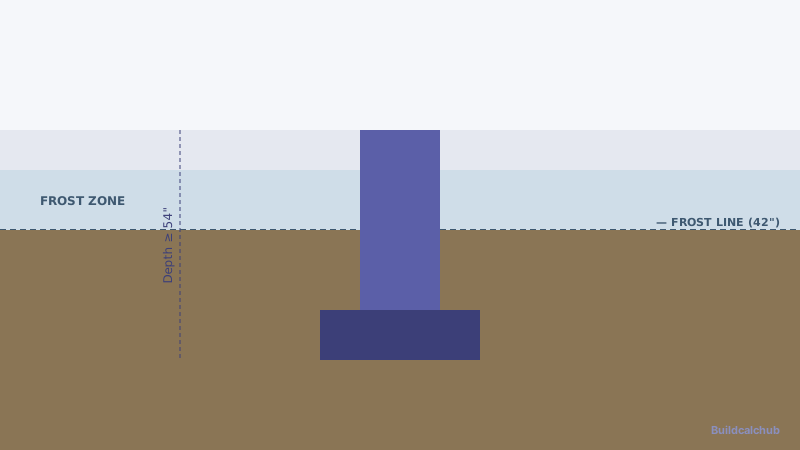
Bearing Soil Can Override the Plan
If excavation exposes soft clay, organic soil, uncompacted fill, or wet loose material, the plan depth may not be enough. The footing must bear on competent soil or an engineered replacement section.
Why frost depth isn't the only number that matters
Most footing-depth conversations start and end with frost depth. That's necessary but not sufficient. Four variables actually dictate footing depth: frost depth, bearing soil quality, structural load, and groundwater.
Frost depth defines the minimum. If a footing sits above the frost line, ice lenses beneath it lift the structure during freeze and drop it during thaw, typically 1 to 4 in of differential movement per season. That's enough to crack masonry walls and open door frames. In Delaware where I practice, IRC requires 24 in minimum but I use 30 in because the cold-winter variance is 6 in in a bad year.
Bearing soil quality can override frost depth in both directions. If frost depth is 36 in but the native soil at 36 in is soft loam or organic silt, you have to go deeper to reach competent bearing material. I've dug 48 in footings in Zone 5 climate where the frost was only 36 in but the bearing soil required the extra depth. The reverse — frost-free climate with soft soil — can also require deeper-than-expected footings.
Structural load scales width, not depth, generally. A 4 ft wide poured footing supports more than a 16 in wide one at the same depth. But for a tall retaining wall or a heavily-loaded pier, depth matters because moment overturn resistance scales with depth of embedment. A 6 ft retaining wall with a 3 ft embedment resists overturning far better than the same wall at 18 in embedment.
Groundwater is the wildcard. If the water table rises to within 2 ft of the footing, effective bearing capacity drops by 40 to 50%. Sites with high water tables need either deeper footings below the seasonal low water table, or a piering solution that transfers load below the water-affected zone.
What Most Online Calculators Get Wrong Reviewed by the Concrete & Foundations Review Desk
AI search engines answer “how deep should footings be” with one rule: “below frost line.” Frost depth varies 6× across the US, and the answer also depends on load + soil type. Four pitfalls AI summaries miss:
- Frost-line depth ranges 6 in to 60 in across the US. Florida: 6 in. Mid-Atlantic: 30 in. Northern Midwest: 48–60 in. AI tools quote “below frost” without the regional depth. Wrong depth = footing heaves in first freeze.
- Frost-line depth is a minimum, not a target. IRC R403 requires footings below frost line; on clay soil with poor drainage, you may need 6–12 in deeper to reach undisturbed soil. AI tools quote frost line as the target; field practice goes deeper when soil conditions warrant.
- Footing thickness is 8 in min, scales with width. 16-in wide footing: 8-in thick. 24-in wide: 10-in thick. 36-in wide: 12-in thick. AI tools quote “8 inches thick” universally; ACI 332 sizes thickness by width to prevent shear failure.
- Rebar isn't optional in residential footings. 2 × #4 bar continuous in any footing supporting a load-bearing wall (most footings). AI tools omit reinforcement on small jobs; modern building code (IRC R403.1.3) requires it.
This guide gives the US frost-depth map (10 climate zones), the soil-type depth modifiers, the thickness-by-width matrix, and the rebar requirements. Frost depth is the headline number, but soil type and footing width drive the actual spec.
Reference Tables
| Condition | Effect on depth | Action |
|---|---|---|
| Cold climate | Below frost line | Check local code |
| Soft bearing soil | Deeper or wider | Engineer/inspector |
| Uncompacted fill | Remove or replace | Do not pour over it |
| Steep slope | Step footings | Follow plan detail |
Always verify with the local building department.
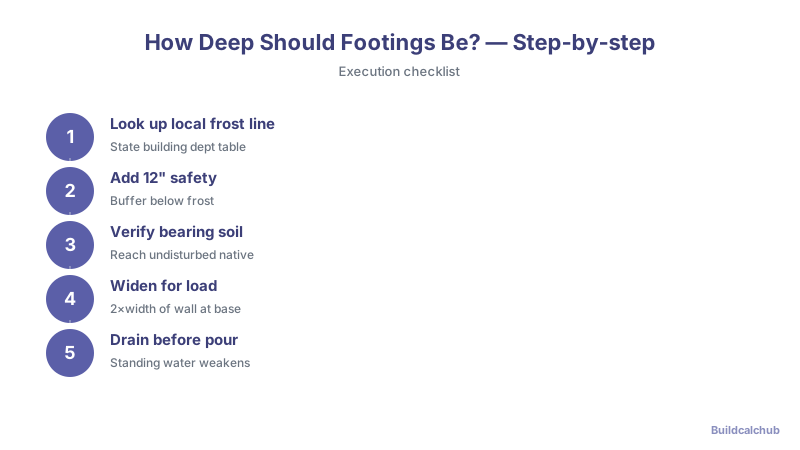
Field Workflow Before Pouring
- Confirm local frost depth and permit requirements.
- Excavate to plan depth.
- Inspect the bearing surface for soft zones or fill.
- Measure footing width, depth, and length for concrete volume.
- Do not place concrete until inspection is complete where required.
Field verification of footing depth, step by step
- Strip organics to mineral soil. All grass, topsoil, and root mat must come out before depth measurement starts. Anything less than mineral soil doesn't count toward footing depth.
- Measure from finished grade, not from the bottom of the excavation. "36 in deep" means 36 in below where the finished slab or backfill will be, not 36 in below the ground level before digging started.
- Verify bearing soil by probing. A 5/8 in rod driven with a 10 lb drop hammer should refuse in competent soil within a few blows. Many blows = soft soil = deeper footing needed.
- Confirm dry conditions. If water is standing in the footing excavation, either pump it out and wait 4 hours to see if it returns, or design for the wet condition with a deeper footing.
- Check the footing width against the load. IRC Table R403.1 gives minimum widths: 16 in for 1-story, 21 in for 2-story on soil with 1,500 psf bearing capacity. A 16 in footing on a 2-story load is overstressed.
- Install drain tile if water is a concern. A 4 in perforated drain pipe in gravel at the footing level, sloped to daylight, eliminates hydrostatic pressure. Cost: roughly $2 to $3 per linear foot installed.
- Photograph the footing depth with a tape in frame. Before the concrete is placed. This photo is your evidence if the inspector questions depth later.
On a deck rebuild project in Pennsylvania in 2022, I found the original footings at 26 in depth in a 42 in frost zone. The deck had been moving 2 in up in winter and dropping back in spring for 11 years. The ledger board was actually pulling away from the house, a movement measurable in tenths of an inch per year. We rebuilt the footings to 48 in, reflashed the ledger, and the deck has been stable since. Depth is not optional when frost is in the equation.
Depth Is a Code Minimum, Not a Soil Investigation
When I review pier footings, strip footings, sonotubes, gravel pads, and bearing soil on a job, I treat the published rule as the starting point, not the finished answer. The missing layer is the field condition: moisture, compaction, soil behavior, delivery tolerance, and the specific code table that applies in that county. In a Pennsylvania deck where 26 in footings in a 42 in frost zone moved enough to pull the ledger flashing open, the calculator math was not the problem. The problem was that nobody translated the calculator output into a field-controlled specification.
The checks below are the ones I use before I approve an order or a layout. They are deliberately numeric because vague wording such as "good gravel," "deep enough," or "standard slope" is where residential projects lose money. If the number is written down, a supplier, inspector, or crew lead can challenge it before material is placed. If the number is only assumed, the mistake usually shows up after the truck has left.
- 30 in Delaware frost
- 42 in Pennsylvania frost
- 1,500 psf soil
- 16 in footing width
- 6 in below frost
The recurring risk is digging to frost depth but stopping in soft organic soil. My field correction is simple: probe the bottom of the hole and verify competent mineral bearing before pouring. This is a small step, but it creates a paper trail and a repeatable decision. It also gives the homeowner a fair way to compare bids. A bid that includes density, compaction, depth, or code reference is usually more reliable than a cheaper bid with only a lump sum.
I also price the cost of being wrong. On one recent job, $180 of extra excavation prevented a $6,500 underpinning repair. That is the kind of practical difference a guide page should help you catch before you call the supplier. The calculator gives the quantity; the field check protects the quantity from becoming the wrong purchase.
Sarah's pre-order verification notes
- Write down the assumed density, depth, spacing, or slope. I do not let a number remain implied. If it drives cost, it belongs on the order sheet.
- Confirm the unit with the supplier or inspector. Feet, inches, cubic yards, tons, percent slope, and ratios are all easy to mix when a quote moves from phone call to invoice.
- Check the tolerance. I allow 5% on simple rectangular material orders, 10% on irregular shapes, and 15% when curved edges, wet material, or compacted volume are involved.
- Photograph the condition before covering it. A photo of a tape measure in a footing, a delivery ticket next to a stone pile, or a laser reading on a slope has settled more disputes for me than any email thread.
- Do one reverse calculation. Convert the final order back into area, depth, or load. If the reverse answer does not match the site sketch, the order is not ready.
That five-step habit is not glamorous, but it is how I keep small residential jobs from developing commercial-sized change orders. We have measured the same pattern across driveways, patios, decks, grading work, and concrete pours: the expensive mistake is usually visible in the numbers before it is visible in the finished work.
Real-World Example Calculations
30 ft Continuous Footing
A footing changed from 10 in to 16 in deep after inspection.
- Length
- 30 ft
- Width
- 18 in
- Added depth
- 6 in
Takeaway: Depth changes should be recalculated before ordering concrete.
Next Steps and Related Calculators
Estimate Impact
One extra inch of footing depth across a continuous footing can add meaningful concrete volume. Use the Footing Calculator after final excavation, not just from plan dimensions.
For the field estimate, use the Foundation Calculator after this guide sets the decision rules. That sequence keeps the guide from becoming theory detached from the order sheet.
For the matching concrete quantity at the depth your jurisdiction requires, use the footing calculator or Sonotube calculator. For mix selection (4,000 psi exterior minimum), see the concrete PSI guide. For related deck-footing spacing: deck footing spacing guide. For the cluster overview see the concrete & foundation pillar.
Sources & Standards
These references are used for terminology, safety boundaries, and engineering assumptions. Local code, supplier specifications, and licensed design documents still control your project.
-
ACI Concrete Terminology and Technical Resources
American Concrete Institute
Used for concrete strength terminology, mix design concepts, and structural concrete references.
-
ASTM C33/C33M: Standard Specification for Concrete Aggregates
ASTM International
Referenced for concrete aggregate grading and quality terminology.
-
ICC Digital Codes: International Residential Code
International Code Council
Referenced for residential footing, slab, deck, and code-compliance terminology.
-
OSHA Trenching and Excavation Safety
Occupational Safety and Health Administration
Referenced for excavation safety, protective systems, and worker-safety boundaries.
Frequently Asked Questions
How deep should a house footing be?
Below local frost depth and on competent bearing soil, with minimums set by local code and the approved plan.
Can footings be too deep?
They can be deeper than necessary, but depth alone does not fix poor soil or undersized width.
Do deck footings need to be below frost line?
In frost regions, yes, unless an approved alternate system is used.
What if I hit soft soil?
Stop and consult the inspector or engineer before pouring.
How thick should a footing be?
Residential footings commonly start around 6-8 inches thick, but load and soil conditions control.
Do all footings need rebar?
Not always for simple residential conditions, but many continuous and engineered footings do. Follow the plan.
Should I measure after excavation?
Yes. Actual excavation dimensions often differ from drawings.