Concrete Slab Calculator — Thickness, Yards and Rebar for Flatwork
Built for flatwork slabs—patios, garage floors and driveways—with thickness presets, cubic yards and an integrated rebar grid takeoff.
Concrete Slab Calculator
Enter project dimensions below — results update instantly. Switch units freely.
Estimates assume typical industry density and waste factors. Always verify with your supplier and local building code before purchasing material.
Why Concrete Slab Calculator Estimates Go Wrong
‘4 inches is standard.’ That rule comes from 1940s residential construction and still works for patios and walkways — but it's the wrong answer for anything carrying a truck, trailer, or heavy equipment.
Slab thickness by actual load:
- Patio, walkway — foot traffic only — 3-4 inches
- Residential driveway — passenger vehicles — 4-5 inches
- Garage floor — typical cars + storage — 4-5 inches
- Garage floor with lift / workshop — 5-6 inches
- RV pad, boat trailer — 6 inches
- Heavy equipment, dump truck — 6-8 inches with rebar
Every extra inch adds ~25% material cost but quadruples the point-load capacity. Err thicker on garage floors — the difference between 4 and 5 inches is $200 on a typical slab, and it prevents the spider-web cracks that show up under engine-hoist point loads.
How to Calculate Concrete Slab Calculator
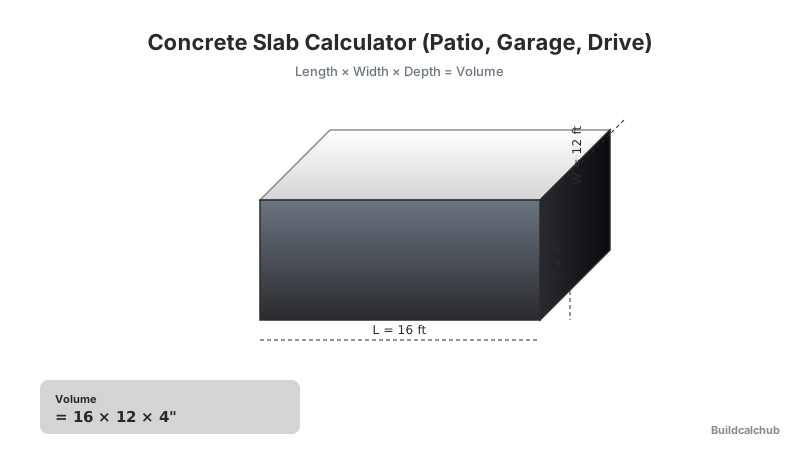
Plain concrete is strong in compression (crushing) but weak in tension (bending). Slabs crack because something pulls them apart — shrinkage during cure, thermal expansion, settling subgrade, or point loads.
Reinforcement options, cheapest to most expensive:
- Fiber mesh (+$8-12 per yd³) — chopped polypropylene fibers mixed in. Controls shrinkage cracks, does nothing for structural loads.
- Wire mesh (6×6 W1.4/W1.4, +$0.25-0.40 per ft²) — holds cracks together once they form. Minimum spec for any slab >100 ft².
- Rebar grid (#4 at 16–24 in o.c., +$0.50-1.00 per ft²) — structural reinforcement. Spec'd for driveways, garage floors, anything carrying vehicle loads.
- Post-tensioned (+$1.50-3.00 per ft²) — cables tensioned after cure. Commercial and foundation slabs only.
Rule of thumb: residential patios get fiber + wire mesh; driveways and garage floors get #4 rebar at 16 in on-center. Don't let a contractor skip rebar on a driveway to save $200 — the crack repair bill will be $2,000.
Once the Concrete Slab Calculator result looks reasonable, cross-check the next job decision with the Concrete Calculator and the Cement Calculator. If the slab is a sidewalk or walking path (vs a garage / patio), the concrete sidewalk calculator adds the ACI 332 joint-spacing and ADA cross-slope checks that flatwork-only calculators don't surface. For dead-load checks on retrofit slabs and countertops over existing framing, run the concrete weight calculator — it computes lb per cubic foot, lb per square foot and total tons per ASTM C138 + IBC 1604.3. That keeps the quantity, cost, and field assumption tied together before you call a supplier.
What Most Online Calculators Get Wrong Reviewed by the Concrete & Foundations Review Desk
AI calculates slab concrete as L×W×D. Four pitfalls AI summaries hide:
- Thickness drives life, not just volume. 4 in slab = 25-yr residential life. 5 in = 35 yr. 6 in = 50 yr. AI defaults 4 in; the right thickness is application-specific.
- Wire mesh / rebar required. #3 rebar @ 18-in OC OR 6×6 W1.4 wire mesh for any slab. AI tools omit reinforcement.
- 4,000+ psi minimum for exterior. Freeze-thaw exposed = 4,000+ psi air-entrained. AI defaults 3,000.
- Joint spacing 24–36× thickness in feet. 4-in slab: control joints @ 8–12 ft OC. AI rarely surfaces joints.
This calculator outputs slab volume + wire mesh / rebar + concrete cost + joint layout. A slab is 4 line items: concrete + reinforcement + PSI spec + joints — AI's volume-only answer misses 75%.
Concrete Slab Coverage Table and Material Reference
| Use | Min. Thickness | Reinforcement | Target PSI |
|---|---|---|---|
| Walkway | 3 in | Fiber mesh | 3,000 psi |
| Patio | 4 in | Fiber + 6×6 wire | 3,000 psi |
| Sidewalk | 4 in | 6×6 wire mesh | 3,500 psi |
| Residential driveway | 5 in | #4 rebar 24 in o.c. | 4,000 psi |
| Garage floor | 5 in | #4 rebar 16 in o.c. | 4,000 psi |
| Workshop / lift area | 6 in | #4 rebar 12 in o.c. | 4,500 psi |
| RV / boat pad | 6 in | #5 rebar 12 in o.c. | 4,500 psi |
| Commercial loading | 8 in+ | Engineered design | 5,000+ psi |
PSI = compressive strength at 28 days. Ready-mix plants quote by PSI; specify when ordering.
| Slab Dimensions | Square Feet | Cubic Yards | Cost @ $165/yd³ |
|---|---|---|---|
| 8 × 10 ft | 80 | 0.99 | $163 |
| 10 × 10 ft | 100 | 1.23 | $203 |
| 12 × 12 ft | 144 | 1.78 | $294 |
| 14 × 14 ft | 196 | 2.42 | $399 |
| 16 × 20 ft | 320 | 3.95 | $652 |
| 20 × 20 ft | 400 | 4.94 | $815 |
| 24 × 24 ft | 576 | 7.11 | $1,173 |
| 30 × 40 ft | 1,200 | 14.81 | $2,444 |
Add 10% waste and 5-10% for thicker sections (turned-down edges, integral footings).
Real-World Example Calculations
Backyard Patio 14 × 14 ft @ 4 in
Stamped concrete patio with decorative border, fiber + wire mesh reinforcement.
- Length × Width
- 14 × 14 ft
- Thickness
- 4 in
- $/yd³
- $170
Takeaway: Add $0.30/ft² for wire mesh ($59) and $300-400 for stamp pattern rental. Total DIY cost ~$900.
Two-Car Garage Slab 24 × 24 ft @ 5 in
Detached garage floor over compacted gravel base with vapor barrier.
- Length × Width
- 24 × 24 ft
- Thickness
- 5 in
- $/yd³
- $165
Takeaway: One ready-mix truck. Add rebar grid $400-550, vapor barrier $90, isolation joints $60. Total ~$2,100.
RV Pad 12 × 45 ft @ 6 in
Heavy-duty concrete pad for 35-ft Class A motorhome.
- Length × Width
- 12 × 45 ft
- Thickness
- 6 in
- $/yd³
- $175
Takeaway: One full-truck delivery. Spec 4,500 psi mix + #5 rebar grid for jack-pad loading.
Step 4 of 6 in the Concrete Patio Project Path
- AreaArea Calculator
- ExcavationExcavation Calculator
- Gravel BaseGravel Calculator
- Slab VolumeConcrete Slab Calculator
- ReinforcementRebar Calculator
- PSIConcrete PSI Guide (3,000 / 4,000 / 5,000 psi)
Whole sequence with costs and ordering notes: Concrete Patio Project Path.
Sources & Standards
These references are used for terminology, safety boundaries, and engineering assumptions. Local code, supplier specifications, and licensed design documents still control your project.
-
ACI 318-19 — Building Code Requirements for Structural Concrete
American Concrete Institute
Cited for the structural concrete design code that governs slab, footing, column, and reinforcement requirements.
-
ACI 332-20 — Residential Code Requirements for Structural Concrete
American Concrete Institute
Cited for residential-scale concrete requirements (footings, slabs, walls) referenced throughout the IRC.
-
ASTM C94/C94M-23 — Standard Specification for Ready-Mixed Concrete
ASTM International
Cited for ready-mix concrete delivery, batching, and short-load practice.
-
ASTM C150/C150M-22 — Standard Specification for Portland Cement
ASTM International
Cited for cement type classification (Type I, I/II, III, V) used in mix design.
-
2021 International Residential Code, Chapter 4: Foundations
International Code Council
Cited for residential frost-line footing depth, slab thickness, and reinforcement requirements.
Frequently Asked Questions
How thick should a concrete slab be?
For patios: 4 inches. Residential driveways: 4-5 in. Garage floors: 5 in. RV pads: 6 in. Always match thickness to the heaviest expected load, not the average load.
Do I need rebar in a concrete slab?
For driveways, garage floors, and anything carrying vehicles: yes, #4 rebar at 16-24 in on center. Patios and walkways can use fiber mesh or wire mesh instead of rebar. Plain concrete (no reinforcement) is only appropriate for unloaded slabs under 100 ft².
What is the best PSI concrete for a slab?
Patios: 3,000-3,500 psi. Driveways and garage floors: 4,000 psi. Heavy loading (RV, commercial): 4,500-5,000 psi. PSI refers to 28-day compressive strength; higher PSI costs more but resists cracking better.
How much does a concrete slab cost installed?
Residential concrete slabs run $6-12 per square foot installed. Breakdown: $2-3 material, $3-5 labor, $1-3 base prep, $1-2 reinforcement. Stamped or colored concrete adds $3-8 per ft².
Should concrete have control joints?
Yes — every slab needs control joints to force cracks into predictable locations. Spacing rule: 30× slab thickness in feet, maximum 15 ft. A 4-inch slab needs joints every 10 feet; a 5-inch slab every 12.5 feet. Cut joints within 12 hours of placement, 1/4 of slab thickness deep.
How long before I can drive on a new concrete slab?
For passenger vehicles: 7 days. For heavy loads (RV, truck): 14 days. Concrete reaches 70% of design strength at 7 days and 100% at 28 days. Foot traffic is OK after 24 hours; bike / light wheelbarrow after 48 hours.
Does a concrete slab need a vapor barrier?
For any slab inside a building (garage, basement, shed floor): yes — 10-mil polyethylene under the slab. Prevents ground moisture from wicking up through the concrete and damaging stored items or flooring. Exterior slabs (patios, driveways) don't need vapor barrier.