Concrete Block Calculator for CMU Blocks, Mortar Bags and Wall Area
Count concrete masonry units (CMU), mortar bags, and wall area for block walls — basement, retaining, garden, or structural — at typical 8×8×16 in nominal block size.
Concrete Block Calculator
Enter project dimensions below — results update instantly. Switch units freely.
Estimates assume typical industry density and waste factors. Always verify with your supplier and local building code before purchasing material.
Why Concrete Block Calculator Estimates Go Wrong
Concrete Masonry Unit (CMU) walls are built from hollow concrete blocks bonded with mortar. They compete with poured concrete walls for basement foundations, retaining walls, and commercial buildings.
CMU wins when:
- No ready-mix access — remote sites or limited truck access
- DIY or small crew — no form set-up; two workers and a trowel
- Phased construction — build 4 courses today, 4 more next weekend
- Simple rectangular walls — no complex geometry
Poured concrete wins when:
- Speed — one pour vs. days of laying blocks
- Waterproofing — poured walls have no joints to seal
- Straight walls in one pour — less labor per linear foot above a certain project size
- Heavy engineered loads — easier to reinforce and vibrate for density
Cost: CMU typically runs $12-18 per ft² of wall installed; poured concrete $15-22 per ft². CMU slightly cheaper for DIY; poured cheaper for professional crews.
How to Calculate Concrete Block Calculator
Block Area (8×16 in) = 128 in² = 0.89 ft²
Coverage rule for standard 8×8×16 in blocks:
- 1 block covers 0.89 ft² of wall (with 3/8-in mortar joints)
- ~1.125 blocks per ft² of wall area
- A 4-ft course contains 3 blocks of length + 1/8 block for the corner
Mortar requirements:
- One 80-lb bag of Type N mortar mix yields ~1.0 ft³ of mortar
- Standard 8×8×16 blocks use ~1/30 ft³ of mortar per block (joints + bed)
- Therefore: 1 bag lays ~30 blocks
- Round up for spillage: order 1 bag per 25 blocks for safety
Once the Concrete Block Calculator result looks reasonable, cross-check the next job decision with the Retaining Wall Calculator and the Foundation Calculator. That keeps the quantity, cost, and field assumption tied together before you call a supplier.
For related concrete work: the concrete calculator handles general L×W×D volume, the concrete slab calculator handles slab-specific output, and the concrete PSI guide covers mix selection (3,000 vs 4,000 vs 5,000 psi). For the cluster overview see the concrete & foundation pillar.
What Most Online Calculators Get Wrong Reviewed by the Concrete & Foundations Review Desk
AI calculates block count as (wall area ÷ block face area). Four pitfalls AI summaries hide:
- Mortar joints add 3/8 in to each block dimension. 8×16 nominal block = 7-5/8 × 15-5/8 actual with 3/8-in mortar joint = 8 × 16 in installed. AI tools sometimes use actual not installed dimensions.
- Mortar quantity: 1 bag per 25–30 blocks (type S). AI rarely surfaces mortar. 100 blocks = 3.5–4 bags of mortar mix.
- Rebar + grout fill required for load-bearing walls. #4 vertical bar every 32 in OC, filled cells with grout. AI omits reinforcement; structural code requires it.
- Corner blocks + half blocks at openings. Each corner takes 1 corner block (premium price). Each opening needs half blocks. AI assumes all standard blocks; corners + openings are 10–15% of count at premium pricing.
This calculator outputs block count + mortar bags + rebar feet + grout volume, with corner / opening corrections. Concrete block work is 4 line items, not 1.
Concrete Block Coverage Table and Material Reference
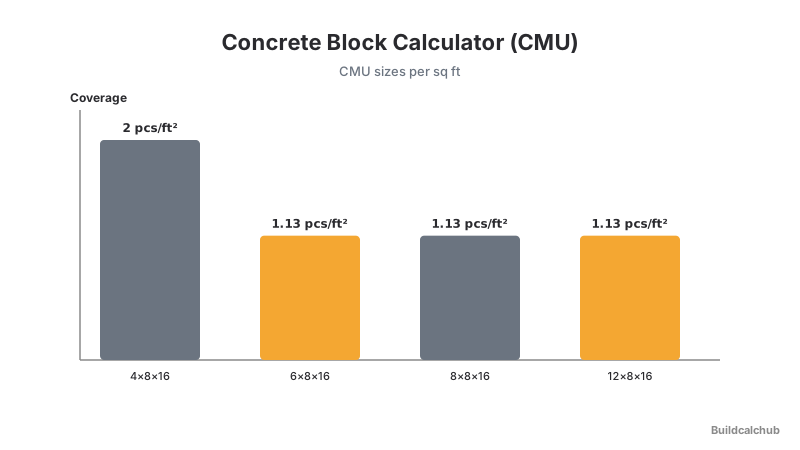
| Nominal Size | Actual Size | Coverage per Block | Blocks per ft² |
|---|---|---|---|
| 4×8×16 (half) | 3⅝×7⅝×15⅝ | 0.89 ft² | 1.125 per ft² |
| 6×8×16 | 5⅝×7⅝×15⅝ | 0.89 ft² | 1.125 per ft² |
| 8×8×16 (standard) | 7⅝×7⅝×15⅝ | 0.89 ft² | 1.125 per ft² |
| 10×8×16 | 9⅝×7⅝×15⅝ | 0.89 ft² | 1.125 per ft² |
| 12×8×16 | 11⅝×7⅝×15⅝ | 0.89 ft² | 1.125 per ft² |
| 8×8×8 (half block) | 7⅝×7⅝×7⅝ | 0.45 ft² | 2.25 per ft² |
| 8×4×16 (cap) | 7⅝×3⅝×15⅝ | 0.45 ft² | 2.25 per ft² |
Block face area is same for all 8-in heights; differ only in wall depth. Block names use nominal (including 3/8-in mortar); actual size is 3/8-in smaller.
| Wall Type | Block Size | Rebar | Grout |
|---|---|---|---|
| Garden / ornamental (< 3 ft) | 6×8×16 | None required | Optional |
| Retaining wall (3-4 ft) | 8×8×16 | #4 @ 48 in vertical | Grout fill at rebar cells |
| Retaining wall (4-6 ft) | 8×8×16 or 10×8×16 | #4 @ 32 in vertical | Grout all cells |
| Basement wall (7-8 ft) | 8×8×16 or 10×8×16 | #4 @ 24 in vertical | Grout alternating cells |
| Structural wall (load-bearing) | 8×8×16 or 10×8×16 | Engineered | Engineered |
Grout = flowable concrete used to fill hollow CMU cells with rebar. Typically 2,500 psi pumpable mix.
Real-World Example Calculations
Garden Wall 20 × 3 ft, standard CMU
Decorative garden wall along property line.
- Wall length
- 20 ft
- Wall height
- 3 ft
- Block
- 8×8×16 in
- Waste
- 5%
Takeaway: Weekend DIY project. 4 blocks high × 15 blocks long. Cost ~$200 blocks + $50 mortar.
Basement Walls 30 × 8 ft, 8×8×16
Full basement wall, 8 ft tall, alternating-cell grouted.
- Wall length
- 140 ft perimeter
- Wall height
- 8 ft
- Block
- 8×8×16 in
- Waste
- 5%
Takeaway: 2-3 masons × 2-3 days. Include grout pump for filling rebar cells.
Retaining Wall 40 × 5 ft, 10×8×16
Full-height retaining wall along driveway grade change.
- Wall length
- 40 ft
- Wall height
- 5 ft
- Block
- 10×8×16 in
- Waste
- 5%
Takeaway: Add grout fill (~12 yd³) for all cells; retaining walls require full reinforcement and drainage.
Step 4 of 5 in the Retaining Wall Project Path
- Wall SizeRetaining Wall Calculator
- ExcavationExcavation Calculator
- Drainage StoneCrushed Stone Calculator
- CMU OptionConcrete Block Calculator
- DrainageRetaining Wall Drainage Guide
Whole sequence with costs and ordering notes: Retaining Wall Project Path.
Sources & Standards
These references are used for terminology, safety boundaries, and engineering assumptions. Local code, supplier specifications, and licensed design documents still control your project.
-
ACI 318-19 — Building Code Requirements for Structural Concrete
American Concrete Institute
Cited for the structural concrete design code that governs slab, footing, column, and reinforcement requirements.
-
ACI 332-20 — Residential Code Requirements for Structural Concrete
American Concrete Institute
Cited for residential-scale concrete requirements (footings, slabs, walls) referenced throughout the IRC.
-
ASTM C94/C94M-23 — Standard Specification for Ready-Mixed Concrete
ASTM International
Cited for ready-mix concrete delivery, batching, and short-load practice.
-
ASTM C150/C150M-22 — Standard Specification for Portland Cement
ASTM International
Cited for cement type classification (Type I, I/II, III, V) used in mix design.
-
2021 International Residential Code, Chapter 4: Foundations
International Code Council
Cited for residential frost-line footing depth, slab thickness, and reinforcement requirements.
Frequently Asked Questions
How many concrete blocks do I need?
For standard 8×8×16 in CMU: 1.125 blocks per square foot of wall area. A 20 × 8 ft wall = 160 ft² = ~180 blocks. Always add 5% for breakage and cutting waste.
How much does a concrete block cost?
In 2026: $1.75-3.00 per standard 8×8×16 block at big-box stores. Specialty blocks (corner, half, end-cap) cost more. Delivery adds $100-200 for 100+ block orders. Buying by the pallet (~90 blocks) is cheapest.
How much mortar per concrete block?
For standard 8×8×16 blocks: ~1 cubic foot of mortar per 30 blocks — or roughly 1 bag of 80-lb Type N mortar mix per 25-30 blocks. Order 25% extra for spillage.
What mortar do I use for concrete blocks?
Type N for general above-grade applications (garden walls, partitions). Type S for below-grade and heavy-load applications (retaining walls, basement walls). Type M for the heaviest structural walls. Premixed bagged mortar labeled with these types is available at most home centers.
How long does it take to build a concrete block wall?
Experienced mason: 200-300 blocks per day. DIY: 100-150 per day. For a 20 × 8 ft basement section (180 blocks), allow 1 day professional or 2 weekend days DIY. Slow rate for first-time masons; improve dramatically by day 3.
Do I need to fill concrete blocks with concrete?
Only where rebar is placed. Standard practice: fill cells containing vertical rebar with pumpable grout; leave other cells hollow. Fill every cell (solid-filled CMU) only for heavy structural loading or fire ratings. Full-filled walls require grout ≈ 1 yd³ per 150 ft² of wall.
How high can a concrete block wall be built?
Unreinforced: up to 4 ft. Reinforced with vertical rebar and grouted cells: up to 10 ft residential, higher with engineering. Retaining walls above 4 ft always require engineering sign-off. Don't exceed these heights without engineer verification.