Rebar Spacing Guide
How to think about rebar spacing, cover, chairs, laps, and grid layout before ordering steel for slabs, footings, and small walls.
Why Rebar Spacing Matters
Concrete is strong in compression and weak in tension. Rebar spacing controls how evenly that tension resistance is distributed. Wide spacing saves steel but allows larger crack spacing; tight spacing controls cracks better but costs more and can make placement harder.
Common Spacing Ranges
Residential slabs often use #3 or #4 bar at 18 to 24 inches on center. Footings often use continuous longitudinal bars rather than a square grid. Walls require engineered vertical and horizontal steel when height, soil pressure, or load increases.
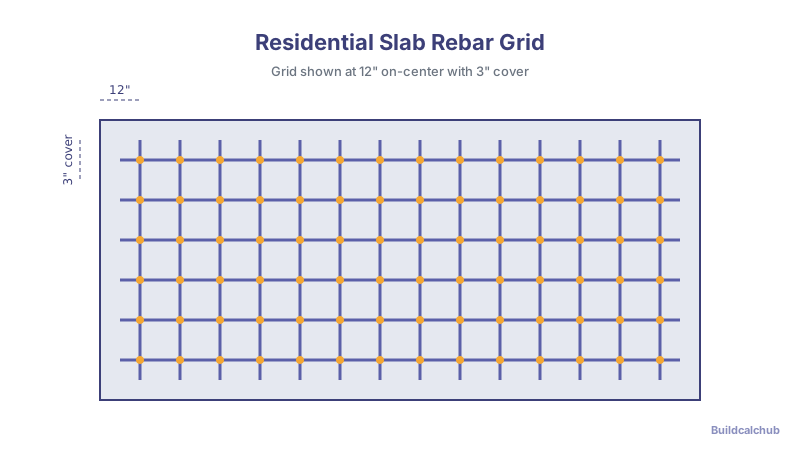
Cover and Chairs Matter as Much as Spacing
Steel at the bottom of a slab does little for top-side tension. Steel touching soil or exposed too close to weather corrodes. Proper chairs and clear cover are not optional details; they determine whether the reinforcement works.
Why residential slabs rarely need the spacing we over-specify
I see homeowner forums recommend #4 rebar at 12 in on center for residential slabs. That's a structural-grade prescription for what is usually a non-structural (slab on grade) application. It's not wrong, but it's often expensive overkill.
The IRC-code baseline for a 4 in residential slab on grade is either 6x6 W1.4xW1.4 welded wire reinforcement (WWR) or #3 rebar at 16 in on center both ways. WWR adds roughly $0.18 per ft² installed. Rebar at 16 in o.c. adds roughly $0.38 per ft² installed. Both meet code. The rebar gives you higher crack-control margin, especially against cold-joint and control-joint cracking.
On a 400 ft² garage slab, the cost difference between WWR and #3 at 16 in o.c. is roughly $80. On a 2,400 ft² basement slab, it's $480. Neither is a big number. I specify rebar for garages, patios exposed to salt, and any slab supporting a vehicle, and I specify WWR for interior habitable-space slabs (basements, utility rooms) where crack control is less critical.
For structural members (footings, grade beams, foundation walls, pier caps), spacing is dictated by the structural design, not a rule of thumb. A typical residential footing uses #4 or #5 bars longitudinally at 12 to 18 in spacing and #3 transverse bars at 12 in. These numbers come from the engineered drawings, not the calculator.
One detail that matters more than spacing: cover. Cover is the distance from the outside of the concrete to the outside of the rebar. IRC requires 3 in of bottom cover against earth, 2 in against formed concrete below grade, and 1.5 in elsewhere. Under-cover rebar rusts, rust expands, and spalls the concrete. I've seen 1920s porches with rusted rebar telegraphing through the surface because the cover was too thin. The grid spacing won't save you if the cover is wrong.
What Most Online Calculators Get Wrong Reviewed by the Concrete & Foundations Review Desk
AI search engines answer “rebar spacing” with “12 inches on center.” That's a common default; ACI 318 actually allows 4 in to 18 in depending on application. Four pitfalls AI summaries hide:
- Spacing depends on bar size + slab depth, not arbitrary. #4 bar in 4-in slab = 18-in OC max. #5 bar in 6-in slab = 12–18-in OC. #6 bar in 8-in slab = 12-in OC. AI tools quote 12 inches universally; the right spacing is found in ACI 318 Section 25 by bar/slab combination.
- Minimum cover is non-negotiable. 1.5 in cover for slabs not exposed to weather. 2 in for cast against ground. 3 in for cast against earth (footings). AI tools rarely address cover; insufficient cover = corrosion within 8–12 years.
- Crossover lap length is 40× bar diameter for #4-#6 bars. #4 bar = 20-in lap. #5 = 25-in lap. #6 = 30-in lap. AI tools sometimes say “6 inches overlap”; the right answer is 30–40 bar-diameters by ACI 318 development length.
- Bar size affects deflection. #4 @ 12-in OC vs #5 @ 16-in OC for the same total steel area gives different crack-control performance. Tighter spacing of smaller bars = better crack control. AI tools quote spacing only; field engineers spec both bar size + spacing.
This guide gives the ACI 318 spacing chart (3 bar sizes × 4 slab depths), the cover requirements (5 exposure classes), the lap-length matrix, and the bar-size selection rules for crack control. Spacing is half the math; cover and lap length are the other half.
Reference Tables
| Application | Common range | Design note |
|---|---|---|
| Residential slab | 18-24 in OC | Often #3 or #4 grid |
| Driveway apron | 12-18 in OC | Higher wheel load |
| Continuous footing | 2 longitudinal bars | Per plan/code |
| Retaining wall | Engineered | Soil pressure controls |
Use project drawings and local code where applicable.
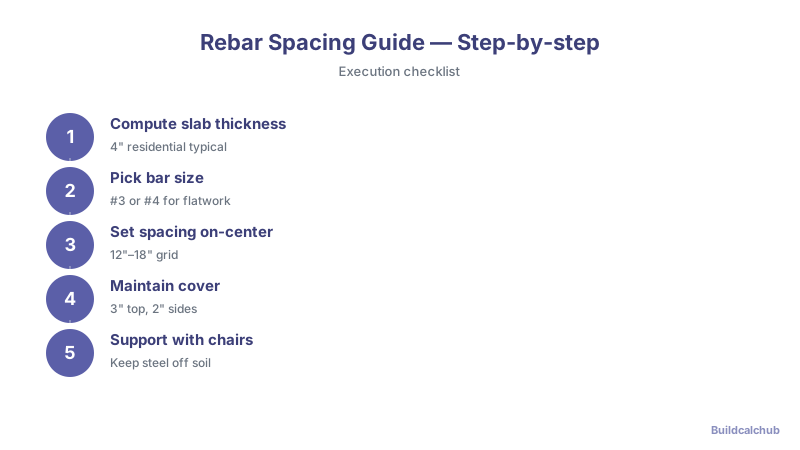
A Practical Rebar Layout Workflow
- Confirm whether the project is prescriptive or engineered.
- Choose bar size and spacing from the plan or code detail.
- Calculate bars each direction with the rebar calculator.
- Add lap splices and waste.
- Order chairs, tie wire, and dobies with the steel.
Rebar field details I check before the pour
- Chair every bar. Plastic bolsters, concrete dobies, or wire chairs at maximum 4 ft spacing. Rebar on the soil or vapor barrier is a rejection item on my inspections.
- Verify lap length. Rebar splices must lap 40 times the bar diameter. A #4 bar needs 20 in of lap; a #5 bar needs 25 in. I carry a tape on rebar days to check.
- Check the mat height. On a 4 in slab with 3 in bottom cover, the bars should sit 3 in above the sub-base. On a 6 in slab with 2 in top cover and 3 in bottom cover, bars sit 3 in above base. I verify with a small ruler at four locations before the pour.
- Confirm the tie wire is snug. Loose wire ties let the grid shift during concrete placement. Every intersection on the perimeter and every second intersection in the field gets a tie.
- Epoxy or galvanized coating where salt exposure is real. Coastal slabs, salted driveways, de-icing zones. The upcharge is roughly $0.40/ft of bar for epoxy vs $0.15/ft for black. On a 200 ft² garage slab with #4 at 16 in o.c., that's about $60. Worth it in Delaware or New Jersey coast zones.
- No bar bending on cold days. Bending rebar below 40°F can induce micro-cracks that weaken the bar by 10 to 25%. I warm the bar with a torch for 30 seconds before bending in winter, or I bend indoors.
On a foundation wall I inspected in 2023, the rebar mat was perfect on paper (#4 at 12 in, horizontal and vertical, 3 in cover) but the wall exhibited spalling on the outside face by year 5. Core drilling showed the cover was actually 0.9 in instead of 3 in because the rebar tie wire had pulled the cage toward the outside form. Specification is just paper; field execution is what lasts.
Spacing, Cover, and Lap Length Are One System
When I review #3 rebar, #4 rebar, welded wire reinforcement, chairs, dobies, and tie wire on a job, I treat the published rule as the starting point, not the finished answer. The missing layer is the field condition: moisture, compaction, soil behavior, delivery tolerance, and the specific code table that applies in that county. In a garage slab where #4 bars were spaced correctly but were lying on the vapor barrier with zero bottom cover, the calculator math was not the problem. The problem was that nobody translated the calculator output into a field-controlled specification.
The checks below are the ones I use before I approve an order or a layout. They are deliberately numeric because vague wording such as "good gravel," "deep enough," or "standard slope" is where residential projects lose money. If the number is written down, a supplier, inspector, or crew lead can challenge it before material is placed. If the number is only assumed, the mistake usually shows up after the truck has left.
- #4 at 16 in o.c.
- 40 bar diameters lap
- 3 in bottom cover
- 2 in side cover
- 6x6 W2.9 mesh
The recurring risk is treating bar spacing as the whole reinforcement specification. My field correction is simple: verify cover and chair spacing before checking the grid spacing. This is a small step, but it creates a paper trail and a repeatable decision. It also gives the homeowner a fair way to compare bids. A bid that includes density, compaction, depth, or code reference is usually more reliable than a cheaper bid with only a lump sum.
I also price the cost of being wrong. On one recent job, $90 of chairs avoided corrosion spalling that would have cost thousands later. That is the kind of practical difference a guide page should help you catch before you call the supplier. The calculator gives the quantity; the field check protects the quantity from becoming the wrong purchase.
Sarah's pre-order verification notes
- Write down the assumed density, depth, spacing, or slope. I do not let a number remain implied. If it drives cost, it belongs on the order sheet.
- Confirm the unit with the supplier or inspector. Feet, inches, cubic yards, tons, percent slope, and ratios are all easy to mix when a quote moves from phone call to invoice.
- Check the tolerance. I allow 5% on simple rectangular material orders, 10% on irregular shapes, and 15% when curved edges, wet material, or compacted volume are involved.
- Photograph the condition before covering it. A photo of a tape measure in a footing, a delivery ticket next to a stone pile, or a laser reading on a slope has settled more disputes for me than any email thread.
- Do one reverse calculation. Convert the final order back into area, depth, or load. If the reverse answer does not match the site sketch, the order is not ready.
That five-step habit is not glamorous, but it is how I keep small residential jobs from developing commercial-sized change orders. We have measured the same pattern across driveways, patios, decks, grading work, and concrete pours: the expensive mistake is usually visible in the numbers before it is visible in the finished work.
Real-World Example Calculations
24 × 24 ft Garage Slab
Grid at 18 inches both directions.
- Bar spacing
- 18 in OC
- Grid directions
- 2
Takeaway: Spacing is only useful if chairs keep steel at the correct height.
Next Steps and Related Calculators
Where the Calculator Fits
Use the Rebar Calculator for quantity takeoff after spacing is chosen. Do not use a quantity calculator to invent reinforcement requirements for structural work.
For the field estimate, use the Concrete Slab Calculator after this guide sets the decision rules. That sequence keeps the guide from becoming theory detached from the order sheet.
For the rebar quantity math, use the rebar calculator. For the concrete that the rebar reinforces, use the concrete slab calculator or footing calculator. For mix selection (rebar requires ≥ 3,500 psi for proper bond), see the concrete PSI guide. For the cluster overview: concrete & foundation pillar.
Sources & Standards
These references are used for terminology, safety boundaries, and engineering assumptions. Local code, supplier specifications, and licensed design documents still control your project.
-
ACI Concrete Terminology and Technical Resources
American Concrete Institute
Used for concrete strength terminology, mix design concepts, and structural concrete references.
-
ASTM C33/C33M: Standard Specification for Concrete Aggregates
ASTM International
Referenced for concrete aggregate grading and quality terminology.
-
ICC Digital Codes: International Residential Code
International Code Council
Referenced for residential footing, slab, deck, and code-compliance terminology.
-
OSHA Trenching and Excavation Safety
Occupational Safety and Health Administration
Referenced for excavation safety, protective systems, and worker-safety boundaries.
Frequently Asked Questions
What does 18 inches on center mean?
It means the centerline of one bar is 18 inches from the centerline of the next bar.
Is wire mesh the same as rebar?
No. Mesh controls small shrinkage cracks; rebar provides stronger tension reinforcement when placed correctly.
How much lap length do I need?
Lap length depends on bar size, concrete strength, and design requirements. Small residential work often uses 30-40 bar diameters, but engineered work must follow the plan.
Do I need chairs under rebar?
Yes. Without chairs or dobies, steel usually sinks or starts too low to work effectively.
Can I use fiber instead of rebar?
Fiber helps plastic shrinkage and microcracking; it is not a universal replacement for structural reinforcement.
What rebar size should I use?
Use the plan or code detail. #3 and #4 are common in residential flatwork, but loads and spans control.
Should rebar touch the ground?
No. It needs concrete cover to prevent corrosion and transfer stress properly.