Rebar Calculator for Slab Grid Layout, Spacing and Stick Count
Count rebar sticks and linear feet for a two-way slab grid — by slab dimensions, grid spacing, and edge offset — so you can order exactly what you need and no more.
Rebar Calculator
Enter project dimensions below — results update instantly. Switch units freely.
Estimates assume typical industry density and waste factors. Always verify with your supplier and local building code before purchasing material.
Why Rebar Grid Spacing Matters More Than Bar Size
Concrete needs steel reinforcement in tension zones because concrete has almost zero tensile strength. The engineering question isn't ‘do I need rebar?’ — it's ‘how much steel, spaced how closely?’
For residential slabs, the standard choices:
- No rebar — Not recommended for any slab >100 ft². Fiber mesh is a minimum.
- Wire mesh (6×6 W1.4) — 6-inch grid of small-diameter wire. Adequate for patios and walkways.
- #4 rebar at 24 in o.c. — 1/2-inch bars on a 2-ft grid. Standard for residential driveways.
- #4 rebar at 16 in o.c. — 1/2-inch bars on a 16-inch grid. Standard for garage floors and RV pads.
- #5 rebar at 12 in o.c. — 5/8-inch bars on a 1-ft grid. Heavy commercial loading.
Grid spacing dominates. Going from 24-inch spacing to 16-inch spacing triples the steel area — and more than triples crack resistance under point loads.
How to Calculate Rebar Calculator
Linear feet per direction = Bars × Length
Sticks (20 ft) = ⌈Total LF ÷ 20⌉
Rebar comes in standard 20-ft and 40-ft sticks (field-cut to length). The calculator rounds up to the next full stick.
Don't forget:
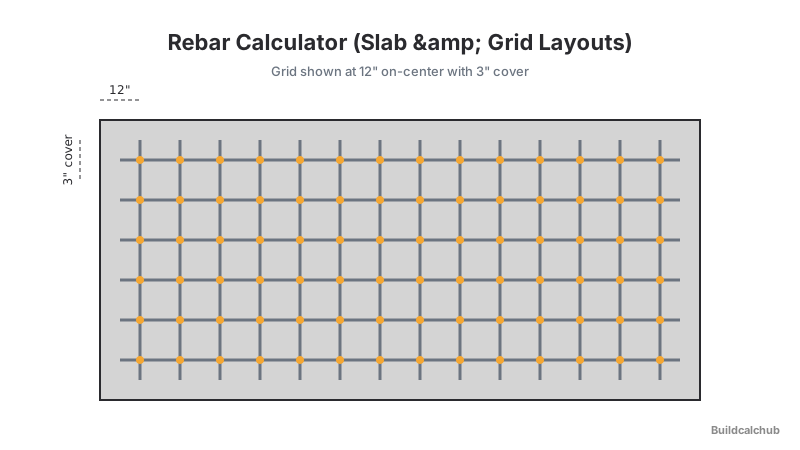
- 3-inch concrete cover (edge offset) keeps steel from corroding where it's exposed to weather
- Lap splices — when bars aren't long enough, overlap 30-40 bar diameters. For #4 bar that's 15-20 inches.
- Chairs or dobies — keep rebar at correct height in the slab (typically mid-depth for slab-on-grade, top 1/3 for suspended slabs)
- Tie wire — secure intersections; ~1-2 ties per 4 ft² of grid
Once the Rebar Calculator result looks reasonable, cross-check the next job decision with the Concrete Slab Calculator and the Concrete Calculator. That keeps the quantity, cost, and field assumption tied together before you call a supplier.
For related concrete work: the concrete calculator handles general L×W×D volume, the concrete slab calculator handles slab-specific output, and the concrete PSI guide covers mix selection (3,000 vs 4,000 vs 5,000 psi). For the cluster overview see the concrete & foundation pillar.
What Most Online Calculators Get Wrong Reviewed by the Concrete & Foundations Review Desk
AI calculates rebar as “area / spacing.” Four pitfalls AI tools miss:
- Spacing depends on bar size + slab depth. ACI 318 Section 25. AI defaults 12-in OC; the right spacing requires bar+slab combo.
- Bar size denoted in 1/8 in. #4 = 4/8 = 1/2 in. #5 = 5/8. #6 = 6/8 = 3/4 in. AI tools sometimes confuse size language.
- Lap length 40× bar diameter. #4: 20-in lap. #5: 25-in. #6: 30-in. AI tools quote arbitrary lap.
- Cover required: 1.5 in slabs, 3 in cast-in-ground. ACI 318 cover spec.
This calculator outputs rebar lineal feet by bar size + spacing + lap length + cover requirement. Rebar is 4 specs: bar size + spacing + lap + cover — AI's spacing-only answer misses 3.
Rebar Coverage Table and Material Reference
| Size | Diameter | Weight per Foot | Price per 20-ft Stick (2026) |
|---|---|---|---|
| #3 | 3/8 in (0.375) | 0.376 lb/ft | $7-9 |
| #4 | 1/2 in (0.500) | 0.668 lb/ft | $10-13 |
| #5 | 5/8 in (0.625) | 1.043 lb/ft | $14-18 |
| #6 | 3/4 in (0.750) | 1.502 lb/ft | $20-25 |
| #7 | 7/8 in (0.875) | 2.044 lb/ft | $27-34 |
| #8 | 1 in (1.000) | 2.670 lb/ft | $35-44 |
Grade 60 (60,000 psi yield) is standard for residential. Grade 40 is older/cheaper; Grade 75+ for heavy commercial.
| Slab Type | Bar Size | Spacing | Grid Direction | Chair Height |
|---|---|---|---|---|
| Patio / walkway | No rebar | Wire mesh 6×6 | 2-way mesh | Mid-slab |
| Residential sidewalk | #3 or WWF | 24 in | 2-way grid | Mid-slab |
| Driveway | #4 | 24 in | 2-way grid | Mid-slab |
| Garage floor | #4 | 16 in | 2-way grid | Top 1/3 |
| RV / boat pad | #5 | 16 in | 2-way grid | Top 1/3 |
| Workshop / lift area | #5 | 12 in | 2-way grid | Top 1/3 + bottom bars |
| Structural slab | Engineered | Varies | Varies | Engineered |
Top 1/3 placement puts steel in tension zone for typical simply-supported slabs. Structural / post-tensioned slabs require engineered design.
Real-World Example Calculations
Patio Slab 12 × 12 ft, #4 @ 18 in
Decorative patio with moderate reinforcement.
- Length
- 12 ft
- Width
- 12 ft
- Spacing
- 18 in
- Offset
- 3 in
Takeaway: Cost ~$110 in rebar plus tie wire. Takes 2 hours to lay out and tie.
Garage Slab 24 × 24 ft, #4 @ 16 in
Two-car detached garage floor.
- Length
- 24 ft
- Width
- 24 ft
- Spacing
- 16 in
- Offset
- 3 in
Takeaway: ~$500 rebar + $50 tie wire + $30 chairs. Allow 1 work day for rebar layout before pour.
Industrial Slab 40 × 60 ft, #5 @ 12 in
Light industrial floor with heavy forklift loading.
- Length
- 60 ft
- Width
- 40 ft
- Spacing
- 12 in
- Offset
- 3 in
Takeaway: ~$3,800 rebar. Heavy labor — 2-3 workers, full day to lay out and tie.
Step 5 of 6 in the Concrete Patio Project Path
- AreaArea Calculator
- ExcavationExcavation Calculator
- Gravel BaseGravel Calculator
- Slab VolumeConcrete Slab Calculator
- ReinforcementRebar Calculator
- PSIConcrete PSI Guide (3,000 / 4,000 / 5,000 psi)
Whole sequence with costs and ordering notes: Concrete Patio Project Path.
Sources & Standards
These references are used for terminology, safety boundaries, and engineering assumptions. Local code, supplier specifications, and licensed design documents still control your project.
-
ACI 318-19 — Building Code Requirements for Structural Concrete
American Concrete Institute
Cited for the structural concrete design code that governs slab, footing, column, and reinforcement requirements.
-
ACI 332-20 — Residential Code Requirements for Structural Concrete
American Concrete Institute
Cited for residential-scale concrete requirements (footings, slabs, walls) referenced throughout the IRC.
-
ASTM C94/C94M-23 — Standard Specification for Ready-Mixed Concrete
ASTM International
Cited for ready-mix concrete delivery, batching, and short-load practice.
-
ASTM C150/C150M-22 — Standard Specification for Portland Cement
ASTM International
Cited for cement type classification (Type I, I/II, III, V) used in mix design.
-
2021 International Residential Code, Chapter 4: Foundations
International Code Council
Cited for residential frost-line footing depth, slab thickness, and reinforcement requirements.
Frequently Asked Questions
Do I need rebar in my concrete slab?
For slabs >100 ft² or carrying vehicle loads: yes. Fiber mesh for patios, wire mesh for walkways, #4 rebar at 16-24 in grid for driveways and garage floors. Unreinforced plain concrete cracks catastrophically under even modest loads.
What size rebar is used in residential slabs?
#4 rebar (1/2-inch diameter) is the residential standard for grid reinforcement. #5 for heavy loads (RV pads, lift areas). #3 for small patios or ornamental work. Bigger bars are available but unnecessary for residential.
How much does rebar cost?
In 2026: $10-13 per 20-ft stick of #4. Per linear foot: $0.50-0.65. For a typical residential 24 × 24 ft garage slab at #4/16 in spacing: roughly $500 in rebar.
How deep should rebar be in a 4-inch slab?
Two options: (1) Mid-slab at 2 inches deep — general-purpose placement, works for wire mesh and residential slabs, (2) Top 1/3 at 1.25 inches deep from top — preferred for slabs experiencing point loads (garage floors, driveways). Use chairs or dobies to hold rebar at correct height.
How far apart should rebar be spaced?
24 inches (2 ft) on center for most residential slabs. Tighter to 16 inches for garage floors and RV pads. 12 inches for heavy industrial. Wider than 24 inches leaves too much unreinforced area between bars.
How much should rebar overlap at splices?
30-40 times the bar diameter. For #4 bar: 15-20 inches. For #5 bar: 19-25 inches. Per ACI 318. Overlap must be tied with wire, not just laid next to each other. Splicing is preferred at low-stress locations, not at slab edges.
Is wire mesh as good as rebar?
For crack control: yes. For structural reinforcement: no. Wire mesh (6×6 W1.4/W1.4 welded wire fabric) holds cracks together after they form. Rebar prevents most cracking by resisting the tensile forces that would create cracks. Wire mesh for patios; rebar for anything carrying loads.