13 Free Aggregate & Base Material Calculators — Gravel, Crusher Run, Pea Gravel, River Rock, Decomposed Granite, Rip Rap, Road Base, Fill Dirt, Sand & Topsoil (2026)
Eleven calculators for the sub-surface materials that carry every driveway, foundation and structure — gravel, crusher run / DGA, pea gravel, river rock, crushed stone, road base, fill dirt, sand and topsoil. Edited by Sarah Miller and checked by the Asphalt & Aggregates review desk against ASTM D448, ASTM C33 and FHWA geotechnical specifications.
- 11Aggregate calculators
- 9US regional cost bands
- 7Source-rock geology zones
- 10Base failures catalogued
- 4,000+Engineer-reviewed words
4 Aggregate Calculators to Open First
If you are estimating a real job right now, open these four first. They answer tonnage, gradation choice, road-base depth and fill-shrinkage — the four questions that decide your aggregate order before you call a quarry.
Why Base Material Matters More Than the Surface
Every durable paved surface — asphalt, concrete, pavers, gravel — is only as strong as the aggregate base beneath it. The surface material (asphalt, concrete) gets all the attention but the base does the actual load-carrying work.
A 4-inch asphalt drive over 6 inches of properly compacted aggregate base lasts 20 years. Same 4-inch asphalt over 2 inches of loose fill fails in 3-5 years with alligator cracking, potholes, and surface rutting. Base isn't a corner to cut.
This cluster covers all eleven base-material calculations:
- Gravel & crushed stone — the family of crushed aggregates
- Crusher run / DGA / ABC — dense-graded driveway and pad base, the only material with a loose-vs-compacted tonnage split
- Pea gravel — 3/8-in rounded decorative stone with bag-vs-bulk pricing and CPSC playground depths
- River rock — 1–6 in rounded landscape stone with size-aware density and coverage
- Road base / base rock — dense-graded compactable sub-base
- Fill dirt — structural grading material
- Sand — bedding and leveling layer
- Topsoil — the final growing layer
All 13 Aggregate Calculators — Browse by Material
Organized by material type — from compactable base rock to garden-grade topsoil, plus the decorative landscape aggregates (pea gravel, river rock) and the dense-graded driveway material (crusher run / DGA).
Gradation: The Key Variable Most Homeowners Skip
Aggregate products are defined by their gradation — the distribution of particle sizes, from dust to largest stone. Gradation determines whether material compacts, drains, or stays stable under load.
Two gradation families:
- Uniformly graded (e.g., #57 stone, #2 stone, pea gravel) — all particles similar size. Open voids. Drains freely. Does not compact into a solid mass.
- Dense-graded (e.g., crusher run, DGA, Class 5, road base) — full range from dust to maximum size. Minimal voids. Compacts into a solid structural base at 95%+ Proctor density.
Practical rule:
- For drainage → uniformly graded stone (voids carry water)
- For structural base → dense-graded base rock (compacts solid)
- For decorative surface → pick by color and shape, gradation secondary
Mixing them up is the #1 DIY aggregate mistake. #57 stone looks great in a driveway until the first rainy week when it shifts and spreads everywhere.
10 Aggregate Mistakes Behind Most Base Failures
Base material failures are the number-one cause of premature pavement and slab failures. The mistakes below are the recurring failure modes the aggregate review checklist exists to catch — why a base cracks, settles, or pumps mud.
- Compacting to 85% instead of 95% Standard Proctor. Crews run a plate compactor for three passes, call it done, and move on. Proper compaction of base aggregate requires lift-by-lift placement (max 4 in loose lift) and plate compaction to refusal, verified with a nuclear gauge or a dynamic cone penetrometer. Undercompacted base settles 8 to 15% under load, which is why driveways develop low spots.
- Skipping geotextile fabric between subgrade and base. On any subgrade with more than 12% clay content, a non-woven geotextile ($0.25 to $0.35/ft²) prevents the fines from migrating up into the base stone during wet-dry cycles. Within 5 to 10 years, an unfabricked base on clay will have lost 20 to 40% of its structural contribution. That $150 skipped fabric costs $2,000 in premature failure.
- Wrong gradation for the application. Crews use what's on the yard, not what's specified. #57 (open-graded, clean) is excellent for drainage but terrible as paver base because it doesn't lock. Crusher run (dense-graded, fines included) is excellent for paver base but poor for drainage behind a retaining wall. The two products look similar to a non-specialist. Always ask for the gradation sheet.
- Placing wet stone over wet subgrade. The moisture in the aggregate migrates into the compacted fill. After compaction, the base holds 3 to 5% more water than optimum, which reduces load-bearing and encourages pumping failure. Drain both before placement.
- Ignoring frost susceptibility of the source material. Some aggregates (especially high-fines glacial tills and some shales) will retain moisture and heave during freeze cycles. Specification of a non-frost-susceptible base (less than 3% passing the #200 sieve) is standard in northern states but easy to overlook in residential work.
- Over-thick lifts. Lifts placed thicker than 4 in loose do not compact uniformly — the top 3 in hits 95% Proctor but the bottom inch is still loose. For any base work I demand placement in 3 to 4 in loose lifts, compacted independently.
- Not ordering enough for compaction shrinkage. Loose stone compacts 15 to 22%. Crew orders by the loose yard, spreads, compacts, and is 18% short. I always order in compacted yards with the 20% swell factor already built in, and I tell the homeowner expecting 30 tons that 36 tons will show up.
- Using recycled concrete aggregate (RCA) without checking pH. RCA is a great sustainable option ($18 to $28/ton vs $32 to $45 for virgin) but fresh RCA can run pH 11 or above. For landscaping and planting beds the high pH kills vegetation. Age the material 6 months, or rinse, or use virgin stone near plantings.
- Spreading stone over organic or loam topsoil. Organics compress indefinitely. Every patch of topsoil under a base layer is a future low spot. Strip all topsoil to mineral subgrade, period.
- No crown or cross-slope. Flat base under a flat driveway traps water. A 2% cross slope ($0 extra to build) keeps the base drained and doubles service life.
Density, Compaction & Coverage Reference
Four numbers to know for every aggregate:
- Loose density: as delivered — 75-110 lb/ft³ range. The exact value by material (crusher run, DGA, #57, RAP, modified) lives in our base rock density chart (AASHTO T 180) with max-dry-density values for each.
- Compacted density: after rolling — 10-15% higher than loose
- Tons per cubic yard: density × 27 / 2,000
- Coverage at X inches: for ordering by area — the 1-ton coverage combo table by stone size (#1 through #67) and depth lives in the gravel depth chart
Quick conversion table at 100 lb/ft³ average:
- 1 cubic yard = 27 cubic feet = 1.35 tons
- 1 cubic yard covers 108 ft² at 3 in deep, 81 ft² at 4 in deep, 54 ft² at 6 in deep
- 1 ton covers 80 ft² at 3 in, 60 ft² at 4 in, 40 ft² at 6 in
If you're trying to decode the #1 vs #4 vs #57 vs #67 stone names, our crushed stone sizes explained guide now includes the full ASTM D448 sieve size chart with percent passing by sieve and the recommended use for each gradation.
Aggregate Selection, Density & 2026 Delivered Pricing Reference
| Application | Best Product | Depth | Density Assumption |
|---|---|---|---|
| Driveway top layer (decorative) | Pea gravel or #57 stone | 2-3 in | 95-100 lb/ft³ |
| Driveway structural base | Road base / DGA | 4-6 in | 110 lb/ft³ |
| Concrete slab sub-base | #57 stone | 4 in | 100 lb/ft³ |
| Paver patio base | DGA + 1 in stone dust | 4 in | 110 lb/ft³ |
| French drain fill | #57 or #4 stone | 12+ in | 95-100 lb/ft³ |
| Retaining wall drainage | #57 stone (behind wall) | 12 in | 100 lb/ft³ |
| Yard leveling / grading | Screened fill dirt | Varies | 90 lb/ft³ |
| New lawn topsoil | Screened topsoil | 4-6 in | 75 lb/ft³ |
| Raised garden bed | Premium garden mix | 8-12 in | 75 lb/ft³ |
| Sandbox | Play sand (washed) | 6-8 in | 95 lb/ft³ |
| Paver bedding | Paver sand (coarse) | 1 in | 100 lb/ft³ |
Use this table to pick the right calculator and default density for your project.
| Material | Price/ton at Quarry | Delivered Price/yd³ | Typical Delivery Minimum |
|---|---|---|---|
| Fill dirt (screened) | $8-18 | $15-35 | 10 yd³ |
| Topsoil (screened) | $14-28 | $22-42 | 8 yd³ |
| Premium garden mix | $35-55 | $45-65 | 6 yd³ |
| Pea gravel | $28-45 | $40-60 | 10 yd³ |
| #57 stone | $22-35 | $35-50 | 10 yd³ |
| DGA / crusher run | $18-28 | $30-42 | 10 yd³ |
| Base rock (West Coast) | $26-38 | $40-58 | 10 yd³ |
| Concrete sand | $28-42 | $40-58 | 10 yd³ |
| Paver bedding sand | $32-48 | $48-68 | 5 yd³ |
Larger tonnage orders (30+ tons) may qualify for reduced per-ton pricing. Negotiate on bulk orders. Minimum deliveries typically one full truck load.
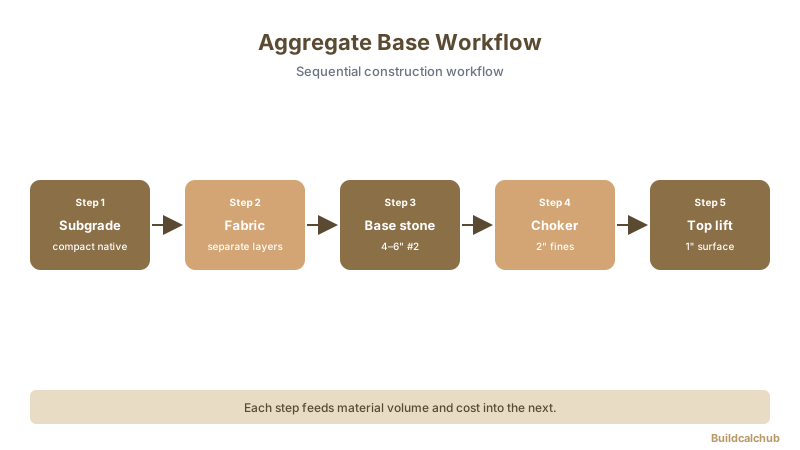
The Excavation-to-Surface Workflow
- Excavate — remove organic material (grass, roots, topsoil) to a depth that accommodates the base + surface stack. Typically 8-12 in for driveways.
- Compact subgrade — roll or plate-compact the exposed soil to 90%+ Proctor. Prevents future settling.
- Geotextile (optional but recommended) — fabric layer prevents soil and aggregate from mixing. Adds $0.30-0.60 per ft². Critical on clay soils.
- Base aggregate — place dense-graded base rock in 4-6 in lifts; compact each lift with plate or roller.
- Leveling layer — 1 in of sand or stone dust for paver applications; skip for concrete or asphalt.
- Surface material — asphalt, concrete, pavers, or gravel top course.
The order is non-negotiable. Skipping compaction between layers causes layer migration and base failure within 2-3 years.
For a deeper walk-through of driveway-specific layering with thickness recommendations for clay, sandy, and rocky subgrades, see our complete driveway base layers guide.
If the goal is a complete driveway rather than one aggregate order, use the gravel driveway project path to connect excavation, geotextile, road base, surface gravel, and drainage.
Real-World Example Calculations
Complete Driveway Material Breakdown: 12 × 50 ft
New gravel driveway from scratch, with proper base prep.
- Excavation
- 12 × 50 × 12 in = 22 yd³ removed
- Geotextile fabric
- 600 ft² = $210
- Road base
- 12 × 50 × 6 in = 16.5 tons @ $22 = $363
- Top gravel (#57)
- 12 × 50 × 3 in = 8.25 tons @ $28 = $231
Takeaway: Typical material cost for a quality 600 ft² gravel driveway. Labor and equipment add $2,000-3,500 if hired; DIY brings total to ~$1,000-1,500.
2026 Aggregate Market & 3-Year Cost Trend
Bulk aggregate prices rose 8–14% from 2024–2025, driven by:
- Fuel costs — aggregate trucking is fuel-intensive; diesel surcharges pass through directly
- Quarry permit constraints — new quarries are politically difficult to permit, limiting supply growth
- Transportation miles — as near-market quarries are exhausted, hauls lengthen
- Cement industry competition — concrete sand and dolomitic limestone supply tightens when concrete demand is high
| Year | National avg $/ton delivered | YoY change | Primary driver |
|---|---|---|---|
| 2024 | $24–$36 | baseline | Stable diesel, normal quarry supply |
| 2025 | $28–$42 | +12–15% | Diesel surcharge, longer haul averages |
| 2026 | $30–$46 | +8–14% | Quarry permit constraints + cement-sand competition |
Cost-saving strategies:
- Schedule in off-season — November–March for less demand
- Recycled aggregate (RCA & RAP) — crushed concrete or crushed asphalt millings, 30–50% cheaper than virgin. NSSGA / USGS lifecycle data show recycled aggregate cuts embodied CO2 by roughly 65–90% per ton substituted (virgin crushed stone embodies about 5–9 kg CO2e/ton; RCA mostly captures haul-only emissions).
- Direct from quarry — skip landscape-supply middleman; pay trucking direct
- Combine orders — split a truck with neighbors for smaller quantities
For grading work, do not treat all soil as interchangeable. The fill dirt vs topsoil guide explains which material belongs in compacted grade and which belongs only in the growing layer.
Regional Geology & Aggregate Availability
"Gravel" means different things in different parts of the country. The bulk density of a #57 stone in Vermont is not the same as a #57 in Georgia, because the parent rock is different. When I spec 20 tons of base rock for a Delaware driveway and my cousin runs the same spec for his barn in Montana, we are literally ordering different materials. Here's the regional geology I've had to learn to price projects honestly.
Appalachian corridor (PA, MD, VA, WV, TN, KY): limestone-dominant
The eastern US runs on crushed limestone. It's quarried in thousands of locations, it's affordable, and it compacts beautifully. Typical bulk density for compacted #57 limestone: 135 to 140 lb/ft³. Abrasion resistance is middle of the road (LA abrasion loss around 22 to 28%), which means it will powder under heavy truck traffic over 15 to 20 years. For driveway and patio base it's ideal. For industrial loading docks I push toward harder granite.
Southeast (NC, SC, GA, AL): granite and gneiss
Piedmont granite is the aggregate of choice from Charlotte to Atlanta. Harder than limestone (LA abrasion around 18 to 24%), higher specific gravity (around 2.70 vs 2.65 for limestone), slightly higher bulk density (138 to 143 lb/ft³ compacted #57). Because it's harder, it resists breakdown under traffic. The tradeoff: it's slightly more expensive per ton because of the higher energy cost to crush, and it tends to have angular sharp fragments that can puncture tires if used as a surface layer on drives where people walk barefoot.
Pacific Northwest (OR, WA, northern CA, parts of ID): basalt
The Columbia River basalt flows gave this region enormous reserves of dense, hard volcanic rock. Basalt compacted bulk density runs 140 to 148 lb/ft³, which is 5 to 8% heavier than the limestone I'm used to in Delaware. When a West Coast client ran my calculator assuming 135 lb/ft³ density for limestone and bought basalt, they ended up 6% short on tonnage because they underestimated the weight per cubic yard. Always confirm the source rock with the supplier.
Upper Midwest and Prairie (MN, WI, ND, SD, IA, parts of NE, MO): glacial till and pea gravel
This region's dominant material is rounded river gravel and glacial till, not crushed quarry stone. The texture matters: rounded stone does not interlock the way crushed stone does. Compacted bulk density is typically 100 to 110 lb/ft³ for pea gravel, 115 to 125 for glacial till. It drains beautifully but it shifts under load. For driveway base I always spec a crushed material with 8% or more P200 fines to lock the matrix together.
Desert Southwest (AZ, NV, NM, southern CA, southern UT): caliche and decomposed granite
Caliche (calcium-carbonate-cemented gravel) is a regional oddity. It's cheap, widely available, and gives excellent dry compaction, but it loses 25 to 40% of bearing capacity when saturated. In the flash-flood events common in monsoon season, caliche base under a concrete slab can turn to slurry. I don't use pure caliche on anything that might see sustained water; I blend in 30 to 40% crushed granite for stability.
Gulf Coast and Florida (FL, south LA, coastal TX): shell and limestone rock
Florida runs on crushed oolitic limestone and, in some areas, crushed shell rock. Shell rock is unique: light (compacted 95 to 105 lb/ft³), extremely soft (LA abrasion 35%+), and acidic in runoff. It is acceptable for paver base and residential applications below pavement but not for structural load. I've seen shell rock crush under a loaded concrete truck on a base prep site.
Northeast and New England (NY, VT, NH, ME, MA): trap rock and glacial gravel
Trap rock (a New England term for basalt and diabase) is harder than limestone, denser (144 to 150 lb/ft³ compacted), and more expensive. Widely used for highway aggregate and railroad ballast. For residential projects my clients in Vermont typically end up with crushed gravel from local glacial pits, which compacts to 125 to 135 lb/ft³.
Regional Delivered Pricing & Haul Economics
Aggregate is the most haul-cost-sensitive commodity in construction. The stone at the quarry is cheap; the delivered-to-site price can be 2 to 4x the quarry price depending on distance. Below is what I see in actual delivered pricing across regions in Q1 2026.
| Region | #57 base stone $/ton delivered | Crusher run $/ton delivered | Topsoil $/yd³ delivered |
|---|---|---|---|
| Northeast (NY/NJ/MA/CT) | $38–$52 | $32–$44 | $42–$58 |
| Mid-Atlantic (DE/MD/PA/VA) | $28–$38 | $24–$32 | $35–$48 |
| Southeast (NC/SC/GA/FL) | $30–$42 | $26–$36 | $28–$38 |
| Midwest (OH/IL/IN/MI) | $26–$36 | $22–$32 | $32–$45 |
| Great Plains (IA/MN/ND) | $30–$42 | $25–$35 | $30–$42 |
| Mountain West (CO/UT/AZ) | $35–$48 | $30–$42 | $38–$55 |
| Texas | $26–$38 | $22–$32 | $28–$42 |
| Pacific Northwest (OR/WA) | $34–$46 | $28–$40 | $40–$52 |
| California (coastal) | $42–$60 | $38–$52 | $48–$68 |
| Rural (add to any region) | +$8 to $18 beyond 15 mi | +$8 to $18 | +$6 to $14 |
The haul math that actually determines your bill
Aggregate trucking is priced in one of two ways and you need to understand which one your supplier is using:
- Bundled per ton: a single number that includes material and haul. Most suppliers quote this way for deliveries within 15 to 20 miles of the quarry. It masks the haul component.
- Material + haul separated: material at the quarry gate, plus haul at a per-mile rate ($6 to $12 per mile one-way for a tri-axle dump in 2026). Long hauls show the true cost.
A working rule: beyond 25 miles from the quarry, each additional 10 miles adds $5 to $9 per ton. For a 20-ton driveway base order, a 50-mile haul vs a 15-mile haul costs $100 to $315 more.
Three savings moves I use on every project
- Take the full truckload. Most suppliers charge a short-load fee (typically $45 to $90) below 18 tons. If you need 14 tons, ask the supplier to bring 18 and stockpile the extra on the lot; it's cheaper per ton and you might use it for landscaping edging later.
- Choose the gradation that matches the job, not the one that looks premium. Many crews default to #57 because it "looks cleaner" than crusher run. For paver base and driveway base, crusher run ($8 to $14 less per ton) performs better because the fines lock the matrix.
- Time the order for weekday mornings. Quarries are less congested Tuesday through Thursday mornings. Friday afternoon deliveries sometimes get pushed to Monday, which means a lost workday if you planned around stone showing up.
For volume estimates, start with the gravel calculator, the crusher run calculator (driveway / pad base with loose-vs-compacted split), the pea gravel calculator (paths, patio fill, CPSC playground), or the river rock calculator (dry creek beds, xeriscape, decorative beds) and apply the regional pricing above. If you're within 15 miles of a quarry, use the low end of the range; beyond 25 miles, use the high end.
Engineering References
These references are used for terminology, safety boundaries, and engineering assumptions. Local code, supplier specifications, and licensed design documents still control your project.
-
ASTM D448: Standard Classification for Sizes of Aggregate
ASTM International
Referenced for crushed stone and aggregate size classifications.
-
ASTM C33/C33M: Standard Specification for Concrete Aggregates
ASTM International
Referenced for concrete aggregate grading and quality terminology.
-
USGS National Minerals Information Center
U.S. Geological Survey
Referenced for aggregate, sand, stone, and mineral commodity context.
-
FHWA Geotechnical Engineering Program
Federal Highway Administration
Referenced for subgrade, compaction, and soil support concepts.
-
National Stone, Sand & Gravel Association (NSSGA)
NSSGA
Referenced for aggregate industry pricing context, sustainability data, and recycled-aggregate guidance.
Frequently Asked Questions
What's the difference between gravel and crushed stone?
Gravel is naturally rounded stone from riverbeds. Crushed stone is quarried and mechanically broken, producing angular faces. Crushed stone compacts denser (~95% Proctor); gravel tops out at ~85%. For structural applications, always specify crushed stone.
How do I calculate aggregate tonnage?
Multiply length × width × depth (all in feet), multiply by material density (lb/ft³), divide by 2,000 for tons. For 100 lb/ft³ material, a shortcut: ft³ × 0.05 = tons.
What's the best gravel for a driveway?
Two-layer approach: 4-6 inches of road base / DGA for the structural sub-base (compacted), 2-3 inches of #57 or pea gravel for the driving surface. Single-layer driveways with only decorative gravel fail within 1-2 years under vehicle loads.
How much does aggregate cost delivered?
Residential deliveries in 2026: $35-65 per cubic yard delivered for standard crushed stone. Fill dirt $15-35. Topsoil $22-42. Premium garden mix $45-65. Add $60-150 per load in trucking fees on top of per-yard pricing.
Can I compact gravel with a car?
Partially — driving back and forth compresses the top layer to ~85% density, adequate for low-use applications. For structural driveways and under pavement, rent a plate compactor ($60/day) or vibratory roller ($350/day). Proper compaction extends the life of any surface placed on top by 5-10 years.
How much aggregate do I need for a 10x20 ft driveway?
At 6 inches compacted road base + 2 inches #57 top layer: ~8 tons of road base + 2.5 tons of #57 for a 200 ft² driveway. Small projects have higher per-ton trucking costs — consider splitting a load with a neighbor.
Do I need a weed barrier under gravel?
Yes for landscape applications and decorative gravel paths. Landscape fabric prevents weeds from growing up through the gravel and keeps gravel from sinking into soil. For driveways and structural applications, use geotextile fabric instead — heavier duty, prevents clay migration up into the base.