How Much Asphalt Do I Need?
Step-by-step method for calculating asphalt tonnage, cost, and delivery planning — with the density and waste factor tricks most online calculators skip.
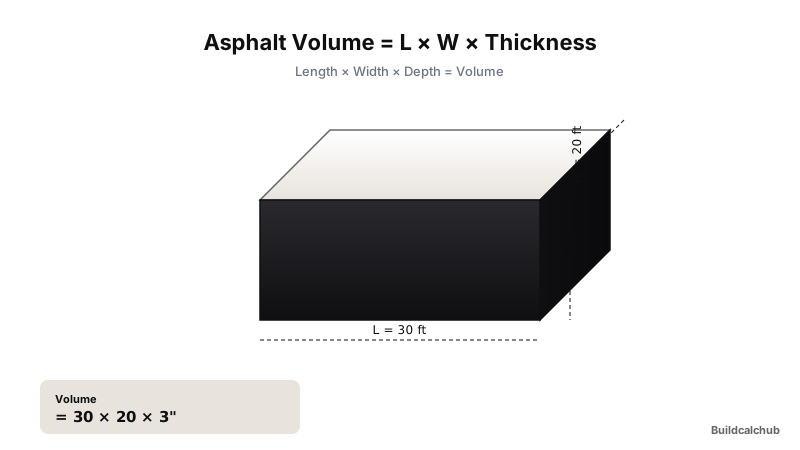
Calculating asphalt for your project comes down to one equation:
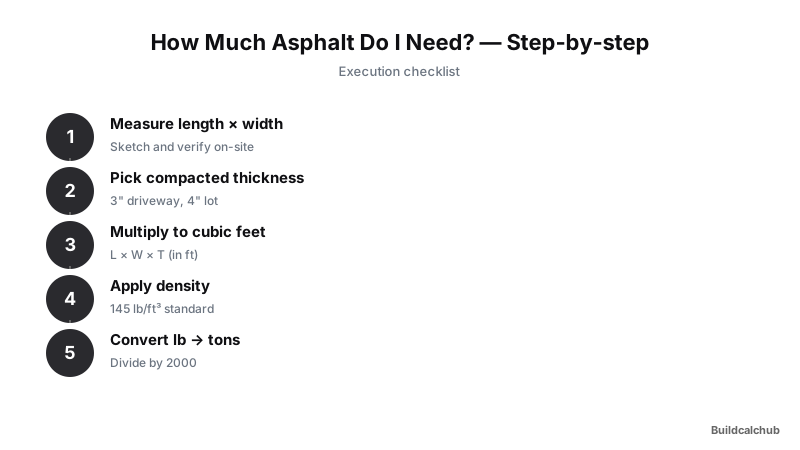
Tons = Area × Thickness × Density ÷ 2,000
But the devil is in the details. What density to use? How thick? How much extra for waste? This guide walks through all five decisions using a real example: a residential driveway 50 × 12 ft, getting 3 inches of hot-mix asphalt. By the end, you'll know exactly how much to order.
Step 1: Measure Your Area
The most common mistake: measuring the visible surface only. If you're paving a new driveway over existing base, measure the base area (usually 6-12 inches wider than the surface will be — the base extends past the edge of pavement for support).
For our example: 50 × 12 ft = 600 ft². If the driveway has a 3-ft turnaround apron at the garage, add that: 3 × 12 ft = 36 ft². Total: 636 ft².
Rule of thumb: measure the base area, not just the visible drive surface. Asphalt that doesn't bond to base edge will crack within 2-3 years.
Step 2: Choose Your Thickness
Thickness by application:
- Residential walkway: 1.5-2 inches
- Residential driveway: 2-3 inches (3 recommended)
- Commercial driveway: 3-4 inches
- Parking lot: 3-4 inches surface + 6-8 in base course = 10-12 total
- Local road: 4-6 inches over 8-12 in base
- State highway: 8-12 inches total (engineered design)
For our driveway: 3 inches = 0.25 feet.
Step 3: Apply the Density Formula
Hot-mix asphalt density varies by mix type:
- Standard hot-mix asphalt (HMA): 145 lb/ft³ (most common residential)
- Heavy-duty HMA: 150 lb/ft³
- Stone-matrix asphalt (SMA): 155 lb/ft³
- Open-graded friction course: 135 lb/ft³
- Cold-mix asphalt patch: 110-130 lb/ft³
Multiply:
Weight = 159 ft³ × 145 lb/ft³ = 23,055 lb
Tons = 23,055 ÷ 2,000 = 11.53 tons
For a quick reference: at 145 lb/ft³, 1 ton of HMA covers about 55 ft² at 3 inches thick. Our 636 ft² driveway needs 11.6 tons, consistent with the formula.
Why supplier quotes sometimes disagree with calculator output
I've seen plenty of homeowners come to me confused because their calculator says 17 tons but the supplier is quoting 19 tons. It's almost never a math error. It's one of three things:
- Density assumption mismatch. Calculators default to 145 lb/ft³, which is the compacted-in-place density for standard dense-graded HMA. Suppliers often quote in loose tons (what gets weighed on the truck at the plant), which is about 5 to 8% lower density than compacted. A 17-ton compacted calculation might correspond to an 18 to 19-ton loose delivery.
- Waste factor added silently. Experienced suppliers add 5 to 10% waste to their quote because they know single-truck precision is hard in the field. If your calculator didn't include a waste factor and the supplier did, the numbers diverge.
- Mix type difference. Stone Matrix Asphalt (SMA) runs 148 to 152 lb/ft³ compacted; polymer-modified hot-mix runs 146 to 149; standard HMA runs 145; recycled asphalt (RAP) runs 125 to 135. The mix you're actually buying determines the right density input.
On a 24x40 ft driveway at 3 in compacted I calculate 17.4 tons at 145 lb/ft³. If the supplier is quoting 19.2 tons of loose RAP at 130 lb/ft³, that's the same 3 in of compacted pavement in the end. The truck just weighs a different number because the material is different. Verify the mix, verify the density, and the math always reconciles.
I've also watched the reverse: a calculator-obsessed homeowner ordered 14 tons when 16 was needed, because the calculator spit out 14 and they didn't add a waste factor. The crew ran short at the end of the driveway and had to leave a 50 ft² gap that got patched a week later. The patch now telegraphs a cold joint line that will be visible for decades. Order 10% more than the math says.
What Most Online Calculators Get Wrong Reviewed by the Asphalt & Aggregates Review Desk
“How much asphalt do I need” is one of the most-asked AI search queries in paving, and AI typically responds with a single tonnage formula. Four operational realities the formula doesn't capture:
- Tonnage is only one of the three numbers you need. You need (1) in-place compacted tonnage from L×W×D, (2) plant-order tonnage (in-place × 1.10–1.20 for loose-state), (3) truck count (order ÷ 18–22 tons/truck rounded up). AI tools answer (1); contractors order on (2)+(3).
- Coverage charts assume one mix type. “1 ton covers 80 ft² at 2 in compacted” is true for 145 lb/ft³ dense-graded. For SMA (150 lb/ft³), 1 ton covers 76 ft²; for OGFC (118 lb/ft³), 1 ton covers 95 ft². Picking the wrong mix coverage = 20% order error.
- Waste-factor varies 3× by job geometry. Square 1,000 ft² driveway = 5% waste; L-shaped 1,000 ft² driveway with 3 turns = 12–15% waste; commercial parking lot with islands and curbs = 15–22% waste. AI tools use a flat 5–7%; the real number tracks turn count and edge complexity.
- The 1-ton short-load minimum is a fixed cost ignored by AI. Plants impose a 3–5 ton minimum charge and short-load surcharges. A 1.5-ton residential repair gets billed at 4–5 tons. AI calculators show 1.5 tons; the real invoice is for 4–5. Knowing this lets you batch multiple repairs into one truck.
This guide gives the three-tier tonnage math, coverage by mix type (4 types), the waste-factor matrix by job geometry, and the plant minimum + short-load surcharge schedule. The right answer to “how much asphalt do I need” is always two numbers: theoretical tonnage AND order tonnage AND truck count.
Reference Tables
| Application | Min Thickness | Recommended | Base Course |
|---|---|---|---|
| Walkway | 1.5 in | 2 in | Optional |
| Residential driveway | 2 in | 3 in | 4-6 in aggregate |
| Commercial driveway | 3 in | 4 in | 6-8 in aggregate |
| Parking lot | 3 in | 4 in | 6-8 in aggregate |
| Local road | 4 in | 5-6 in | 8-12 in aggregate |
| State highway | 8-12 in (engineered) | per design | 12-18 in aggregate |
Base course is compacted aggregate beneath the asphalt; combined depth is ‘pavement structure’ thickness.
Step 4: Add the Waste Factor
Waste factor for asphalt accounts for:
- Material in the truck's hopper that doesn't make it onto the drive
- Slight over-rolling / compaction variance
- Edge compaction against existing surfaces
- Unforeseen low spots on the base course
Typical waste: 5-7% for residential, 3-5% for commercial. For our driveway at 7% waste:
11.53 tons × 1.07 = 12.34 tons. Round up: order 12.5 tons.
Step 5: Plan Delivery
Asphalt trucks hold 18-22 tons typical. Our 12.5-ton order is a single-truck delivery. Book it during mild weather (50-90°F) and schedule the paver crew for the same day. Asphalt cools fast — it must be placed and rolled within 45 minutes of arrival.
Delivery scheduling:
- Confirm 48 hours ahead
- Verify truck access (12-ft driveway minimum)
- Have crew on-site 30 minutes before truck arrival
- Place and roll within the truck's cool-down window
My checklist before I let a crew order asphalt
- Sketch and dimension the area. A site plan with length, width, thickness, and irregular zones marked. Photo of the sketch for reference.
- Identify the mix type. Standard HMA, polymer-modified, SMA, or RAP. Ask the contractor and the supplier to confirm they match.
- Confirm the density basis. Compacted in place (145 lb/ft³ for standard HMA) vs loose delivered. The quote needs to state which.
- Calculate tons using the asphalt calculator. Cross-check with the asphalt calculator if you want a built-in waste factor.
- Add 5 to 10% for waste. 5% for a straight rectangle, 10% for driveways with curves, and 12 to 15% for anything with cutouts, islands, or stamped borders.
- Verify truck capacity. Standard tri-axle tandem holds 22 tons; quad-axle 25 to 26 tons. Three loads of 22 tons each is 66 tons of capacity; plan your day's deliveries against that.
- Plan the last truck small. The last truckload of the day is often a short load, and suppliers charge $45 to $80 short-load fees below 15 tons. I ask the supplier to deliver a full final load at 80 or 90% of the day's remaining need, then order a final topping load the following morning if needed.
On a county road repave I estimated for a client in 2024, our 460-ton calculation matched the supplier tonnage ticket within 1.8%. Three years earlier, a similar job with no waste factor applied on the calculator side came in 7% short and cost the contractor an emergency second delivery at premium rate. The 10% padding is the cheapest insurance in paving.
Real-World Example Calculations
Worked Example: 50 × 12 ft Driveway at 3 in
Residential driveway replacement, standard HMA, 7% waste factor.
- Base area
- 636 ft² (incl. 3×12 apron)
- Thickness
- 3 in = 0.25 ft
- Density
- 145 lb/ft³
- Waste
- 7%
Takeaway: Single truck delivery. Cost at $115/ton HMA: $1,438 material + delivery fee.
Next Steps and Related Calculators
Now you know the five-step method. For your specific project, use the Asphalt Calculator to run the numbers. Pair it with these companion tools:
- Asphalt Cost Calculator for total project budget
- Asphalt Thickness Calculator for structural design
- Crusher Run Calculator for the compacted aggregate beneath the asphalt
Once you have the tonnage in hand, walk through our line-item breakdown of 2026 asphalt driveway pricing — it converts the material number into a full quote you can sanity-check against any contractor bid.
Sources & Standards
These references are used for terminology, safety boundaries, and engineering assumptions. Local code, supplier specifications, and licensed design documents still control your project.
-
FHWA Pavement Program
Federal Highway Administration
Referenced for pavement performance, asphalt structure, and roadway material context.
-
AASHTO Transportation and Pavement Design Resources
American Association of State Highway and Transportation Officials
Referenced for pavement structure, traffic loading, and base course design concepts.
-
USGS National Minerals Information Center
U.S. Geological Survey
Referenced for aggregate, sand, stone, and mineral commodity context.
-
OSHA Trenching and Excavation Safety
Occupational Safety and Health Administration
Referenced for excavation safety, protective systems, and worker-safety boundaries.
Frequently Asked Questions
How many tons of asphalt per 1,000 square feet?
At 3 inches thick and 145 lb/ft³: 18 tons per 1,000 ft². At 2 inches: 12 tons. At 4 inches: 24 tons. Always add 5-7% waste for residential, 3-5% for commercial.
How do I calculate asphalt in tons?
Tons = (L × W × D in feet) × density in lb/ft³ ÷ 2,000. For 3-in HMA at 145 lb/ft³: Tons = ft² × 0.0181 (shortcut). A 500 ft² driveway = 9.1 tons before waste.
What density should I use for asphalt?
For standard hot-mix asphalt (HMA): 145 lb/ft³. This is the industry default. Specialty mixes run 130-155 lb/ft³. Always confirm with your asphalt plant before large orders.
How much waste to add on asphalt orders?
Residential: 5-7%. Commercial/highway: 3-5%. Remote or difficult-access sites: 8-10%. Under-ordering and running short is always worse than slight over-order; wasted material is cheaper than crew wait time.
How do I calculate asphalt for a parking lot?
Same formula. Note that parking lots typically require base course (2-3 in) plus surface course (1-1.5 in) = 3-4 in total asphalt thickness. Commercial waste factor 3-5%. Use our Parking Lot Asphalt Calculator for full breakdown.
Can I calculate cold-mix asphalt the same way?
Yes, but adjust density. Cold-mix is typically 110-130 lb/ft³, significantly lighter than HMA. For 3-inch cold mix at 120 lb/ft³: 1 ton covers 67 ft² (versus 55 ft² for HMA).
What's the cost per ton of asphalt?
In 2026: $90-130 per ton for standard HMA delivered. Premium mixes (SMA, polymer-modified) run $140-200/ton. Labor and equipment for placement adds $40-80/ton on top of material cost.