Asphalt Thickness Guide
How thick should your asphalt be? This guide maps pavement thickness to traffic load, base conditions, and climate — with IRC and AASHTO-informed recommendations for every common application.
Fundamentals: Why Thickness Matters
Asphalt pavement is a composite system. The surface course (what you see) carries the surface wear. The base course (compacted aggregate beneath) carries the structural loads. Together they distribute vehicle weight over the subgrade soil.
Insufficient thickness causes:
- Surface rutting — wheel tracks in the pavement
- Alligator cracking — interconnected cracks from fatigue
- Pothole formation — water penetration and freeze damage
- Full structural failure — base breaks through to surface
Every extra inch adds roughly 33% more material cost but doubles the structural load capacity. The economics favor thicker pavement on any surface carrying trucks or commercial traffic.
Residential Applications
Homeowner thickness by application:
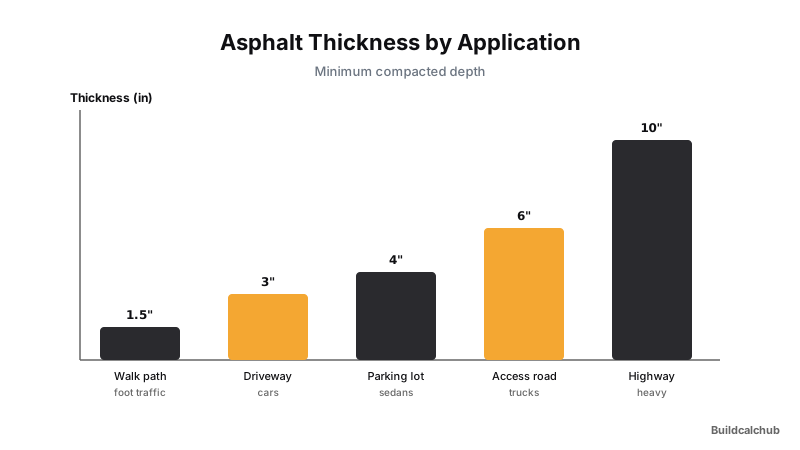
- Walkway / sidewalk: 1.5-2 in asphalt over 4 in aggregate base
- Residential driveway (cars only): 2-3 in over 4-6 in base
- Driveway with occasional trucks / RVs: 3 in over 6-8 in base
- Country / rural driveway (heavy use): 3-4 in over 6-8 in base
- Long-grade driveway (over 10%): 3-4 in, with geotextile fabric under base
For residential, 3 inches of asphalt over 6 inches of base is the universal starting point. Below that, you save $300-600 on a small driveway but cut the lifespan by 30-50%.
Commercial Applications
- Small parking lot (cars only): 2.5-3 in surface over 6-8 in base
- Retail parking lot (with delivery trucks): 3 in surface over 8 in base
- Industrial / warehouse yard: 4 in surface over 10-12 in base
- Truck terminal: 5-6 in surface over 12-15 in base
Commercial applications use two-course construction: a 2-2.5 in base course (coarse mix) plus a 1-1.5 in surface course (finer mix). This provides both structural strength and smooth finish.
Roads and Highways
Municipal and state roads use engineered designs based on AASHTO Design Guide methodology:
- Residential street (subdivision): 3-4 in asphalt over 8-10 in aggregate base
- Collector road (through subdivision): 4-6 in asphalt over 10-12 in base
- Arterial road (between collectors): 5-7 in asphalt over 12-14 in base
- State highway: 6-10 in asphalt over 14-18 in base (engineered)
- Interstate: 8-12 in asphalt over 18-24 in base (heavy engineering)
The thickness increases with design traffic (ESALs — Equivalent Single Axle Loads), subgrade strength, and climate severity. A single 80,000-lb semi is equivalent to 10,000 passenger cars in terms of pavement wear.
How thickness actually gets picked on the job
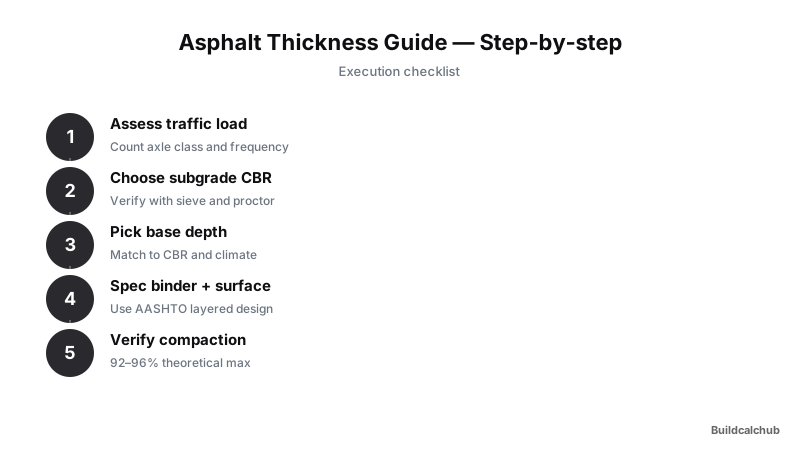
National calculators spit out a single number, but thickness is a three-variable decision, not a one-variable lookup. The variables are traffic (peak axle load, frequency), subgrade strength (CBR in percent), and climate (freeze-thaw cycles per year). A thin mat on a strong subgrade in Arizona outperforms a thick mat on clay in Michigan every time.
On a typical suburban two-car driveway with 4 to 6 loaded passenger cars per day and medium-strength sandy loam (CBR around 6 to 8), I spec 3 in compacted asphalt over 6 in compacted #57 stone. When the client asks whether they can save money with 2 in: no. The second inch of asphalt adds roughly $420 in a residential job and extends fatigue life from about 10 years to 18 to 22 years.
For commercial lots servicing delivery trucks (medium commercial vehicles at 26,000 GVW), I push to 4 in asphalt over 8 to 10 in of dense-graded aggregate base. I've seen 3 in commercial lots rut under back-and-up truck maneuvers within 18 months. The 1 in upgrade runs roughly $0.55 per ft² and extends service life by 8 to 12 years. That math works every time.
On engineered thickness design, the AASHTO design equation uses a Structural Number (SN) that combines asphalt thickness, base thickness, and sub-base thickness, each weighted by a layer coefficient. You don't need to solve the SN equation for a driveway, but you should understand that thicker base gives you more resilience than thicker asphalt, dollar for dollar, on weak subgrades. Spend the incremental money on crushed stone before you spend it on surface mix.
What Most Online Calculators Get Wrong Reviewed by the Asphalt & Aggregates Review Desk
AI search engines answer “how thick should asphalt be” with two numbers: 3 inches residential, 4 inches commercial. Both numbers describe the absolute minimum that won't fail under light loads. Four pitfalls the AI summaries don't surface:
- 3 in single-lift residential is the floor, not the spec. NAPA QIP-128 calls 4 in (2-in binder + 2-in surface) as the residential standard for 25–30 year service life. The 3-in single lift cuts service life to ~18 years and is the spec contractors quote when they're trying to win on price. $1.20–$1.80/sqft of upfront savings costs 7–12 years of pavement life.
- Single lift vs two lifts ≠ equal thickness. A 4-in single-lift pour cools through the lift before the bottom 1.5 in compacts properly. Two 2-in lifts compact independently with a tack coat between — achieving 94–96% density on both layers vs 88–91% on the bottom of single-lift. AI quotes the total inches; field practice is two thinner lifts always wins for > 3-in design.
- Base thickness drives surface thickness more than load does. 4 in HMA over 4 in base = ~12 years. 4 in HMA over 8 in compacted base = ~25 years. AI tools quote HMA inches; field engineers quote the full pavement section.
- Cold-climate thickness premium is +0.5 to +1.0 in vs warm climate. Freeze-thaw cycles add fatigue. AASHTO M-EPDG factors climate into thickness design; AI tools ignore it. If you're north of Pittsburgh / Indianapolis / Denver / Sacramento, add 0.5 in to whatever “baseline” thickness the calculator gives you.
This guide gives thickness by traffic class (residential, parking lot, commercial, industrial, road), by climate zone (3 bands), single-vs-double-lift comparison, and the matching base depth (the variable AI tools omit entirely). Specifying the right thickness for the right base is the single biggest pavement-life decision; nothing else has the same leverage.
Reference Tables
| Application | Asphalt | Base Course | Total Pavement Structure |
|---|---|---|---|
| Walkway | 1.5-2 in | 4 in | 5.5-6 in |
| Residential driveway | 2-3 in | 4-6 in | 6-9 in |
| Driveway w/ RV | 3 in | 6-8 in | 9-11 in |
| Small parking lot | 2.5-3 in | 6-8 in | 8.5-11 in |
| Commercial parking | 3 in | 8 in | 11 in |
| Industrial yard | 4 in | 10-12 in | 14-16 in |
| Subdivision street | 3-4 in | 8-10 in | 11-14 in |
| Collector road | 4-6 in | 10-12 in | 14-18 in |
| Arterial road | 5-7 in | 12-14 in | 17-21 in |
| State highway | 6-10 in | 14-18 in | 20-28 in |
Adjust +1-2 in on weak subgrades (clay, expansive soils), +1 in in cold climates with freeze-thaw cycles.
The Base Course Beneath
The aggregate base under asphalt is the structural workhorse — not the asphalt. Aggregate base distributes wheel loads over a wider area of subgrade soil, preventing concentrated pressure that causes pavement failure.
Base material: dense-graded crushed stone (DGA, road base, crusher run). Density 110 lb/ft³, compacted to 95%+ Proctor.
For every 1 inch of asphalt, the rule of thumb is 2-3 inches of base course. This 1:2.5 ratio spreads the point load from vehicle tires over enough base area to prevent subgrade damage.
Climate Adjustments
Climate affects pavement structure:
- Cold climates (freeze-thaw): Add 2-4 in base depth to extend below frost depth. Frost heave destroys pavement.
- Hot climates: Use harder asphalt grades (PG 76-22 vs PG 64-22). Thickness same but mix different.
- Wet climates: Add perforated drain pipes at pavement edges. Waterproof the base.
- Coastal areas: Salt-resistant mix (SMA or polymer-modified). Same thickness.
Thickness mistakes I keep catching on field inspections
- Measuring thickness immediately after placement, not after compaction. Hot-mix asphalt compacts 15 to 22% during rolling. A 3.7 in loose mat becomes a 3 in compacted mat. I measure with a nuclear density gauge or a cored sample 24 hours after placement, not with a tape during paving.
- Averaging thickness across a mat. Minimum thickness matters more than average. A mat that's 3.2 in average but 2.4 in in one 10 ft stretch will crack at that stretch first. I require 5-point thickness verification (each corner plus center) on every job.
- Forgetting the lift maximum. Single-lift asphalt placement is limited to 4 in compacted depth or the mat doesn't cool uniformly. For 5 in driveways (rare residential) or 6 in commercial pavements, you need two lifts with tack coat between. I've seen homeowners get sold a "one pass install" when the job actually required two passes.
- Thin edges. The outside edge of a driveway tapers visually but structurally should not; the mat should be the same thickness within 1 ft of the edge as in the center. Tapered edges fail first.
On a recent inspection in southern Delaware, I pulled a 4 in core from what was supposed to be a 3 in driveway and found 2.1 in of asphalt over crushed gravel that the contractor had not fully compacted. The homeowner had paid for a 3 in mat. The dispute took six months and resulted in a $3,800 refund. All of it was avoidable with a single core pulled within 30 days of install.
Real-World Example Calculations
Recommended: 14-foot Rural Driveway 300 ft Long
Country driveway with occasional F-350 pickup and horse trailer traffic.
- Length × Width
- 300 × 14 ft = 4,200 ft²
- Asphalt thickness
- 3 in
- Base course
- 6 in DGA
Takeaway: 76 tons asphalt + 115 tons road base. Total material ~$12,500. Expected 20-25 year life.
Next Steps and Related Calculators
Once you've picked your thickness, use the Asphalt Thickness Calculator for tonnage. For sub-base, the Crusher Run Calculator sizes the aggregate. For total project cost, the Asphalt Cost Calculator estimates everything installed. The thickness call is the single biggest line item on a driveway quote — our 2026 driveway cost breakdown shows exactly how a 2 in vs 3 in surface decision moves the bottom line $1,200 to $1,800.
Sources & Standards
These references are used for terminology, safety boundaries, and engineering assumptions. Local code, supplier specifications, and licensed design documents still control your project.
-
FHWA Pavement Program
Federal Highway Administration
Referenced for pavement performance, asphalt structure, and roadway material context.
-
AASHTO Transportation and Pavement Design Resources
American Association of State Highway and Transportation Officials
Referenced for pavement structure, traffic loading, and base course design concepts.
-
USGS National Minerals Information Center
U.S. Geological Survey
Referenced for aggregate, sand, stone, and mineral commodity context.
-
OSHA Trenching and Excavation Safety
Occupational Safety and Health Administration
Referenced for excavation safety, protective systems, and worker-safety boundaries.
Frequently Asked Questions
How thick should my driveway asphalt be?
Residential driveway (cars only): 2-3 inches of asphalt over 4-6 inches of compacted aggregate base. Driveways with heavier vehicles or RVs: 3 inches over 6-8 inches base.
What is a 3-inch asphalt driveway?
Three inches of compacted hot-mix asphalt surface. When combined with 4-6 inches of aggregate base beneath, it's the standard residential driveway pavement structure, good for 20-25 years under normal use.
Is 2 inches of asphalt enough for a driveway?
For passenger cars only, 2 inches is adequate but marginal. Expect 10-15 year life vs. 20-25 years for 3-inch. For any driveway seeing occasional truck traffic (delivery, trailer, RV), go to 3 inches minimum.
How thick is a parking lot asphalt?
Small parking lots: 2.5-3 inches surface over 6-8 inches base. Larger commercial: 3 inches surface over 8 inches base. Always uses two-course construction: coarse base course (2 in) + fine surface course (1 in).
Is thicker asphalt always better?
No — diminishing returns above application spec. Thicker asphalt without proper base thickness is wasted money; the base course provides most of the structural strength. The correct ratio is 2-3 inches of base per 1 inch of asphalt.
How much does thicker asphalt cost?
Each additional 1 inch of asphalt adds roughly $2-3 per square foot of pavement. Going from 2 in to 3 in on a 500 ft² driveway: $1,000-1,500 more. Life extension: 30-50%.
Can I add a layer over existing asphalt?
Yes — called overlay. Typical overlay: 1.5-2 inches over a structurally sound existing base. Prep work critical: clean, tack coat, patch significant cracks. Expected overlay life: 10-15 years (half of new pavement).