Foundation Calculator — Wall and Footing Concrete Combined
Combine foundation wall + footing cubic yards for crawl spaces and basements. Footing-only jobs stay on the footing calculator.
Foundation Calculator
Enter project dimensions below — results update instantly. Switch units freely.
Estimates assume typical industry density and waste factors. Always verify with your supplier and local building code before purchasing material.
Why Foundation Calculator Estimates Go Wrong
Every full foundation is two separate concrete pours spaced 1-7 days apart:
- Footings first — continuous footings at the perimeter, pad footings at interior columns. Cured for 1-3 days before walls go up on top.
- Foundation walls second — vertical walls rising from footings. Formed, reinforced, and poured.
The sequence matters because footings create a level, solid bearing surface for wall forms. Skip the sequence and you're trying to form walls on uneven excavation.
This calculator outputs wall volume, footing volume, and total separately so you can:
- Book separate concrete deliveries for each pour (different days)
- Compare the two line items on a contractor's bid
- Identify which portion dominates the material cost (usually walls for a full basement)
How to Calculate Foundation Calculator
Footing Volume = Perimeter × Widthft × Depthft
Total = Wall + Footing
Common foundation types by volume:
- Crawl space — 3-4 ft walls; 40-ft × 30-ft house = ~7-9 yd³ total concrete
- Partial basement (6-ft walls) — same house = ~12-15 yd³
- Full basement (8-ft walls) — same house = ~18-22 yd³
- Walk-out basement — varying wall heights around perimeter; typically 20-30 yd³
Wall thickness:
- 8 inches for residential walls under 8 ft in height and moderate earth pressure
- 10-12 inches for walls over 8 ft, or with significant lateral earth pressure (walk-out, sloped lot)
- Insulated Concrete Forms (ICF) change the math — consult ICF-specific volume charts
Once the Foundation Calculator result looks reasonable, cross-check the next job decision with the Footing Calculator and the Concrete Calculator. That keeps the quantity, cost, and field assumption tied together before you call a supplier.
For related concrete work: the concrete calculator handles general L×W×D volume, the concrete slab calculator handles slab-specific output, and the concrete PSI guide covers mix selection (3,000 vs 4,000 vs 5,000 psi). For the cluster overview see the concrete & foundation pillar.
What Most Online Calculators Get Wrong Reviewed by the Concrete & Foundations Review Desk
AI calculates foundation concrete as L×W×D. Four pitfalls AI summaries hide:
- Foundation wall thickness 8–10 in residential, 12+ in heavy load. AI defaults 8 in.
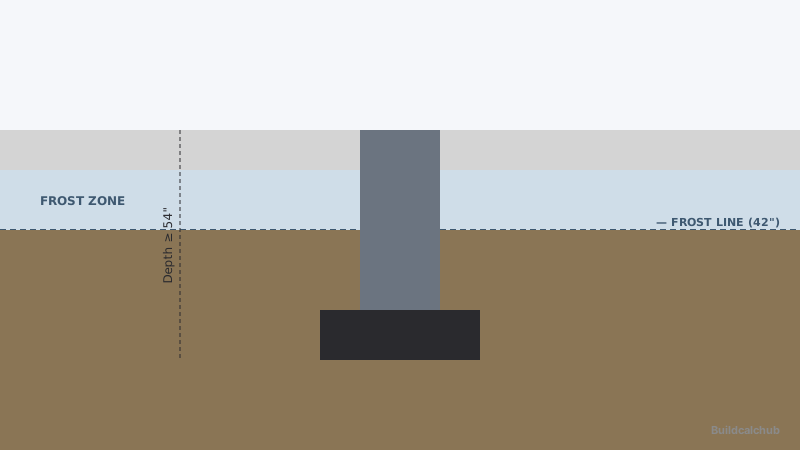
- Foundation height includes frost depth + slab thickness + above-grade. AI tools sometimes use only above-grade height.
- Rebar required: #4 vertical @ 32-in OC + #4 horizontal in 2 courses. IRC R403 spec.
- 4,000 psi minimum, air-entrained for exterior exposure.
This calculator outputs foundation volume (full height) + rebar matrix + recommended PSI + waterproofing reference. Foundations are the most code-loaded concrete; the L×W×D output is one of 4 numbers needed.
Foundation Coverage Table and Material Reference
| House Size | Crawl (3 ft walls) | Partial (6 ft) | Full Basement (8 ft) |
|---|---|---|---|
| 24 × 32 ft | ~5.5 yd³ | ~9.5 yd³ | ~13.5 yd³ |
| 28 × 36 ft | ~6.8 yd³ | ~12 yd³ | ~17 yd³ |
| 30 × 40 ft | ~7.5 yd³ | ~13.5 yd³ | ~19.5 yd³ |
| 32 × 44 ft | ~8.5 yd³ | ~15 yd³ | ~22 yd³ |
| 36 × 48 ft | ~9.8 yd³ | ~17.5 yd³ | ~25.5 yd³ |
| 40 × 60 ft | ~12 yd³ | ~22 yd³ | ~32 yd³ |
Based on 8-in wall thickness, 16-in × 8-in footings. Add 15% for waste, over-excavation, and engineering variability.
| Wall Height | Soil Pressure Normal | Soil Pressure Heavy | With Vertical Rebar |
|---|---|---|---|
| 3 ft (crawl) | 6 in | 8 in | 6 in + #4 at 48 in |
| 5 ft | 8 in | 10 in | 8 in + #4 at 32 in |
| 7 ft | 8 in | 10 in | 8 in + #4 at 24 in |
| 8 ft (full basement) | 8 in | 10 in | 8 in + #4 at 16 in |
| 9-10 ft (walk-out) | 10 in | 12 in | 10 in + #5 at 16 in |
Per IRC 404. Heavy soil pressure = wet clay, hillsides, or >5-ft exposed wall height.
Real-World Example Calculations
Full Basement 40 × 30 ft × 8 ft walls
Standard new-construction basement with 8-ft walls and 16 × 8 in continuous footing.
- Length
- 40 ft
- Width
- 30 ft
- Wall height
- 8 ft
- Wall thickness
- 8 in
Takeaway: Two separate pours. Footings: single truck. Walls: 2 trucks 45 min apart. Add interior column footings (~1-2 yd³).
Crawl Space 30 × 40 ft × 3 ft walls
Crawl space foundation for single-story ranch.
- Length
- 40 ft
- Width
- 30 ft
- Wall height
- 3 ft
- Wall thickness
- 8 in
Takeaway: Single truck per pour. Footings one day, walls the next. Cost ~$1,200-1,400 concrete material.
Walk-out Basement 48 × 28 ft × 9 ft avg walls
Walk-out basement with one 9-ft exposed wall, 5-ft buried on opposite side.
- Length
- 48 ft
- Width
- 28 ft
- Wall height avg
- 9 ft
- Wall thickness
- 10 in
Takeaway: Large pour. 3 trucks for walls (45 min apart). Spec 10-in walls with vertical #5 rebar at 16 in o.c. for the 9-ft walk-out wall.
Sources & Standards
These references are used for terminology, safety boundaries, and engineering assumptions. Local code, supplier specifications, and licensed design documents still control your project.
-
ACI 318-19 — Building Code Requirements for Structural Concrete
American Concrete Institute
Cited for the structural concrete design code that governs slab, footing, column, and reinforcement requirements.
-
ACI 332-20 — Residential Code Requirements for Structural Concrete
American Concrete Institute
Cited for residential-scale concrete requirements (footings, slabs, walls) referenced throughout the IRC.
-
ASTM C94/C94M-23 — Standard Specification for Ready-Mixed Concrete
ASTM International
Cited for ready-mix concrete delivery, batching, and short-load practice.
-
ASTM C150/C150M-22 — Standard Specification for Portland Cement
ASTM International
Cited for cement type classification (Type I, I/II, III, V) used in mix design.
-
2021 International Residential Code, Chapter 4: Foundations
International Code Council
Cited for residential frost-line footing depth, slab thickness, and reinforcement requirements.
Frequently Asked Questions
How much concrete does a foundation need?
For a typical 40 × 30 ft house with 8-ft basement walls: 18-22 cubic yards. Crawl space for the same house: 7-9 yd³. Walk-out basement: 25-32 yd³. Use this calculator with your specific dimensions.
How thick should foundation walls be?
Per IRC: 8 inches for walls under 8 ft height with normal soil pressure. Walls 9-10 ft or with heavy soil pressure require 10-12 inches. Always verify with local code and a structural engineer for anything beyond standard residential.
Can foundation walls and footings be poured together?
Normally no — they're poured separately with 1-3 days between. Monolithic foundations (slab-on-grade with integrated turn-down footings at the perimeter) are a single-pour option in warm climates without a basement. Requires careful forming to maintain thickness transitions.
How much does a concrete foundation cost?
For a standard 30 × 40 ft full basement: $15,000-25,000 installed. Breakdown: concrete material 20-25%, labor 35-40%, forms and rebar 15-20%, excavation and backfill 15-20%, waterproofing 5-10%.
What's the difference between crawl space and basement?
Crawl space: 3-5 ft tall, inaccessible for living space, primarily for utilities access. Basement: 7-10 ft tall, can be finished as living space. Basements cost roughly 2-3× more than crawl spaces due to wall height, excavation depth, and interior finishing.
How long should foundation concrete cure before building on it?
Walls should cure 7 days minimum before framing begins — reaches 70% of design strength. Full 28-day cure for 100% strength is not required before framing. Backfill should wait until floor joists or first-floor diaphragm is installed to brace the walls.
Do foundation walls need waterproofing?
Yes — typically a bituminous coating or rubberized membrane applied to the exterior before backfill. Plus drain tile at the footing to carry groundwater away. Skipping waterproofing almost guarantees basement leaks within 5 years, regardless of soil conditions.