9 Free Landscape Construction Calculators — Pavers, Paver Base, Sod, Grass Seed, Retaining Walls, Mulch, Patios, Fences & Decks (2026)
Nine calculators for the outdoor hardscape and softscape projects that decide a backyard renovation — pavers, paver base, sod, grass seed, retaining walls, mulch, patios, fences and decks. Edited by Sarah Miller and checked by the Landscape & Hardscape review desk across USDA Zones 3–10, verified to ICC IRC, ICPI Tech Spec 2, ASTM C936/C902, NCMA SRW Design Manual, AWC DCA-6 deck spans and Penn State / Texas A&M turfgrass guides.
- 9Landscape calculators
- 8US regional cost bands
- USDA 3–10Hardiness zones covered
- 10Field mistakes catalogued
- 3,000+Engineer-reviewed words
5 Landscape Calculators to Open First
If you are budgeting a real backyard project, open these five first. They answer paver count, ICPI-compliant paver base depth, sod pallet count, retaining-wall block count, and mulch yards before you commit to a contractor or a material run.
Landscape Projects = Hardscape + Softscape
Residential landscaping divides into two domains:
- Hardscape — all the non-living structural elements: patios, walkways, retaining walls, fences, decks, fire pits, built-in seating. Permanent installations measured in square feet or linear feet. Use the Paver Calculator + Paver Base Calculator together — one for the surface, one for the structural stack underneath.
- Softscape — the living and organic elements: lawn, plants, trees, mulch beds, gardens. Evolves over time. The Sod Calculator and Grass Seed Calculator cover the same-day-install vs slow-grow-from-seed trade-off for lawns; the Mulch Calculator covers bed finishing.
This cluster covers the hardscape calculations (pavers, paver base, retaining walls, fences, decks, patios) plus softscape (sod, grass seed, mulch). The total project value in a typical residential landscape renovation is 60-75% hardscape, 25-40% softscape — get the hardscape sizing right and the softscape fits in.
All 9 Landscape Calculators — Pavers, Paver Base, Sod, Grass Seed, Walls, Mulch & More
From ornamental (mulch, pavers) to structural (retaining walls, decks).
Why Landscape Material Pricing Spans 10× in the Same Category
Unlike structural calculations (concrete, asphalt) where codes and specs are tight, landscape materials span a huge range within each category:
- Pavers: $1-15 per piece — 15× price range based on size, quality, design
- Fence: $14-110 per linear ft installed — 8× range based on material
- Decking: $15-70 per ft² — 4.5× range
- Mulch: $28-300 per yd³ — 10× range (organic vs. rubber)
This makes early material selection critical. A paver patio at $15/ft² is a different project than one at $45/ft². Decide on material before sizing so your cost estimates stay grounded.
Three-category approach:
- Function tier: What does the project need to do? (contain soil, pave surface, screen view, etc.)
- Quality tier: Budget minimum, mid-range, premium
- Aesthetic tier: Traditional, contemporary, rustic, minimalist
The calculators in this cluster give you volume and unit counts; the material tier determines total cost.
10 Landscape Construction Mistakes I Watch Repeat
Landscape failures rarely happen during construction — they show up 6 to 36 months later, after the original contractor is long gone. These are the errors I see inherit to homeowners again and again.
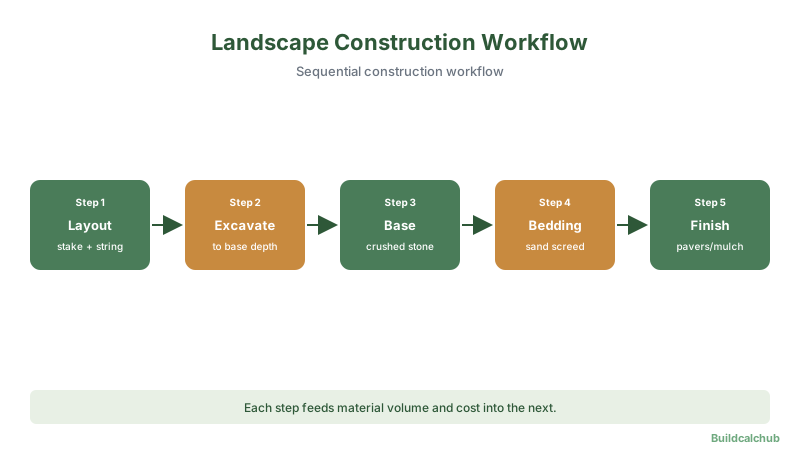
- Paver base less than 4 inches compacted. Crews in a hurry place 3 in of stone, run the compactor once, and drop sand. Within 18 months the pavers sink in traffic lanes. I specify 6 in base on patios, 8 in on driveways, compacted in 3 in lifts.
- Bedding sand deeper than 1 inch. The ‘just add more sand’ impulse is almost never right. Sand deeper than 1 in behaves as a slow-moving fluid under point loads. Every paver failure I've diagnosed where the base was adequate turned out to have 1.5 to 2.5 in of bedding sand. Screed the sand to exactly 1 in, re-screed if you step on it.
- Polymeric joint sand applied wrong. The polymer only activates with a brief moisture cycle. Too much water and you get white haze on the pavers; too little and the joint stays loose. The fix: read the product data sheet, apply at specified ambient humidity, and mist with a fine spray, not a flood.
- No drainage stone behind retaining walls. A wall below 4 ft tall without drainage works maybe 60% of the time in dry climates and maybe 20% of the time in wet ones. Above 4 ft, it's a failure waiting for the next rainy week. Always 12 in of clean 3/4 in stone wrapped in filter fabric with a 4 in perforated drain at the base (NCMA SRW Design Manual).
- Fence post footings shallower than 1/3 of the fence height. A 6 ft fence needs at least 24 in of post below grade, 30 in in wind-exposed areas. Homeowners save on fence because the posts ‘seem solid’ when the concrete sets; 18 months later the fence leans in the first wind event.
- Mulch volcanoes at tree bases. Piling mulch 6 to 10 in deep against the trunk rots the bark, starves the root flare of oxygen, and harbors rodents. I strip these out and rebuild with a 2–3 in layer pulled back 3 in from the trunk.
- Deck ledger not flashed correctly. The #1 cause of deck collapse isn't framing failure — it's a ledger board lag-bolted to a rotten rim joist. Always flash with Z-flashing or a self-adhered membrane, never caulk alone, and confirm the rim joist is sound before bolting (AWC DCA-6).
- Edge restraint missing or weak. A paver patio with no perimeter restraint spreads sideways every season. Steel edging driven with 10 in spikes every 24 in is my minimum. Plastic edge with 6 in spikes every 36 in fails within three years.
- Planting rows against drainage grade. Shrub beds graded flat or toward the foundation push water against the house. Every bed needs a 2% slope away from structure and I check it with a level before mulching.
- Using hardscape materials without reading the salt-weather spec. Clay and some concrete pavers will spall under deicing salt. In salt-use regions I spec ASTM C902 Class SX for clay or ASTM C936 with Class A freeze-thaw for concrete pavers. Cheaper Class B or Class C pavers are fine in Phoenix and disastrous in Syracuse.
Material Selection & Cost Guide
Typical landscape project budget distribution:
- Patio: 25-35% of total
- Deck: 30-45%
- Retaining walls: 10-20%
- Fence: 10-15%
- Mulch & planting: 8-15%
- Base materials & prep: 10-15%
For the average 1/4-acre residential lot, full hardscape renovation ranges $15,000-50,000+. Budget 10-15% contingency for unforeseen conditions (tree roots, drainage issues, access problems).
Retaining walls deserve special attention — they fail from water pressure more than from structural overload. Before sizing a wall, read our retaining wall drainage guide to learn why the drainage layer matters as much as the wall material itself. For 2026 installed pricing ($30–$95/face-ft by material plus the 4-ft engineering threshold), see the companion retaining wall cost guide.
For 2026 paver patio pricing — the most common landscape project — see our paver patio cost guide with $/sqft by paver material (concrete $14–$22, brick $20–$30, natural stone $25–$40), the four line items every quote should show, DIY vs contractor break-even and regional multipliers across 6 US bands.
Landscape Project Quick Reference — Material, Size & 2026 Cost
| Project | Typical Size | Material Cost Range | Time to DIY |
|---|---|---|---|
| Mulch bed refresh | 300 ft² | $80-200 | 1 day |
| Small paver patio | 144 ft² (12×12) | $600-2,100 | 1 weekend |
| Large paver patio | 360 ft² (18×20) | $1,500-5,200 | 2-3 weekends |
| Low garden wall | 20 × 2 ft | $250-450 | 1 weekend |
| Driveway retaining wall | 40 × 4 ft | $1,600-3,200 | 3-4 weekends |
| Wood privacy fence | 100 lf × 6 ft | $1,500-2,500 | 2-3 weekends |
| Small wood deck | 12 × 16 ft | $1,800-3,500 | 3 weekends |
| Composite deck | 14 × 20 ft | $7,000-12,000 | 4 weekends |
Material costs only. Installation labor adds 50-100% for fence, 75-150% for deck, 50-80% for paver/concrete projects. DIY timing for intermediate skill level.
Project Sequencing for Mixed Landscape
When combining multiple projects (patio + deck + fence + walls), sequence matters:
- Permits & design — deck and walls typically need permits; fence sometimes.
- Excavation & grading — earth-moving first. Final grade before any hardscape installs.
- Retaining walls — create level pads for subsequent work.
- Deck foundations (concrete piers / footings) — 1-3 days ahead so concrete cures.
- Drainage installation — pipes, catch basins, French drains routed before any impermeable surfaces go in.
- Patio base & pavers — separate stage; often at same level as deck posts.
- Deck framing & boards — after concrete cure.
- Fence installation — near last; avoids damage from equipment.
- Planting & mulch — final step after all construction done.
This sequence minimizes re-work and site damage. Skip the order and you're digging up fresh pavers to run drain pipes, or damaging new fence to haul deck lumber.
For patio builds, the paver patio project path connects excavation, base depth, bedding sand, paver count, slope, and edging into one workflow.
For walls, the retaining wall project path links block count, drainage stone, base, excavation, and failure-risk checks.
For paver work specifically, the paver base depth guide should be checked before using the paver, patio, road base, and sand calculators together.
Real-World Example Calculations
Full Backyard Renovation: 1/4-acre Home
Complete landscape install: 320 ft² paver patio, 16 × 20 ft composite deck, 40 × 4 ft retaining wall, 150 lf × 6 ft wood privacy fence, 800 ft² mulched beds.
- Paver patio
- 360 ft² × $22 = $7,920
- Composite deck
- 320 ft² × $35 = $11,200
- Retaining wall
- 160 ft² × $35 = $5,600
- Wood fence
- 150 lf × $32 = $4,800
- Mulch beds
- 800 ft² × $0.30 = $240
Takeaway: Average residential backyard renovation. Phased over 4-6 months allows budgeting and quality focus on each project.
2026 Landscape Pricing & 3-Year Cost Trend
Landscape material costs rose 6–12% from 2024–2025, with the biggest jumps in:
- Lumber (decking, fencing) — supply chain still recovering from 2021–2024 swings
- Composite decking — petroleum-based component pricing
- Natural stone — imported pavers subject to shipping costs
- Concrete pavers — cement and aggregate cost pass-through
| Year | Paver patio $/ft² | Retaining wall $/face ft | 6-ft fence $/lf | Composite deck $/ft² |
|---|---|---|---|---|
| 2024 | $15–$22 | $28–$42 | $22–$34 | $28–$42 |
| 2025 | $17–$25 | $32–$48 | $26–$38 | $32–$48 |
| 2026 | $18–$28 | $34–$52 | $28–$42 | $35–$55 |
Labor rates for landscape contractors rose 15–20% in major metros, reflecting a tight construction trades market. DIY is more attractive than ever for those with time — saves $8,000–15,000 on a mid-size renovation.
For structural outdoor work, review the deck footing spacing guide before estimating concrete piers and the fence post depth guide before ordering posts and concrete.
Hardiness Zones, Frost Depth & Landscape Material Choice
Landscape construction lives at the intersection of engineering and horticulture. A paver patio in Ann Arbor and the same patio in Orlando are built from different depths, different fabrics, and different edging details, even if the surface stones look identical. I've spent enough summers building in zones 5 through 9 to know which details make the difference.
Zone 3-4 (MN, ND, northern WI, most of Alaska): deep-frost country
Frost line runs 48 to 60 inches. Deck footings extend below 54 inches by code in most of Minnesota (or you build a frost-protected shallow foundation, which is a separate spec with insulation details). Retaining walls over 3 ft in height need engineered footings here, not just a gravel base. Mulch depth should go to 4 in in spring to protect root systems; thinner and the freeze-thaw cycle lifts plantings right out of the ground.
Edging matters differently up here: a 10 ft run of plastic bender board will frost-heave right off an overnight 20°F to 45°F swing. Use metal or stone edging pinned at 18 in deep anchors. I switched my Minneapolis clients to 3/16 in steel after three consecutive seasons of plastic failure.
Zone 5-6 (NY, MA, PA, OH, IL, most of IA, northern MO, northern UT): standard frost belt
Frost line 32 to 42 inches. This is where most of my East Coast work happens and where the textbook numbers actually apply. Paver base goes 6 to 8 inches, retaining wall base goes 12 inches compacted, deck footings 42 inches to be safe against a cold winter. Mulch depth 3 in in spring, 2 in in fall top-off.
One detail specific to this zone: late-fall paver install is risky. Pavers set in October or November sit in a wet, slowly-freezing base all winter and can shift during the first spring thaw. I don't start a paver patio after October 10 in Zone 6; I schedule it for April instead.
Zone 7-8 (VA, NC, TN, KY, AR, most of GA, parts of TX): shallow-frost, heavy-rain
Frost line 12 to 24 inches. Deck footings can legally be 18 inches in most of Virginia and North Carolina, but I still go 24 in because the red clay subsoil swells and shrinks seasonally. Retaining walls need more drainage attention here than frost attention: I've seen 8 ft walls fail from hydrostatic pressure in 48 hours after a 4 in rain event. Spec the drainage system like your insurance depends on it.
Mulch breaks down faster in warm humid climates. Shredded hardwood lasts 2 to 3 years in Zone 5 but only 14 to 18 months in Zone 8. Budget for more frequent refresh.
Zone 9-10 (FL, south TX, south CA, AZ, NV desert, HI): frost-free but challenging
No frost, but everything else is different. Expansive soils in central TX and parts of AZ require engineered slabs or pier-and-beam decks. Termite pressure in FL means pressure-treated posts must contact copper azole or micronized copper treatments, not just the older CCA. Salt spray in coastal FL and HI corrodes standard galvanized hardware; use 316 stainless or polymer-coated.
Mulch in Zone 9+: pine straw, rubber mulch, or cocoa hull — not shredded hardwood. Hardwood mulch in Phoenix becomes termite habitat within a season.
Pacific Northwest (Zone 7-8 coastal WA, OR, northern CA): wet and mild
Rain is the dominant variable. Paver patios require 2 to 3% crown drainage or they hold standing water. Retaining wall drainage stone should be 16 in wide instead of the 12 in I use in drier regions. Mulch goes 2 in deep but gets replaced annually because the rain breaks it down. Deck structures need extra flashing and kiln-dried framing lumber to prevent rot.
Regional Landscape Project Pricing (2026)
Installed hardscape pricing swings dramatically by region because labor is the biggest single line item (often 50 to 70% of a mulch or paver project). Below is what I see in the market in Q1 2026 for the four most common residential landscape projects.
| Region | Paver patio $/ft² installed | Retaining wall $/face ft | Mulch install $/yd³ spread | 6-ft fence $/linear ft |
|---|---|---|---|---|
| Northeast (NY/NJ/MA) | $22–$32 | $38–$55 | $78–$105 | $32–$48 |
| Mid-Atlantic (DE/MD/VA) | $18–$26 | $32–$45 | $62–$85 | $26–$38 |
| Southeast (NC/SC/GA/FL) | $14–$22 | $28–$40 | $55–$78 | $22–$34 |
| Midwest (OH/IN/IL/MI) | $16–$24 | $30–$42 | $58–$82 | $24–$36 |
| Mountain West (CO/UT/AZ) | $18–$28 | $34–$48 | $68–$92 | $28–$40 |
| Pacific Northwest (OR/WA) | $20–$30 | $38–$52 | $78–$105 | $32–$45 |
| California (non-Bay) | $22–$32 | $42–$58 | $85–$115 | $36–$52 |
| California Bay Area | $28–$42 | $55–$78 | $110–$145 | $48–$68 |
| Rural (any region) | -10% to -20% | -10% to -20% | -10% | -5% to -15% |
Where the money goes on a 400 ft² paver patio
For a 400 ft² paver patio in the Mid-Atlantic priced at $22/ft² (so $8,800 turnkey) in 2026, I usually see this breakdown:
- Excavation and disposal: $800 to $1,200 (9 to 14%)
- Base aggregate and geotextile: $900 to $1,400 (10 to 16%)
- Pavers (material): $1,600 to $2,400 (18 to 27%)
- Bedding sand, joint sand, edge restraint: $350 to $550 (4 to 6%)
- Labor, equipment, compaction: $3,200 to $4,400 (36 to 50%)
- Overhead, insurance, profit: $600 to $900 (7 to 10%)
A patio bid at $14/ft² in this market is almost certainly cutting the base, the fabric, or the labor compaction steps. I've inspected enough failed discount patios to know what happens three summers later.
Four cost-control moves that don't compromise quality
- Size the patio to standard paver dimensions. A 12x14 patio uses whole pavers; a 12x13.5 patio generates 7% cut waste. Plan dimensions in multiples of your chosen paver.
- Local-source pavers. Shipped pavers from out-of-state add $0.60 to $1.20 per ft². A local manufacturer with a 60-mile radius beats an imported European paver on both cost and regional freeze-thaw performance.
- Do prep work yourself, leave install to pros. Homeowner-done excavation and base placement (with rental compactor) can save $1,500 to $2,500 on a 400 ft² patio. The precision-dependent work (screed, placement, polymeric) is where pros earn their rate.
- Combine with neighbors. Fence projects especially benefit from shared crews and shared material delivery. A 200 linear ft fence project on two adjacent lots runs 12 to 18% less per foot than two 100-ft fences scheduled separately.
Price any landscape project with the paver calculator, retaining wall calculator, mulch calculator, or fence calculator for materials, then layer the regional labor factor from the table above on top.
Seasonal scheduling windows I use with clients
Material choice is only half the job; timing decides whether you are fighting the weather or working with it. I write my project calendars by the following windows, which I've refined after too many muddy spring mornings and too many frozen November ground-freeze calls:
- March 15 to May 1 (zones 5-7): best window for retaining walls and paver install. Ground has thawed but vegetation hasn't leafed out, so excavation is clean and plant protection is simple. Order material 4 weeks ahead because this is also when every contractor competes for the same crushed stone.
- April 15 to June 15 (zones 5-7): ideal mulch install window. Soil temperature is warm enough to suppress weeds, vegetation has emerged so you can see bed edges, and you avoid the June heat that desiccates fresh mulch.
- September 1 to October 15 (zones 5-7): best deck install window. Lumber has dried through summer, humidity is dropping, and staining cures reliably in the cool dry air.
- June through August (zones 5-7): I avoid major excavation in this window because high humidity slows concrete cure, and existing landscape plants struggle to recover from root disturbance during active growth.
- November and December (zones 8+): excellent window for hardscape in the warm-winter regions. Crews are less booked, ground is firm, and temperatures are ideal for concrete cure.
In my scheduling spreadsheet I tag every project with a preferred window and a fallback window. A client committed to both gets a 5 to 8% discount because I can move their project into the slot that works best for my crew. That's not quite a formal discount program, but it's what happens when contractors get flexibility.
Engineering References
These references are used for terminology, safety boundaries, and engineering assumptions. Local code, supplier specifications, and licensed design documents still control your project.
-
ICC Digital Codes: International Residential Code
International Code Council
Referenced for residential footing, slab, deck, and code-compliance terminology.
-
ASTM D448: Standard Classification for Sizes of Aggregate
ASTM International
Referenced for crushed stone and aggregate size classifications.
-
OSHA Trenching and Excavation Safety
Occupational Safety and Health Administration
Referenced for excavation safety, protective systems, and worker-safety boundaries.
-
American Wood Council DCA-6: Prescriptive Residential Wood Deck Construction Guide
American Wood Council
Referenced for deck framing, span tables, ledger flashing and post-footing requirements.
-
NCMA Segmental Retaining Wall (SRW) Design Manual
National Concrete Masonry Association
Referenced for SRW height limits, drainage stone width, geogrid reinforcement and base preparation used in the retaining-wall calculator.
-
ASTM C936 / C902: Standard Specifications for Solid Concrete & Clay Pavers
ASTM International
Referenced for paver freeze-thaw class (Class A) and salt-spalling resistance used in regional material selection.
Frequently Asked Questions
What's the best order for a landscape renovation?
1. Design & permits. 2. Excavation. 3. Retaining walls. 4. Deck footings. 5. Drainage. 6. Patio & pavers. 7. Deck framing. 8. Fence. 9. Plantings & mulch. Each step avoids disturbing the next.
How much does a landscape renovation cost?
Residential scope: $15,000-50,000 for full backyard hardscape renovation (1/4-acre typical). High-end custom: $50,000-150,000+. Phased renovation spread over 2-3 years can fit $5k-10k annual budgets.
Can I DIY a whole landscape project?
Yes for small-medium scope. Most hardscape projects (patio, walls under 3 ft, fence, mulch) are intermediate-DIY. Decking and larger walls are advanced-DIY. Time is the biggest factor — DIY typically takes 3-5× longer than hired work. Make sure you have the calendar space before committing.
Do I need a landscape designer?
For under $10k projects, typically no. For $10-30k, an hour of paid design consultation ($150-300) pays for itself by preventing costly mistakes. For $30k+, working with a designer typically saves 10-20% overall by optimizing material choices and sizing.
How long does landscape work take?
Professional: 2-6 weeks for full renovations. DIY: 4-6 months typical, with weekend progress. Weather, permitting, and material availability affect both. Plan to start in early spring for summer completion.
What's the best time to do landscape work?
Late spring to early fall for most regions. Concrete and pavers need temperatures above 40°F and below 95°F for proper curing. Planting ideally in fall (cooler root establishment) or early spring. Fence and deck can install in winter if ground isn't frozen.
What permits do I need for landscape work?
Typically: retaining walls over 3-4 ft, decks attached to house, fences over 6 ft back / 4 ft front, significant drainage modifications, impervious surface increases in flood zones. Always check with your local building department. Unpermitted work creates issues at home sale.