Concrete Calculator — Cubic Yards, Bags and Material Cost
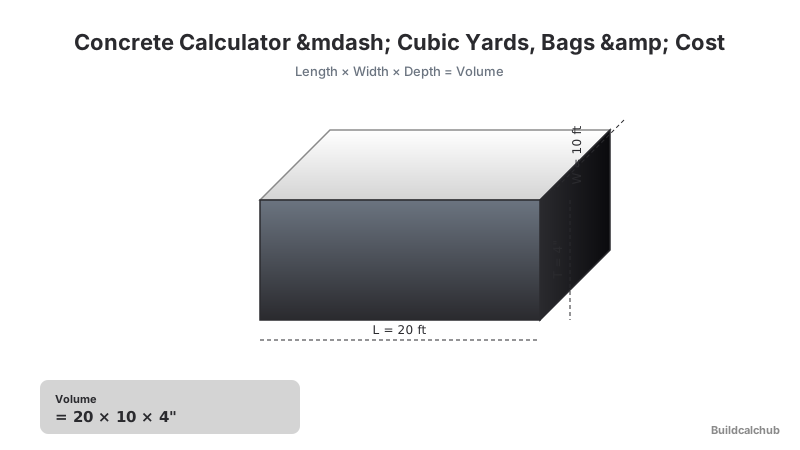
Estimate cubic yards of concrete from length × width × thickness, then convert to 60-lb / 80-lb bags or a ready-mix order with a visible waste factor.
Concrete Calculator
Enter project dimensions below — results update instantly. Switch units freely.
Estimates assume typical industry density and waste factors. Always verify with your supplier and local building code before purchasing material.
Why Concrete Short-Ordering Wrecks Your Project
Ready-mix trucks pour concrete in a continuous stream. Once the pour starts, the clock is running — concrete begins initial set at 30 minutes and reaches final set at 2-4 hours. If you run out mid-pour and have to wait for another truck, you get a cold joint that becomes a permanent structural weakness.
Three mistakes that wreck concrete estimates:
- Calculating on plan dimensions — not accounting for over-excavation or form flex
- Ignoring waste — 5-10% goes to spillage, form bleeding, and the inevitable last-bucket overrun
- Rounding down instead of up — suppliers charge for the truck capacity used; rounding up to the next quarter-yard costs $30-50, while a return trip costs $200-400
This calculator builds in a 10% waste default and outputs bag equivalents so you can pick between ready-mix trucks and bagged mix based on total volume.
The Concrete Volume Formula — Yards, Bags, and 2026 Cost
27 is the number of cubic feet in a cubic yard (3 × 3 × 3).
Why 27? A cubic yard is a 3-ft cube. Each side is 36 inches. Three feet × three feet × three feet = 27 cubic feet. Every concrete calculation eventually hits this ÷ 27 step.
Bag equivalents (cured volume):
- 60-lb bag yields 0.45 ft³ (about 2.2 bags per ft³)
- 80-lb bag yields 0.60 ft³ (about 1.67 bags per ft³)
- 40 bags of 80-lb ≈ 1 cubic yard (per Quikrete & Sakrete yield charts, verified against ASTM C387)
Ready-mix cutoff is typically 1 cubic yard — below that, bagged is cheaper; above that, ready-mix is cheaper and faster.
| Year | Avg $/yd³ full truck | Short-load minimum (1–3 yd³) | YoY change |
|---|---|---|---|
| 2024 | $135–$155 | $85–$120 fee | baseline |
| 2025 | $145–$170 | $85–$135 fee | +8–10% |
| 2026 | $150–$180 | $85–$150 fee | +4–6% |
Once the Concrete Calculator result looks reasonable, cross-check the next job decision with the Concrete Slab Calculator and the Concrete Calculator. For sidewalk pours specifically, use the dedicated concrete sidewalk calculator — it adds the ACI 332 control-joint spacing rule (3T to 5T in feet) and the ADA 2010 cross-slope check (max 2%) that flatwork-only calculators miss. For dead-load and floor-framing capacity questions (countertops, overlays, retrofit slabs), run the concrete weight calculator to get lb/ft³, lb/yd³ and lb/sqft by mix type before committing to a thickness. That keeps the quantity, cost, and field assumption tied together before you call a supplier.
If you're trying to decide between bags and a ready-mix truck, the bag-count math (with break-even at 1.5 yd³) is in our how many bags of concrete do I need guide. If the pour you’re sizing is a driveway, walk our asphalt vs concrete driveway comparison first — the 20-year cost-of-ownership math and climate-fit table push a meaningful share of homeowners back toward asphalt for residential driveways in freeze-thaw regions.
What Most Online Calculators Get Wrong Reviewed by the Concrete & Foundations Review Desk
The concrete calculator gives you cubic yards. What it can’t give you is the four engineering decisions that turn the right cubic yards into a slab that hits design strength. Most online concrete calculators get all four wrong; here’s the working fix.
- Cure temperature isn’t in the model. Calculators assume the slab hits 100% of 28-day design strength regardless of weather. In Mid-Atlantic October pours (avg 50°F cure temp) the slab tops out at 85–92% of design at day 28 (per concrete curing time chart). Below 40°F without active heating, you lose 60–80% of design strength permanently. The cubic yards number is correct; the strength assumption is fiction unless you control cure temperature. Use insulating blankets + heaters on any pour below 50°F ambient.
- Slump and water-cement ratio dropped at the chute. The single biggest field failure: driver or crew adds water to ease finishing. Every gallon of added water to a 10-yard truck drops 28-day strength by 150–250 psi. Five gallons of hose water takes a 4,000 psi design mix to ~3,000 psi real-world strength — a 25% strength loss invisible until cylinder break at day 28. Field check: a properly-batched 4,000 psi mix slumps 3–5 in. If the mix looks wetter than that and finishers complain about workability, water is being added. See concrete mix ratio guide for the working w/c ranges.
- Air entrainment robs 4–5% strength per 1% air. Calculators assume the design PSI is the placed PSI. For freeze-zone exterior concrete with 6% air entrainment, that’s a ~25% strength loss from air voids. A 4,000 psi design + 6% air tests more like 3,000–3,200 psi at 28 days. To land at 4,000 psi placed strength, design for 4,500–5,000 psi. Ready-mix plants handle this if you tell them the exposure class; calculators don’t prompt for it.
- (KOL counter-view) Cylinder testing isn’t the only acceptance method — ACI 318-19 added in-place verification. Traditional QA breaks ASTM C39 cylinders at day 28. But ACI 318-19 Section 26.12 now permits maturity-based in-place strength estimation per ASTM C1074, which uses embedded temperature sensors to compute the actual placed strength continuously. For cold-weather pours or aggressive schedule projects, in-place maturity testing catches strength gain 3–7 days earlier than cylinder breaks — letting you safely strip forms and resume work on real evidence, not on the calendar. The sensor cost is ~$80 per pour vs the $4,000–14,000 cost of a wrong strip-form decision. (Source: Dr. Nick Carino, NIST, originator of the maturity method; widely adopted on DOT and commercial projects since 2019.)
Concrete Coverage Table and Material Reference
| Project | Cubic Feet | Cubic Yards | 60-lb Bags | 80-lb Bags | Best Method |
|---|---|---|---|---|---|
| Fence post hole (12×36 in) | 2.4 | 0.09 | 6 | 4 | Bags |
| Sonotube 10 in × 4 ft | 2.2 | 0.08 | 5 | 4 | Bags |
| Sidewalk 4 × 8 ft × 4 in | 10.7 | 0.40 | 24 | 18 | Bags |
| Patio 10 × 10 ft × 4 in | 33.3 | 1.23 | 74 | 56 | Ready-mix |
| Patio 14 × 14 ft × 4 in | 65.3 | 2.42 | 145 | 109 | Ready-mix |
| Garage slab 20 × 20 ft × 5 in | 166.7 | 6.17 | — | — | Ready-mix |
| Basement slab 30 × 40 ft × 4 in | 400.0 | 14.81 | — | — | Ready-mix |
Break-even between bags and ready-mix is typically ~1 cubic yard at 2026 pricing.
| Quantity | Ready-Mix $/yd³ | Surcharge | Total Effective $/yd³ |
|---|---|---|---|
| 1-3 yd³ (short load) | $165 | $85-150 min. fee | $195-215 |
| 4-6 yd³ | $160 | None | $160 |
| 7-10 yd³ | $155 | None | $155 |
| 11+ yd³ (full truck) | $150 | None | $150 |
| Weekend / overtime | +$30 | +$75-125 dispatch | varies |
Pricing excludes delivery distance surcharge ($3-8 per mile beyond 20 mi), unloading time overage ($1-3 per min after 5-7 min per yd³).
Real-World Example Calculations
Standard Patio 12 × 12 ft @ 4 in
Backyard entertainment patio, residential.
- Length
- 12 ft
- Width
- 12 ft
- Thickness
- 4 in
- Waste
- 10%
Takeaway: Break-even point — ready-mix is $327 vs. bags at $525. Take the ready-mix.
Two-Car Garage Slab 24 × 24 ft @ 5 in
Detached garage floor over compacted gravel base.
- Length
- 24 ft
- Width
- 24 ft
- Thickness
- 5 in
- Waste
- 10%
Takeaway: One truck delivery (10-yd³ capacity). Add 4,000 psi mix, vapor barrier, and wire mesh reinforcement.
Basement Slab 30 × 40 ft @ 4 in
New construction basement floor with radiant heat tubing.
- Length
- 40 ft
- Width
- 30 ft
- Thickness
- 4 in
- Waste
- 10%
Takeaway: Two truck deliveries at 8 yd³ each. Schedule 90 minutes apart. Confirm pump availability if pour is more than 50 ft from truck access.
Sources & Standards
These references are used for terminology, safety boundaries, and engineering assumptions. Local code, supplier specifications, and licensed design documents still control your project.
-
ACI 318: Building Code Requirements for Structural Concrete
American Concrete Institute
Referenced for minimum cover, mix-design boundaries and structural slab thickness assumptions used in this calculator.
-
ASTM C94/C94M: Standard Specification for Ready-Mixed Concrete
ASTM International
Referenced for ready-mix tolerance, slump and delivery time limits used in the short-load fee discussion.
-
ASTM C387: Standard Specification for Packaged, Dry, Combined Materials for Mortar and Concrete
ASTM International
Referenced for the 60-lb and 80-lb bag yield conversion (0.45 ft³ and 0.60 ft³).
-
NRMCA Industry Data Survey & Ready Mixed Concrete Resources
National Ready Mixed Concrete Association
Referenced for 2026 ready-mix pricing context, short-load practices and full-truck capacity assumptions.
-
USGS Mineral Commodity Summaries (Cement)
U.S. Geological Survey
Referenced for the 3-year cost trend and cement supply economics.
Frequently Asked Questions
How many cubic yards of concrete do I need?
Calculate L × W × D (all in feet, convert inches by dividing by 12), then divide by 27. A 10×10 ft slab at 4 in thick = 10 × 10 × (4÷12) ÷ 27 = 1.23 cubic yards. Always add 10% waste: order 1.4 yd³.
How much concrete is in an 80-lb bag?
An 80-lb bag of concrete mix yields 0.6 cubic feet (≈ 0.022 cubic yards) of cured concrete. A 60-lb bag yields 0.45 ft³; a 40-lb bag yields 0.30 ft³. It takes about 45 bags of 80-lb to make 1 cubic yard.
Should I use bagged concrete or ready-mix?
Break-even is ~1 cubic yard. Below that, bagged is cheaper and doesn't require a truck. Above that, ready-mix is cheaper, faster, and produces a better continuous pour with no cold joints.
How much does a yard of concrete cost in 2026?
Ready-mix runs $150-180 per cubic yard for standard 4,000 psi mix. Short-load orders (under 4 yd³) add $85-150 in minimum fees. Specialty mixes (high-early, polymer-modified, fiber-reinforced) add $20-60 per yd³.
What is a short-load fee?
Concrete trucks hold 9-11 cubic yards. Orders under 4 yards typically incur a $85-150 minimum charge to cover the truck's lost capacity. Some suppliers call this a ‘short-load fee’ or ‘partial-load surcharge.’ Ask before ordering.
Can I pour concrete in winter?
Yes with precautions. Below 40°F, use hot water in the mix, accelerator additives, insulated blankets over the fresh pour, and/or propane heaters. Below 20°F, most contractors won't pour. Hydration needs to continue without freezing for 24-48 hours for proper strength gain.
How much waste should I add to my concrete order?
Standard recommendation: 10% for most residential pours. Add 15% for footings (over-excavation), 8% for flat slab work, 5% for perfectly formed pours like sonotubes. The cost of 10% extra material is always less than a return-trip for a short pour.
How many cubic yards fit in a concrete truck?
A typical ready-mix truck carries 8–10 cubic yards. Divide your calculated yards (with waste) by truck capacity and round up. Below ~1 yd³, bagged premix is usually cheaper than a short-load fee—price fees on the ready mix cost calculator.