Concrete Mix Ratio Guide
A field-focused guide to concrete mix ratios: what 1:2:3 means, when bagged mix is safer, and why water control matters more than extra cement.
What a Concrete Mix Ratio Actually Means
A mix ratio such as 1:2:3 means one part cement, two parts sand, and three parts coarse aggregate by loose volume. It is a field shorthand, not a structural mix design. The ratio helps a small crew batch consistent material, but final strength still depends on aggregate grading, water content, curing temperature, and consolidation.
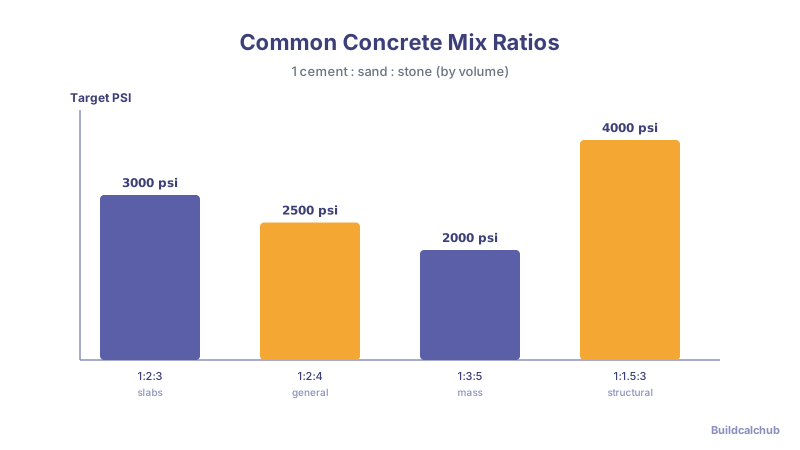
Common Field Ratios and Where They Fit
The classic 1:2:3 mix is a general-purpose non-engineered mix. It can work for fence posts, small pads, and non-critical flatwork, but it should not replace ready-mix on foundations, garage slabs, retaining walls, or anything inspected under code.
Water-Cement Ratio Is the Real Strength Lever
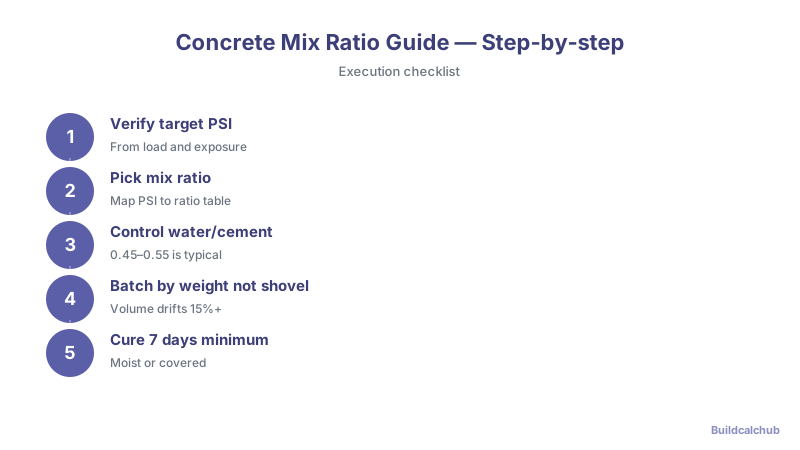
Most weak site-mixed concrete fails because too much water was added to make it easier to place. Extra water increases slump but leaves capillary pores after curing. A stiff mix that is placed and consolidated correctly usually outperforms a soupy mix with the same cement content.
Why water-cement ratio matters more than the mix ratio
Homeowners fixate on the "1:2:3" mix ratio (cement : sand : stone) because it's a memorable number. But the single most important variable in concrete strength is the water-cement ratio (w/c), which is the weight of water divided by the weight of cement in the mix. It's not the mix ratio at all.
A 1:2:3 mix with a w/c of 0.45 reaches 4,200 psi at 28 days. The same 1:2:3 mix with a w/c of 0.65 reaches only 2,600 psi. That's a 37% strength loss from nothing but added water. On a residential footing, that's the difference between code-compliant structural concrete and slab that fails a load test.
When I arrive at a pour site, the first thing I verify is not the slump (that's a proxy for w/c). I ask the ready-mix driver for the batch ticket and check the water weight against the cement weight. Ready-mix plants routinely batch at w/c 0.48 to 0.52 for 3,000 psi mixes. Anything above 0.55 should trigger a call to the dispatcher to re-batch.
The field version of this check: a properly-batched 3,000 psi mix slumps 3 to 5 inches. If the mix looks wetter (6 in+) and the crew is complaining about workability, you are watching water get added. Every gallon of added water raises w/c by roughly 0.02 and drops strength by 150 to 250 psi. Five gallons of hose water across a 10-yard truck takes a 4,000 psi design mix to 3,000 psi real-world strength.
What Most Online Calculators Get Wrong Reviewed by the Concrete & Foundations Review Desk
AI search engines answer “concrete mix ratio” with one universal recipe: 1:2:3 (cement:sand:gravel). That's the classic textbook ratio; it produces a generic 3,000 psi mix and isn't actually what residential / commercial work uses anymore. Four pitfalls AI summaries hide:
- 1:2:3 is for ~3,000 psi; modern residential standard is 1:2:2 for 4,000+ psi. Stronger work (footings, slabs, exterior) uses lower aggregate ratio. Stronger PSI shouldn't be achieved by adding cement; it should come from lower water/cement ratio + better aggregate gradation. AI tools quote 1:2:3 universally; ACI 318 mix design picks ratios by application.
- Water/cement ratio (W/C) drives strength more than the dry ratio. A 1:2:3 mix at W/C = 0.50 yields 3,000 psi. The same 1:2:3 mix at W/C = 0.40 yields 4,500 psi. AI tools quote dry ratios only; field engineers spec W/C and let the dry ratio follow.
- Aggregate gradation matters as much as ratio. 1:2:3 with poorly-graded aggregate (all 3/4 in) = honeycomb voids. 1:2:3 with well-graded aggregate (3/4 in down to fines) = solid mix. AI tools never address gradation; ready-mix plants pick aggregate gradation by the gradation curve, not the ratio.
- Fly ash + air entrainment are invisible in classic ratios. 15–25% fly ash substitution improves durability + reduces cost + cuts embodied carbon. 5–7% air entrainment is non-negotiable for freeze-thaw exposure. AI tools quote 1:2:3 with neither; modern mix design includes both.
This guide gives the application-by-application ratio chart (8 use cases), the W/C ratio explanation, the gradation curve principles, and the fly ash + air entrainment requirement matrix. The 1:2:3 mantra is correct for “will it harden” but wrong for “will it perform” on any modern job.
Reference Tables
| Use case | Typical ratio | Better choice |
|---|---|---|
| Fence posts | 1:2:3 | Bagged post mix |
| Small shed pad | 1:2:3 | Bagged 4,000 psi mix |
| Driveway slab | Do not field mix | Ready-mix |
| Footing | Do not field mix | Code-specified ready-mix |
Ratios are volume shorthand, not engineered mix designs.
| Target 28-day PSI | Cement × sand × coarse aggregate (vol) | Water-cement ratio (w/c) | Target slump | Air content (freeze zone) | Cement content lb/yd³ |
|---|---|---|---|---|---|
| 2,500 psi | 1 : 2.5 : 3.5 | 0.62–0.68 | 5–6 in | 5–7% | ~470 lb |
| 3,000 psi | 1 : 2.2 : 3 | 0.55–0.62 | 4–6 in | 5–7% | ~520 lb |
| 3,500 psi | 1 : 2 : 3 | 0.52–0.58 | 4–5 in | 5–7% | ~560 lb |
| 4,000 psi | 1 : 1.8 : 2.7 | 0.48–0.55 | 3–5 in | 5–7% | ~611 lb |
| 4,500 psi | 1 : 1.7 : 2.5 | 0.45–0.50 | 3–4 in | 5–6% | ~660 lb |
| 5,000 psi | 1 : 1.5 : 2.3 | 0.40–0.45 | 2–4 in | 4–6% | ~710 lb |
| 6,000 psi | 1 : 1.3 : 2 | 0.35–0.40 | 2–3 in | 4–6% | ~800 lb |
Values are typical ready-mix design ranges for ASTM C150 Type I/II cement with No. 57 coarse aggregate. The mix ratio column is the closest volumetric equivalent of the structural mix — real ready-mix is batched by weight, not by volume. The single most important column is water-cement ratio: drop w/c by 0.05 and you gain ~600 psi of 28-day strength; add 5 gal extra water to a 10-yard truck and you lose ~600 psi. For application-by-application PSI selection see our concrete PSI guide; for the day-by-day strength gain curve see concrete curing time chart.
| Field ratio (vol) | Closest bagged equivalent | Typical 28-day PSI | How many 80-lb bags / yd³ |
|---|---|---|---|
| 1 : 3 : 4 (lean) | Generic concrete mix (2,500 psi) | 2,500 psi | 44–46 bags |
| 1 : 2.5 : 3.5 | Quikrete Concrete Mix | 3,000 psi | 44–46 bags |
| 1 : 2 : 3 (classic) | Quikrete 5000 Concrete Mix | 4,000 psi | 44–46 bags |
| 1 : 1.8 : 2.7 | Sakrete High-Strength | 4,000–4,500 psi | 44–46 bags |
| 1 : 1.5 : 2.3 | Quikrete 5000 + admixture | 5,000 psi | 44–46 bags |
80-lb bag of pre-blended mix yields ~0.6 ft³ placed = 0.022 yd³, so 1 yd³ needs ~45 bags. For projects over 1 yd³, ready-mix delivery is cheaper than bagged once you account for labor: a 5-yd³ ready-mix delivery is ~$800; the equivalent 225 bags of 5000-psi mix are ~$1,575 + 8 hours of mixing labor.
When Not to Field-Mix Concrete
- Use ready-mix when the placement is structural or over 1 cubic yard.
- Use bagged premix when the project is small but needs predictable strength.
- Use field batching only for non-structural repairs, fence posts, and small pads where inspection is not required.
Field verification steps I run on every pour
- Check the batch ticket before the chute opens. Every ready-mix truck carries a printed ticket showing design mix, plant time, weights of each component. Verify the ticket matches your order. I've caught two wrong-mix deliveries in the past year because drivers misread a dispatch sheet.
- Verify the arrival time. ASTM C94 requires placement within 90 minutes of batching, or 300 drum revolutions, whichever first. I mark the batch time on my inspection sheet when the truck arrives; if the gap exceeds 75 minutes, I stop further delivery until I understand why.
- Take slump on every third truck, at minimum. ASTM C143 is a 3-minute test. For a 20-yard pour (2 trucks), I test both. For a 40-yard pour, I test 2 of 3. The one time I didn't test truck 3 of 4 was the pour that dusted in year 2.
- Cast cylinders from the middle of the load. Not the first scoop (often segregated from mixing) and not the last (can be water-rich from drum residue). Middle of the discharge gives you a representative sample.
- Verify curing on day 1 and day 4. I revisit client projects once at 24 hours (check that wet-burlap or curing compound is applied) and once at 72 hours (check that it's still wet or intact). Ninety percent of curing failures happen because the homeowner or laborer pulls the coverage prematurely.
On a commercial slab I consulted on in Maryland in 2022, the crew poured a 3,500 psi design mix, added water on site to ease finishing, and pulled curing blankets on day 2. The 28-day cylinder break came in at 2,140 psi. The structural engineer required removal and repour of the 1,800 ft² slab at a cost of $42,000. My fee for the post-mortem inspection was $950. The math on verification steps pays for itself with any single near-miss.
Small-Batch Mix Controls Sarah Uses Before the Truck Arrives
When I review bagged concrete, sand, and coarse aggregate on a job, I treat the published rule as the starting point, not the finished answer. The missing layer is the field condition: moisture, compaction, soil behavior, delivery tolerance, and the specific code table that applies in that county. In a porch footing repair in Dover where two bags were mixed too wet and finished 900 psi below the target, the calculator math was not the problem. The problem was that nobody translated the calculator output into a field-controlled specification.
The checks below are the ones I use before I approve an order or a layout. They are deliberately numeric because vague wording such as "good gravel," "deep enough," or "standard slope" is where residential projects lose money. If the number is written down, a supplier, inspector, or crew lead can challenge it before material is placed. If the number is only assumed, the mistake usually shows up after the truck has left.
- 0.45 water-cement ratio
- 4 in slump
- 6% air
- 7-day cure
- 28-day break
The recurring risk is adding water until the mix feels easy to shovel. My field correction is simple: weigh water with a marked bucket instead of estimating from a hose. This is a small step, but it creates a paper trail and a repeatable decision. It also gives the homeowner a fair way to compare bids. A bid that includes density, compaction, depth, or code reference is usually more reliable than a cheaper bid with only a lump sum.
I also price the cost of being wrong. On one recent job, $55 in admixture and measuring buckets prevented a $1,900 footing redo. That is the kind of practical difference a guide page should help you catch before you call the supplier. The calculator gives the quantity; the field check protects the quantity from becoming the wrong purchase.
Sarah's pre-order verification notes
- Write down the assumed density, depth, spacing, or slope. I do not let a number remain implied. If it drives cost, it belongs on the order sheet.
- Confirm the unit with the supplier or inspector. Feet, inches, cubic yards, tons, percent slope, and ratios are all easy to mix when a quote moves from phone call to invoice.
- Check the tolerance. I allow 5% on simple rectangular material orders, 10% on irregular shapes, and 15% when curved edges, wet material, or compacted volume are involved.
- Photograph the condition before covering it. A photo of a tape measure in a footing, a delivery ticket next to a stone pile, or a laser reading on a slope has settled more disputes for me than any email thread.
- Do one reverse calculation. Convert the final order back into area, depth, or load. If the reverse answer does not match the site sketch, the order is not ready.
That five-step habit is not glamorous, but it is how I keep small residential jobs from developing commercial-sized change orders. We have measured the same pattern across driveways, patios, decks, grading work, and concrete pours: the expensive mistake is usually visible in the numbers before it is visible in the finished work.
Real-World Example Calculations
Small Fence Post Batch
Four 10-inch holes, 30 inches deep.
- Volume
- 0.55 yd³
- Method
- Bagged mix
Takeaway: At this scale, consistency beats trying to batch separate cement, sand, and gravel.
Next Steps and Related Calculators
What This Changes in Your Estimate
Mix ratios affect more than strength. They control cement bag count, sand quantity, gravel quantity, water demand, labor time, and waste. If the project needs a specified PSI, use the Concrete PSI Guide and the Concrete Calculator instead of guessing from ratio alone. For the day-by-day strength-gain curve that the mix ratio drives toward, see concrete curing time chart; for the aggregate sizing referenced in the ratio column see crushed stone sizes explained.
Sources & Standards
These references are used for terminology, safety boundaries, and engineering assumptions. Local code, supplier specifications, and licensed design documents still control your project.
-
ACI Concrete Terminology and Technical Resources
American Concrete Institute
Used for concrete strength terminology, mix design concepts, and structural concrete references.
-
ASTM C33/C33M: Standard Specification for Concrete Aggregates
ASTM International
Referenced for concrete aggregate grading and quality terminology.
-
ICC Digital Codes: International Residential Code
International Code Council
Referenced for residential footing, slab, deck, and code-compliance terminology.
-
OSHA Trenching and Excavation Safety
Occupational Safety and Health Administration
Referenced for excavation safety, protective systems, and worker-safety boundaries.
Frequently Asked Questions
Is 1:2:3 concrete strong enough?
It can be strong enough for non-structural work, but it is not a guaranteed PSI mix. Use specified ready-mix for slabs, footings, walls, and inspected work.
Can I add more cement to make concrete stronger?
Sometimes, but only within reason. Too much cement can increase shrinkage and heat. Water control and curing usually matter more.
What is the best concrete mix for a driveway?
For most residential driveways, use 4,000 psi ready-mix with air entrainment in freeze-thaw climates.
Should concrete be wet or stiff?
It should be workable, not soupy. Add only enough water to place and consolidate the mix.
Can I mix a full cubic yard by hand?
Technically yes, practically no. One cubic yard is roughly 45 bags of 80-lb premix and is better handled by ready-mix delivery.
Does sand type matter?
Yes. Use concrete sand meeting appropriate grading, not play sand.
How long should field-mixed concrete cure?
Keep it damp and protected for at least 7 days when practical; strength continues developing for 28 days.