Cement Bag Calculator — Premix Bags for Small Pours
Count premix cement bags (60-lb / 80-lb) for small DIY pours. For truck-delivered cubic yards, use the concrete calculator instead—cement ≠ ready-mix concrete.
Cement Bag Calculator
Enter project dimensions below — results update instantly. Switch units freely.
Estimates assume typical industry density and waste factors. Always verify with your supplier and local building code before purchasing material.
‘Cement’ vs. ‘Concrete’: Terminology That Costs Money
In casual conversation they're synonyms. In the aisle at a home center, they're different products:
- Portland cement — pure grey powder, the binder. Sold in 94-lb bags. Does not make concrete by itself.
- Premixed concrete — cement + sand + aggregate + dry admixtures. Labeled ‘concrete mix’ on bags. Sold in 40/60/80-lb bags. Just add water.
- Mortar mix — cement + fine sand, no aggregate. For laying brick and block. Labeled ‘mortar mix’ or ‘Type N/S’.
- High-strength / rapid-set — premixed concrete with accelerators. For post setting and fast-cure applications.
When someone asks ‘how many bags of cement?’ they almost always mean ‘how many bags of concrete mix?’ — which is what this calculator counts.
Key yields to memorize:
- 80-lb bag yields 0.60 cubic feet
- 60-lb bag yields 0.45 cubic feet
- 40-lb bag yields 0.30 cubic feet
How to Calculate Cement Calculator
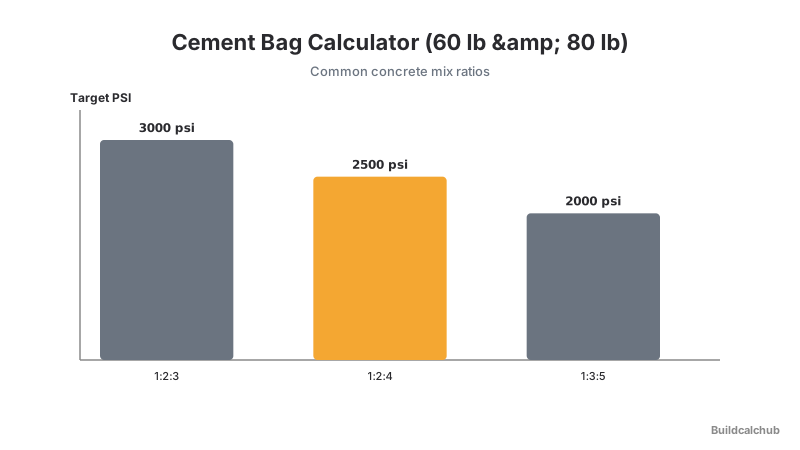
Bagged premixed concrete is the right choice for projects under 1 cubic yard (~45 bags of 80-lb). Above that, ready-mix is both cheaper per cubic foot and faster to place.
Cost comparison for 1 cubic yard (27 ft³):
- 45 bags of 80-lb @ $5-7 each = $225-315
- 60 bags of 60-lb @ $4-5 each = $240-300
- Ready-mix short load (1 yd³) = $165 + $85-150 min fee = $250-315
Bagged is competitive for small jobs but the real cost is labor. Mixing 45 bags by hand takes 4-6 hours and produces inconsistent slump. Ready-mix delivered is done in 5 minutes of unloading.
For projects where ready-mix access is impossible (backyard behind a building, remote site, upper-floor work), bagged is the only option even above 1 yd³.
Once the Cement Calculator result looks reasonable, cross-check the next job decision with the Concrete Calculator and the Concrete Slab Calculator. For full bag-count math by project (fence posts, footings, patios, sidewalks) and the bagged-vs-ready-mix break-even table, read how many bags of concrete do I need. That keeps the quantity, cost, and field assumption tied together before you call a supplier.
What Most Online Calculators Get Wrong Reviewed by the Concrete & Foundations Review Desk
AI search engines treat “cement” and “concrete” as synonyms. They're not — cement is the binder (10–15% of mix), concrete is the cured product. Four pitfalls AI summaries hide:
- Cement bag does NOT equal concrete volume. One 94-lb cement bag yields ~1 ft³ of cement powder. Combined with sand + aggregate + water, that one bag produces ~4–5 ft³ of cured concrete (1:2:3 ratio). AI tools sometimes equate the two.
- Type I vs II vs V cement: 3 different products. Type I/II = general residential. Type III = high early strength (cold weather). Type V = sulfate-resistant (coastal / chemical exposure). AI tools quote “cement” generically.
- Water/cement ratio drives strength more than cement quantity. W/C = 0.40 yields 4,500 psi; W/C = 0.60 yields 2,500 psi. Same cement bag, different result. AI tools focus on bag count; field engineers spec W/C.
- Cement bag yield is 0.45–0.50 ft³, NOT 1 ft³ of cured concrete. AI sometimes equates bag count to concrete cubic feet. For 1 yd³ of concrete (27 ft³), you need ~6.5 bags of cement plus sand + gravel + water.
This calculator distinguishes cement bags from concrete volume, applies W/C ratios, and references Type I/II/V/III selection. Don't confuse cement with concrete — the math is fundamentally different.
Cement Coverage Table and Material Reference
| Bag Size | Yield (ft³) | Yield (yd³) | Bags per yd³ | Typical Cost |
|---|---|---|---|---|
| 40 lb | 0.30 ft³ | 0.011 yd³ | 90 bags | $3.50-4.50 each |
| 50 lb | 0.38 ft³ | 0.014 yd³ | 72 bags | $4.00-5.00 each |
| 60 lb | 0.45 ft³ | 0.017 yd³ | 60 bags | $4.00-5.00 each |
| 80 lb | 0.60 ft³ | 0.022 yd³ | 45 bags | $5.00-7.00 each |
| 94 lb Portland | 0.70 ft³ (mortar) | 0.026 yd³ | 39 bags | $12-18 each |
Yield is approximate; always read the specific product label for the exact yield specification.
| Project | Volume | 60-lb Bags | 80-lb Bags |
|---|---|---|---|
| 8 in × 2 ft fence post | 0.7 ft³ | 2 | 2 |
| 10 in × 3 ft mailbox post | 1.6 ft³ | 4 | 3 |
| 12 in × 3 ft deck footing | 2.4 ft³ | 6 | 4 |
| 10 in × 4 ft deck footing | 2.2 ft³ | 5 | 4 |
| Sonotube 12 in × 4 ft | 3.1 ft³ | 7 | 6 |
| Shower curb 6 × 4 in × 4 ft | 0.67 ft³ | 2 | 2 |
| Stoop 4 × 4 × 4 in | 5.3 ft³ | 12 | 9 |
| Sidewalk 4 × 12 × 4 in | 16.0 ft³ | 36 | 27 |
Always buy 1-2 extra bags beyond the calculation for small pours — returning unused bags is simpler than making a second hardware-store trip mid-pour.
Real-World Example Calculations
Fence Installation: 12 × (8 in × 2.5 ft) posts
100-ft backyard fence with posts every 8 ft.
- Post count
- 12 posts
- Hole diameter
- 8 in
- Hole depth
- 2.5 ft
- Bag size
- 60 lb
Takeaway: Buy 35 bags at ~$140. Use fast-setting mix to avoid waiting 24 hr per post.
Concrete Sidewalk 4 × 20 ft × 4 in
DIY front walkway from driveway to porch.
- Length × Width
- 20 × 4 ft
- Thickness
- 4 in
- Bag size
- 80 lb
Takeaway: Cost ~$270 for concrete + $40 wire mesh. Takes ~4 hr to mix and place with a small portable mixer.
Generator Pad 4 × 6 × 6 in
Small concrete pad for backup generator installation.
- Length × Width
- 6 × 4 ft
- Thickness
- 6 in
- Bag size
- 80 lb
Takeaway: Perfect weekend project. Use high-early-strength mix so generator can be set in 7 days instead of 28.
Sources & Standards
These references are used for terminology, safety boundaries, and engineering assumptions. Local code, supplier specifications, and licensed design documents still control your project.
-
ACI CODE-318-19(22) — Building Code Requirements for Structural Concrete and Commentary
American Concrete Institute
Cited for the structural concrete design code that governs slab, footing, column, and reinforcement requirements.
-
ACI CODE-332-20 — Code Requirements for Residential Concrete and Commentary
American Concrete Institute
Cited for residential-scale concrete requirements (footings, slabs, walls) referenced throughout the IRC.
-
ASTM C94/C94M-23 — Standard Specification for Ready-Mixed Concrete
ASTM International
Cited for ready-mix concrete delivery, batching, and short-load practice.
-
ASTM C150/C150M-22 — Standard Specification for Portland Cement
ASTM International
Cited for cement type classification (Type I, I/II, III, V) used in mix design.
-
2021 International Residential Code, Chapter 4: Foundations
International Code Council
Cited for residential frost-line footing depth, slab thickness, and reinforcement requirements.
Frequently Asked Questions
How many bags of concrete do I need?
Calculate volume in cubic feet (L × W × D ÷ 1 for length/width in ft and D in ft). Then divide by 0.60 for 80-lb bags or 0.45 for 60-lb bags. Always round up. Add 10% for waste on flat work.
How much concrete does an 80 lb bag make?
An 80-lb bag of premixed concrete yields 0.60 cubic feet (about 0.022 cubic yards) of cured concrete. It takes 45 bags of 80-lb to make 1 cubic yard.
How many 60 lb bags are in a cubic yard?
60 bags of 60-lb premixed concrete equal 1 cubic yard (27 cubic feet). Equivalent counts: 45 × 80-lb bags, 90 × 40-lb bags.
How much concrete do I need for a fence post?
For an 8-inch-diameter, 2-ft-deep hole: 0.7 cubic feet = 2 bags of 60-lb or 60-lb fast-setting mix. For a 10-inch-diameter, 3-ft-deep hole: 1.6 cubic feet = 4 bags of 60-lb.
Can I mix bagged concrete with a shovel?
Yes for 1-2 bags at a time. Beyond that, rent a portable mixer ($60-80/day) — hand mixing 20+ bags produces inconsistent slump and is exhausting. Commercial-grade concrete needs consistent mixing for proper strength.
What's the difference between fast-set and regular concrete?
Fast-set (Quikrete Fast-Setting, Sakrete Post Setter) cures to initial set in 20-40 minutes and reaches working strength in 4 hours. Regular concrete initial set is 2-4 hours, working strength 24 hours. Fast-set is 20-30% more expensive but eliminates waiting. Use for posts and emergency repairs.
How much water do I add to concrete mix?
Read the bag label — typical ratios are ~3 quarts water per 60-lb bag or ~4 quarts per 80-lb bag. Mix until concrete just slumps when you lift the shovel — too wet makes weak concrete, too dry leaves voids. A proper mix flows but holds its shape.