Retaining Wall Calculator for Blocks, Base Material and Drainage
Count blocks, base material, drainage gravel, and geogrid for modular concrete retaining walls — for garden walls up to 6 ft tall or engineered walls beyond.
Retaining Wall Calculator
Enter project dimensions below — results update instantly. Switch units freely.
Estimates assume typical industry density and waste factors. Always verify with your supplier and local building code before purchasing material.
Why Retaining Walls Fail — and How to Avoid Each Failure Mode
Retaining walls are mass structures resisting the lateral earth pressure of the soil behind them. That pressure increases with wall height, soil saturation, and slope above the wall. Failures fall into four categories, all preventable:
- Overturning — top of wall tips forward. Fix: proper setback (batter) each course, adequate base width, lower center of gravity.
- Sliding — entire wall slides forward at base. Fix: embedded foundation below frost line, crushed-stone leveling pad 6+ inches deep.
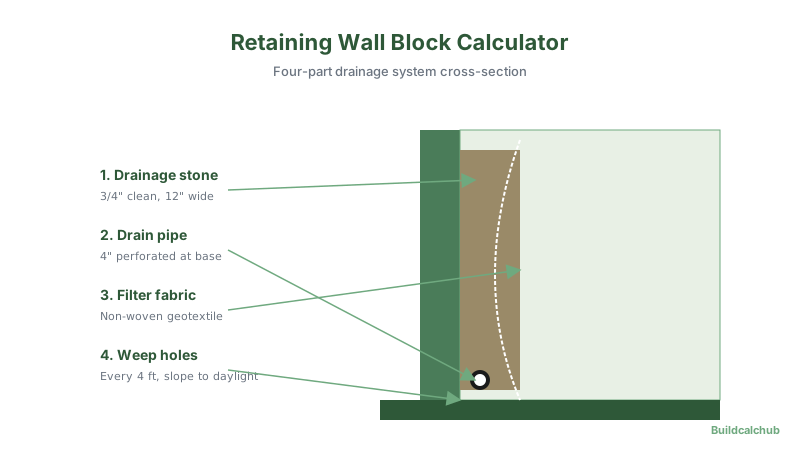
- Hydrostatic failure — water pressure behind wall pushes blocks out. Fix: drain gravel 12+ inches deep directly behind wall, weep holes every 6-10 ft in first course, or perforated drain pipe to daylight.
- Bearing failure — wall sinks into weak soil below. Fix: compact subgrade, 6-in minimum crushed stone base compacted to 95% Proctor.
For walls over 4 ft tall: always engineer with geogrid reinforcement and/or cantilever design. Most jurisdictions require permits and engineer sign-off for walls over 4 ft.
How to Calculate Retaining Wall Calculator
Standard landscape retaining-wall block dimensions (varies by manufacturer):
- Face height: 4-8 inches (common 6 in)
- Depth: 8-12 inches (common 12 in)
- Face length: 12-18 inches (common 18 in)
- Weight: 30-85 lb per block
For a standard 6-in face × 18-in length block:
- A 4-ft-tall × 20-ft wall = ~108 blocks + caps
- A 3-ft-tall × 30-ft wall = ~120 blocks + caps
Base material (compacted crushed stone, 6-in minimum):
- Trench width = block depth + 6-8 in (extra for drain behind)
- Trench depth = 4-6 in (base) + 1 block buried (first course)
Drainage gravel (#57 stone directly behind wall, 12-in wide zone):
- 1 cubic yard covers ~27 lf of wall for 3-ft tall; less for taller walls
Once the Retaining Wall Calculator result looks reasonable, cross-check the next job decision with the Paver Calculator and the Concrete Block Calculator. That keeps the quantity, cost, and field assumption tied together before you call a supplier.
For 2026 installed pricing by wall material ($/face-foot) plus the 4-ft engineering threshold, 7 line items every quote should show and DIY vs contractor break-even, see the companion retaining wall cost guide with regional multipliers across 6 US bands.
What Most Online Calculators Get Wrong Reviewed by the Landscape & Hardscape Review Desk
AI tools calculate retaining wall blocks as area / block face. Four pitfalls AI summaries hide:
- Above 4 ft = engineered wall, building permit required.
- Buried base course (below grade) +1 row.
- Drainage stone column 12-in min behind wall.
- 4-in perforated drain pipe at base.
This calculator outputs block count (+1 buried) + cap blocks + drainage stone + drain pipe + geotextile fabric, with 4-ft engineering threshold check. Retaining walls are 4 components; AI's block-only count misses 3.
Retaining Wall Coverage Table and Material Reference
| Wall Height | Base Depth | Drainage | Reinforcement | Permit? |
|---|---|---|---|---|
| Under 2 ft | 4 in | Drain stone behind | None | Usually no |
| 2-4 ft | 6 in | Drain stone + perforated pipe | Batter each course | Often yes |
| 4-6 ft | 8 in | Full drain system | Geogrid every 2-3 courses | Always yes + engineer |
| Over 6 ft | Engineered | Engineered drain | Engineered geogrid / cantilever | Always yes + engineer |
Geogrid requires setback behind wall (typically 0.7× wall height). Property-line retaining walls may need easement or variance.
| Wall Length | 2 ft tall | 3 ft tall | 4 ft tall | 5 ft tall |
|---|---|---|---|---|
| 10 ft | 28 blocks | 42 | 56 | 70 |
| 15 ft | 40 | 60 | 80 | 100 |
| 20 ft | 54 | 80 | 108 | 134 |
| 30 ft | 80 | 120 | 160 | 200 |
| 40 ft | 108 | 160 | 214 | 268 |
| 50 ft | 134 | 200 | 268 | 334 |
| 75 ft | 200 | 300 | 400 | 500 |
| 100 ft | 268 | 400 | 534 | 668 |
Add 5-10% waste for cuts at corners and ends. Caps are separate — typically 1 per 18 inches of finished wall.
Real-World Example Calculations
Garden Wall 20 × 2 ft
Low decorative garden wall along a mild slope.
- Wall length
- 20 ft
- Wall height
- 2 ft
- Base depth
- 4 in
Takeaway: Weekend DIY project. Buy 14 caps. Cost ~$220 blocks + $20 base stone.
Driveway Wall 40 × 4 ft
Retaining wall along side of sloped driveway.
- Wall length
- 40 ft
- Wall height
- 4 ft
- Base depth
- 6 in
Takeaway: Add 1-2 yd³ drain gravel behind wall, perforated drain pipe, 50 ft geogrid. Requires permit in most jurisdictions.
Terraced Garden 30 × 3 ft each (2 tiers)
Two stepped garden walls creating terraces on a hillside.
- Wall length
- 30 ft each
- Wall height
- 3 ft each
- Base depth
- 6 in each
Takeaway: Tier walls separated by at least 2× lower-wall height (6 ft apart here). Stabler than a single 6-ft wall and usually no permit required.
Step 1 of 5 in the Retaining Wall Project Path
- Wall SizeRetaining Wall Calculator
- ExcavationExcavation Calculator
- Drainage StoneCrushed Stone Calculator
- CMU OptionConcrete Block Calculator
- DrainageRetaining Wall Drainage Guide
Whole sequence with costs and ordering notes: Retaining Wall Project Path.
Sources & Standards
These references are used for terminology, safety boundaries, and engineering assumptions. Local code, supplier specifications, and licensed design documents still control your project.
-
2021 International Residential Code, Chapter 5: Floors and Chapter 8: Roof-Ceiling Construction (decking + framing)
International Code Council
Cited for residential deck framing, joist spacing, and structural requirements.
-
USDA NRCS National Engineering Handbook — Erosion and Sedimentation
USDA Natural Resources Conservation Service
Cited for topsoil placement, slope stability, and drainage practice on landscaping projects.
-
Penn State Extension Center for Turfgrass Science
Penn State College of Agricultural Sciences
Cited for grass seeding rates, sod establishment, and turf-area volume calculations.
-
Sunset Western Garden Book / ANSI A300 Tree Care Standards
Sunset / ANSI
Cited for mulch depth recommendations, tree-well clearance, and landscaping best-practice spacing.
-
CPSC ADA Accessibility Guidelines for Buildings and Facilities
U.S. Consumer Product Safety Commission / ADA
Cited for sidewalk slope, patio threshold, and walkway accessibility requirements.
Frequently Asked Questions
How many blocks do I need for a retaining wall?
Standard 6×12×18 in block: ~1.33 blocks per ft² of wall area. A 4 × 20 ft wall = 80 ft² = 108 blocks. Add 5-10% waste for cuts. Add caps at ~0.67 per linear foot of wall length.
How deep should the base be for a retaining wall?
Minimum 6 inches of compacted crushed stone below the first course of blocks, extending 4-6 inches wider than the block footprint on each side. For walls over 4 ft, go to 8-12 inches of base. Always bury the first course 1/10 of wall height below grade.
Do retaining walls need drainage?
Yes — any wall over 2 feet tall needs drainage. Drain stone (#57) 12 inches wide directly behind the wall, plus a perforated pipe at the base daylighting every 25-50 ft or at wall ends. Without drainage, hydrostatic pressure causes 80% of retaining wall failures.
How much does a retaining wall cost?
DIY: $20-40 per face ft² for under 4-ft walls. Contracted: $35-65 per ft² for standard walls, $80-150 per ft² for engineered walls over 4 ft. A 20-ft × 3-ft garden wall costs $1,200-2,400 DIY, $2,000-4,000 contracted.
What's the maximum height for a DIY retaining wall?
Most jurisdictions allow up to 4 feet without a permit. Higher walls require engineer design, permits, and often professional installation. Even within legal limits, walls over 3 feet carry significant liability; hire a contractor if you're unsure.
How long do retaining walls last?
Concrete block modular walls: 40-50+ years if properly drained. Timber walls (pressure-treated): 20-30 years. Boulder / stacked stone: 50+ years (no mortar to crack). Properly engineered and drained walls last essentially indefinitely with only cosmetic maintenance.
Do I need geogrid in my retaining wall?
For walls over 3-4 ft tall, geogrid reinforcement pulls backward into the soil mass behind the wall and prevents the wall from rotating forward. Install every 2-3 courses, extending back into the soil at least 70% of wall height. Check manufacturer specs for your specific block system.