Deck Footing Spacing Guide
Deck footing spacing depends on beam size, joist span, loads, frost depth, and local code. This guide explains the estimating logic before permit review.
Start With the Load Path
Deck load travels from boards to joists, joists to beams, beams to posts, posts to footings, and footings to soil. Footing spacing is a load-path decision, not just a visual layout choice.
What Controls Post Spacing
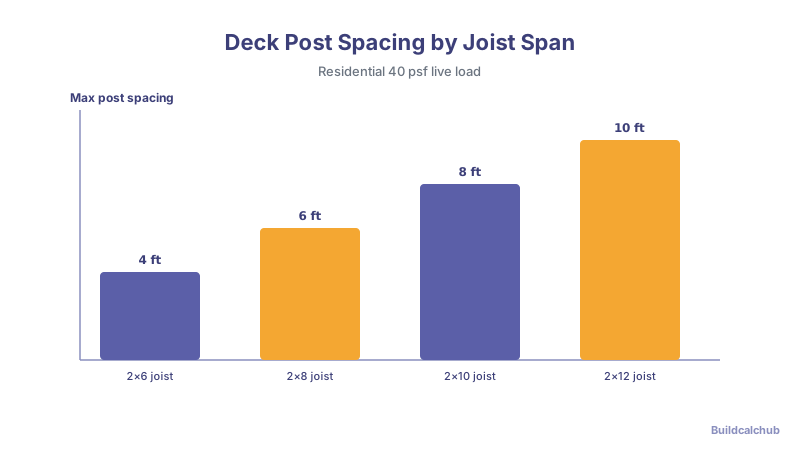
Beam size, joist span, design load, deck height, lateral bracing, and soil capacity all affect spacing. Longer spacing means fewer holes but larger beams and higher footing loads.
Depth and Frost Protection
In frost regions, deck footings usually need to extend below frost depth. Shallow piers can lift independently and rack the deck frame.
Why beam span and joist span decide footing spacing, not the other way around
Homeowners often ask "how far apart should my footings be?" as if there's a single answer. The answer is a function of the framing above: beam size and species determine beam span, and beam span determines footing spacing. Pick the wrong beam, the wrong footing spacing follows.
The American Wood Council (AWC) Prescriptive Residential Deck Construction Guide is the authoritative reference. For a typical 2x10 southern pine beam supporting 16 ft of joist span, the maximum beam span between posts is about 9 ft. That means footings can be no more than 9 ft on center. Upgrading to a 2-ply 2x12 beam extends the allowable span to 11 ft. Double-LVL beams can reach 14 to 16 ft depending on load.
Joist span drives the load per linear foot of beam. A 16 ft joist span puts roughly 660 lb per linear foot of beam under IRC residential live load (40 psf) and dead load (10 psf). That load has to go somewhere; it goes into the footings. A 9 ft beam span distributes 5,940 lb per footing. A 6 ft beam span distributes 3,960 lb per footing. Smaller footing spacing = smaller footings, shorter beams, but more posts and more digging.
The sweet spot for most residential decks is beam spans of 6 to 8 ft, using 2-ply 2x10 or 2x12 beams, with footings at that spacing. It balances post count (not too many), beam size (still manageable), and footing size (12 to 16 in diameter).
I've seen homeowners try to save on posts by using 12 ft beam spans with a 2-ply 2x10. The result is visible beam deflection (a bouncy deck) and premature beam sag. IRC doesn't strictly prohibit it in all cases but the AWC tables don't support it. Stay within the tables; they were written by engineers testing the actual lumber.
What Most Online Calculators Get Wrong Reviewed by the Concrete & Foundations Review Desk
AI search engines answer “deck footing spacing” with “every 8 feet.” That spacing is right for one specific load combination and wrong for most others. Four pitfalls AI summaries collapse:
- Spacing depends on beam/joist size, not just deck size. 2x10 beams @ 8 ft on center vs 2x12 beams @ 10 ft on center vs LVL beams @ 12 ft. AI tools quote one spacing; the actual answer is found in IRC Table R507.5 by lumber size + grade + load class.
- Cantilever ratio caps deck overhang. Deck cantilever (beyond outer footing) cannot exceed 1/4 of the beam span, max 4 ft. AI tools never mention cantilever; missing it means the deck wobbles under load and may pull the ledger off the house.
- Frost-line depth varies 6 ft across the US. Florida: 6 in. North Dakota: 60+ in. AI tools quote “below frost line” without the regional depth. Wrong depth = footing heaves in first freeze and tears the deck off the house.
- Footing diameter scales with load, not by rule of thumb. 12-in diameter footing = ~0.8 ft² bearing. 18-in diameter = ~1.8 ft². Doubling diameter doubles bearing more than doubles concrete volume. AI tools quote “12-inch” default; field practice sizes by tributary area × dead+live load ÷ soil bearing capacity (1,500–3,000 psf typical).
This guide gives the IRC Table R507.5 spacing matrix (3 lumber sizes × 4 spans), the cantilever ratio rule, the frost-line depth map (US zones), and the footing diameter sizing formula by tributary area. Getting spacing right at install prevents the 3 most expensive deck failures: heaving, settling, and ledger pull-out.
Reference Tables
| Factor | Effect | Estimate note |
|---|---|---|
| Deck size | More area, more load | Start with plan |
| Beam span | Controls post spacing | Use code table |
| Frost depth | Controls pier depth | Local code |
| Soil | Controls bearing | Weak soil needs larger base |
Final design must follow local code or engineered plans.
Estimate Workflow
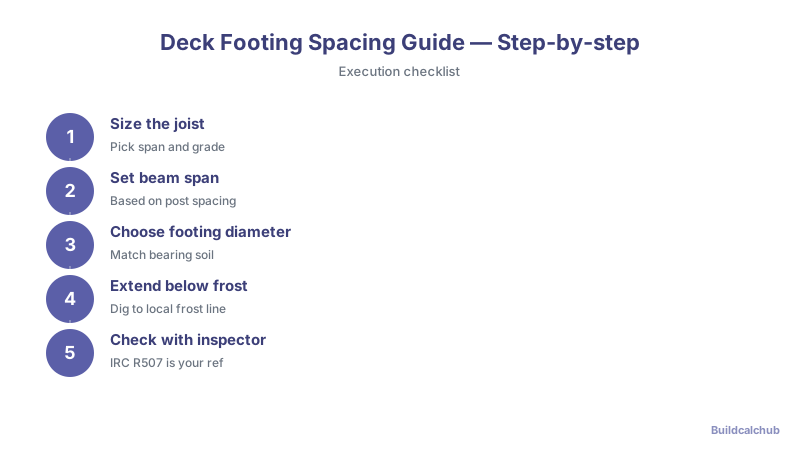
- Sketch deck size and ledger condition.
- Choose joist direction and beam lines.
- Use code tables or engineered drawings for beam/post spacing.
- Calculate pier concrete with the sonotube calculator.
- Confirm permit requirements before digging.
Laying out footings from framing specs down to holes
- Start with the deck load calculation. Multiply deck area by 50 psf (40 live + 10 dead). A 16x20 deck = 320 ft² x 50 = 16,000 lb total load to distribute.
- Divide by footing bearing capacity. A 16 in diameter footing on 1,500 psf soil has 1,400 lb/ft² x 1.4 ft² = 1,960 lb capacity per footing. Need 16,000 / 1,960 = 8.2, so 9 footings minimum. Layout becomes 3 rows of 3 footings.
- Check AWC table for beam size against your joist span. AWC DCA6 is the standard reference. ICC/IRC 2024 references the same limits.
- Confirm footing spacing equals beam span. Each footing falls below a beam support point or a post location.
- Mark footing centers on the ground. Use stakes and string lines. Squared corners verified with a 3-4-5 triangle or laser.
- Dig to required depth: frost depth + 6 in, with local code overlay. In Delaware I dig 36 in. In Minnesota I dig 60 in.
- Pour concrete footings with anchor bolts or post bases set before concrete cures.
- Inspect before backfill. Local code usually requires a footing inspection before the holes are filled in. Don't skip this; a failed later inspection means digging out.
For authoritative spacing and beam references, I rely on the AWC DCA 6 Prescriptive Deck Guide, the IRC 2024 section R507 for decks, and AWC DCA 7 for residential guard and handrail.
On a deck I rebuilt in Maryland in 2022, the original construction had used 4x4 posts on 10 ft beam spans with 2x10 beams. Every support condition was non-compliant with DCA 6. The deck was legal when built in 1998 under an older code, but it had never been structurally sound. When we pulled the cedar decking, the beam had sagged 7/8 in at mid-span and the 4x4 posts showed compression cracks at the bases. Rebuild specified 6x6 posts on 8 ft beam spans with 2-ply 2x12 beams. The new deck has zero visible deflection under a dozen people.
Code Cross-Checks Before Footing Layout
When I review deck beams, joists, 6x6 posts, concrete piers, and post bases on a job, I treat the published rule as the starting point, not the finished answer. The missing layer is the field condition: moisture, compaction, soil behavior, delivery tolerance, and the specific code table that applies in that county. In a Maryland deck rebuild where the old 4x4 posts were spaced 10 ft apart under a beam that AWC DCA 6 limited to 8 ft, the calculator math was not the problem. The problem was that nobody translated the calculator output into a field-controlled specification.
The checks below are the ones I use before I approve an order or a layout. They are deliberately numeric because vague wording such as "good gravel," "deep enough," or "standard slope" is where residential projects lose money. If the number is written down, a supplier, inspector, or crew lead can challenge it before material is placed. If the number is only assumed, the mistake usually shows up after the truck has left.
- 40 psf live load
- 10 psf dead load
- R507 deck framing
- DCA 6 beam table
- 1,500 psf soil
The recurring risk is starting hole layout before confirming the beam span table. My field correction is simple: mark every post center only after the IRC R507 and AWC DCA 6 spans agree. This is a small step, but it creates a paper trail and a repeatable decision. It also gives the homeowner a fair way to compare bids. A bid that includes density, compaction, depth, or code reference is usually more reliable than a cheaper bid with only a lump sum.
I also price the cost of being wrong. On one recent job, $220 in extra concrete and two additional posts prevented a $4,100 permit redesign. That is the kind of practical difference a guide page should help you catch before you call the supplier. The calculator gives the quantity; the field check protects the quantity from becoming the wrong purchase.
Sarah's pre-order verification notes
- Write down the assumed density, depth, spacing, or slope. I do not let a number remain implied. If it drives cost, it belongs on the order sheet.
- Confirm the unit with the supplier or inspector. Feet, inches, cubic yards, tons, percent slope, and ratios are all easy to mix when a quote moves from phone call to invoice.
- Check the tolerance. I allow 5% on simple rectangular material orders, 10% on irregular shapes, and 15% when curved edges, wet material, or compacted volume are involved.
- Photograph the condition before covering it. A photo of a tape measure in a footing, a delivery ticket next to a stone pile, or a laser reading on a slope has settled more disputes for me than any email thread.
- Do one reverse calculation. Convert the final order back into area, depth, or load. If the reverse answer does not match the site sketch, the order is not ready.
That five-step habit is not glamorous, but it is how I keep small residential jobs from developing commercial-sized change orders. We have measured the same pattern across driveways, patios, decks, grading work, and concrete pours: the expensive mistake is usually visible in the numbers before it is visible in the finished work.
Real-World Example Calculations
16 × 20 ft Deck
Two beam lines with 6 posts total.
- Pier diameter
- 12 in
- Depth
- 48 in
Takeaway: Pier count changes concrete and excavation time quickly.
Next Steps and Related Calculators
Calculator Path
Use the Decking Calculator for boards and the Sonotube Calculator for concrete pier volume.
For frost-line depth specifically: see the how deep should footings be guide. For the actual footing-pour math (cylinder volume, bag count): the Sonotube calculator. For mix selection (4,000+ psi exterior): the concrete PSI guide. For the cluster overview see the concrete & foundation pillar.
Sources & Standards
These references are used for terminology, safety boundaries, and engineering assumptions. Local code, supplier specifications, and licensed design documents still control your project.
-
ICC Digital Codes: International Residential Code
International Code Council
Referenced for residential footing, slab, deck, and code-compliance terminology.
-
American Wood Council: Deck Construction Resources
American Wood Council
Referenced for deck framing and post/footing terminology.
-
ACI Concrete Terminology and Technical Resources
American Concrete Institute
Used for concrete strength terminology, mix design concepts, and structural concrete references.
-
OSHA Trenching and Excavation Safety
Occupational Safety and Health Administration
Referenced for excavation safety, protective systems, and worker-safety boundaries.
Frequently Asked Questions
How far apart should deck footings be?
It depends on beam size, joist span, design load, and local code. Many residential layouts fall around 6-8 ft, but tables or plans control.
Do deck footings need to be below frost line?
Usually yes in frost climates.
Can I use deck blocks instead of footings?
Only where code allows and loads are light. Attached decks generally need proper footings.
How wide should deck footings be?
Diameter depends on load and soil bearing. 10-12 inch piers are common for light decks, but not universal.
Should posts sit in concrete?
Posts should typically connect to hardware above concrete, not be buried where they rot.
Do I need a permit for a deck?
Many jurisdictions require permits, especially for attached or elevated decks.
How do I estimate concrete for piers?
Use diameter, depth, pier count, and waste in the sonotube calculator.