Paver Base Depth Guide
Choose paver base depth by traffic load, soil type, drainage, and edge restraint. The right base is what keeps pavers flat.
What the Paver Base Actually Does
Pavers are only the wearing surface. The base spreads load, drains water, resists frost movement, and gives the bedding layer a stable platform. Thin base is the reason most DIY paver patios settle.
Depth by Application
Walkways can often work with 4 inches of compacted base. Patios usually need 4-6 inches. Driveway pavers often need 8-12 inches depending on soil and vehicle load.
Soil and Water Change the Depth
Clay soil, freeze-thaw climate, and poor drainage all push base depth upward. Sandy, well-drained soil can use less base, but still needs compaction and edge restraint.
The base thickness that actually holds a paver
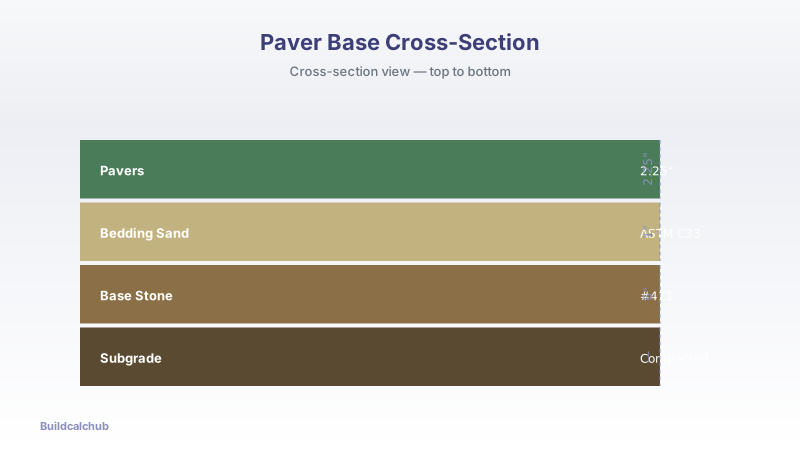
The classic residential paver install calls for 6 in of compacted base plus 1 in of bedding sand plus the paver itself. That spec came from the Interlocking Concrete Pavement Institute (ICPI) decades ago and it works for driveways with car traffic on stable subgrade. It does not work universally.
The variables that determine base depth are subgrade strength, frost depth, and traffic loading, in that order.
Subgrade strength governs the bottom. On a silty clay subgrade (CBR 3 to 4), 6 in of base is not enough; I specify 8 to 9 in. On a sandy loam subgrade (CBR 7 to 10), 4 to 5 in is structurally adequate. On decomposed granite or bedrock (CBR 15+), 3 to 4 in works. The default of 6 in is a cautious average for mixed conditions.
Frost depth dictates whether the base needs to reach below the frost line to prevent heave. In Zone 4 (36 in frost), a 6 in paver base doesn't reach frost depth, so the entire paver assembly heaves as a unit. That's often acceptable for patios (re-screed and re-lay) but not for driveways with adjacent structures. For driveways near garages in deep-frost zones, I specify an 8 in base with a 4 in drainage stone layer below to break the frost path.
Traffic loading separates patios (foot traffic) from driveways (car traffic, with occasional delivery truck loads). A patio base can be 4 in on good soil. A driveway base needs 6 to 8 in. A commercial paver installation (loading dock aprons, etc.) needs 10 to 12 in and engineered drainage.
One detail that saves more paver jobs than depth does: compaction effort. A 4 in base compacted to 98% Proctor outperforms an 8 in base compacted to 88%. I measure compaction with a plate compactor pass count (6 to 10 passes per lift) and verify with a penetrometer at three locations per 100 ft². The base is rejected if any location reads below the refusal depth.
What Most Online Calculators Get Wrong Reviewed by the Landscape & Hardscape Review Desk
AI search engines answer “how deep should paver base be” with one number (4 inches). ICPI Tech Spec 2 actually specifies depth by traffic class with a 4× spread. Four pitfalls the universal-4-inch shorthand collapses:
- Pedestrian patio: 4 in compacted base. Driveway (light vehicle): 6–8 in compacted. Driveway with truck access: 8–10 in. Commercial parking: 10–12 in. AI tools quote 4 in across all; under-spec'd base causes rutting and settlement within 24 months on vehicular jobs.
- Geotextile fabric is required on clay soil, optional on sand. Non-woven fabric prevents fines from migrating up into the base. AI tools never ask about subgrade; if you're on heavy clay (Mid-Atlantic, parts of Texas, anywhere with seasonal saturation), the fabric is non-negotiable. $0.20/sqft cost vs $1.50/sqft re-do.
- 1 in of bedding sand – never 2 in, never 1/2 in. Exactly 1 in of compacted bedding sand is the ICPI spec. Too thick = pavers rut under load. Too thin = base voids show through. AI tools quote “1–2 inches” (the wrong answer); experienced installers use a screed pipe to enforce exactly 1 in.
- Loose vs compacted is 1.25× base order multiplier. 6 in compacted base = 7.5 in loose order. AI tools quote the compacted depth and you order to that — under-ordering 20%. Always order 1.25× the in-place depth for the base course.
This guide gives the depth chart by traffic class (4 bands), the subgrade-correction matrix (fabric required when), the bedding-sand 1-in spec (with screed-pipe technique), and the loose-to-compacted ordering multiplier. Specifying the right base depth for the right load class is the single biggest decision in paver work; everything else is detail.
Reference Tables
| Application | Base depth | Bedding |
|---|---|---|
| Walkway | 4 in | 1 in sand |
| Patio | 4-6 in | 1 in sand |
| Driveway | 8-12 in | 1 in sand |
| Clay soil add-on | +2-4 in | Drainage critical |
Depths are compacted thicknesses, not loose placement thicknesses.
Install Workflow
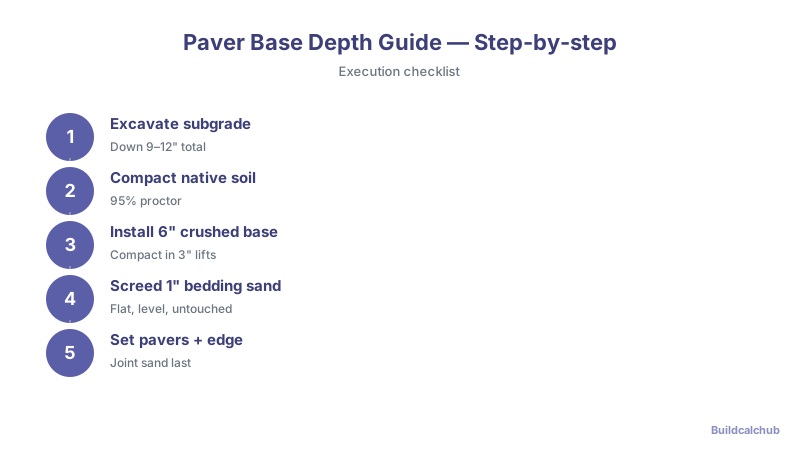
- Excavate for paver thickness, bedding, base, and slope.
- Compact subgrade.
- Place base in lifts and compact each lift.
- Screed 1 inch bedding sand.
- Lay pavers, edge restraint, and joint sand.
My paver base installation sequence
- Excavate to depth + paver + 1 in sand + 6 in base + 2 in over-excavation. On a 2.25 in paver with standard 6 in base, that's 9.25 in minimum excavation.
- Compact the subgrade with a plate compactor until it stops deforming. Any soft spots get dug out and replaced with base stone, not just stamped down.
- Install geotextile fabric for any subgrade with more than 10% clay. The fabric prevents fines from migrating into the base over time.
- Place base in 3 in loose lifts, compact each lift to refusal. Measure depth at four locations; any variation over 1/2 in is rejected and re-leveled.
- Screed bedding sand to 1 in. Use two 1-in screed rails and a 2x4 to strike the sand flat. Do not walk on screeded sand.
- Place pavers without disturbing the sand bed. Start from a corner, work outward.
- Edge restraint before compaction. Metal or spiked plastic restraint prevents paver migration.
- Compact the paver surface with a plate compactor through a protective pad. This forces the pavers into the bedding sand and locks the matrix.
- Sweep polymeric joint sand into the joints, mist lightly per product data sheet.
On a back-yard paver patio I built in 2021, I dug 9 in instead of the 7 in I'd originally planned because I uncovered a buried tree root system at 5 in that I had to fully remove. The extra 2 in of clean base eliminated the soft spot and gave me a rock-solid installation that's showing no settlement 5 years later. The 30 minutes of extra excavation and the $40 of extra base stone were the best value in that project.
Compaction Is the Hidden Depth Variable
When I review crusher run, bedding sand, geotextile fabric, edge restraint, and concrete pavers on a job, I treat the published rule as the starting point, not the finished answer. The missing layer is the field condition: moisture, compaction, soil behavior, delivery tolerance, and the specific code table that applies in that county. In a small patio where the base was nominally 6 in but only the top 2 in had been compacted, the calculator math was not the problem. The problem was that nobody translated the calculator output into a field-controlled specification.
The checks below are the ones I use before I approve an order or a layout. They are deliberately numeric because vague wording such as "good gravel," "deep enough," or "standard slope" is where residential projects lose money. If the number is written down, a supplier, inspector, or crew lead can challenge it before material is placed. If the number is only assumed, the mistake usually shows up after the truck has left.
- 6 in patio base
- 8 in driveway base
- 3 in loose lifts
- 1 in bedding sand
- 95% Proctor
The recurring risk is placing one thick base layer and assuming the plate compactor reaches the bottom. My field correction is simple: compact in 3 in loose lifts and verify elevation after each lift. This is a small step, but it creates a paper trail and a repeatable decision. It also gives the homeowner a fair way to compare bids. A bid that includes density, compaction, depth, or code reference is usually more reliable than a cheaper bid with only a lump sum.
I also price the cost of being wrong. On one recent job, $48 of extra base and 40 minutes of compaction prevented visible settlement at the house edge. That is the kind of practical difference a guide page should help you catch before you call the supplier. The calculator gives the quantity; the field check protects the quantity from becoming the wrong purchase.
Sarah's pre-order verification notes
- Write down the assumed density, depth, spacing, or slope. I do not let a number remain implied. If it drives cost, it belongs on the order sheet.
- Confirm the unit with the supplier or inspector. Feet, inches, cubic yards, tons, percent slope, and ratios are all easy to mix when a quote moves from phone call to invoice.
- Check the tolerance. I allow 5% on simple rectangular material orders, 10% on irregular shapes, and 15% when curved edges, wet material, or compacted volume are involved.
- Photograph the condition before covering it. A photo of a tape measure in a footing, a delivery ticket next to a stone pile, or a laser reading on a slope has settled more disputes for me than any email thread.
- Do one reverse calculation. Convert the final order back into area, depth, or load. If the reverse answer does not match the site sketch, the order is not ready.
That five-step habit is not glamorous, but it is how I keep small residential jobs from developing commercial-sized change orders. We have measured the same pattern across driveways, patios, decks, grading work, and concrete pours: the expensive mistake is usually visible in the numbers before it is visible in the finished work.
Real-World Example Calculations
320 ft² Patio Base
Patio over average soil with 6 inches compacted base.
- Area
- 320 ft²
- Base depth
- 6 in
Takeaway: Order with compaction and edge loss included.
Next Steps and Related Calculators
Calculator Path
Pair the Paver Calculator with the Crusher Run Calculator and Sand Calculator.
Sources & Standards
These references are used for terminology, safety boundaries, and engineering assumptions. Local code, supplier specifications, and licensed design documents still control your project.
-
ICC Digital Codes: International Residential Code
International Code Council
Referenced for residential footing, slab, deck, and code-compliance terminology.
-
ASTM D448: Standard Classification for Sizes of Aggregate
ASTM International
Referenced for crushed stone and aggregate size classifications.
-
ASTM C33/C33M: Standard Specification for Concrete Aggregates
ASTM International
Referenced for concrete aggregate grading and quality terminology.
-
FHWA Geotechnical Engineering Program
Federal Highway Administration
Referenced for subgrade, compaction, and soil support concepts.
Frequently Asked Questions
How deep should paver base be?
Walkways commonly need 4 inches, patios 4-6 inches, and driveways 8-12 inches depending on soil and traffic.
Can I lay pavers on sand only?
No. Sand is a bedding layer, not a structural base.
How thick should bedding sand be?
One inch after screeding is typical.
Do I need geotextile?
On clay or weak soil, geotextile helps separate soil from aggregate.
Should paver base be compacted?
Yes, in lifts. Uncompacted base settles.
What base material should I use?
Dense-graded aggregate or road base is common.
Do pavers need edge restraint?
Yes. Without edge restraint, pavers spread and joints open.