Fence Post Depth Guide
Fence post depth depends on height, wind exposure, soil, frost, and material. This guide explains depth rules before you order posts and concrete.
The One-Third Rule
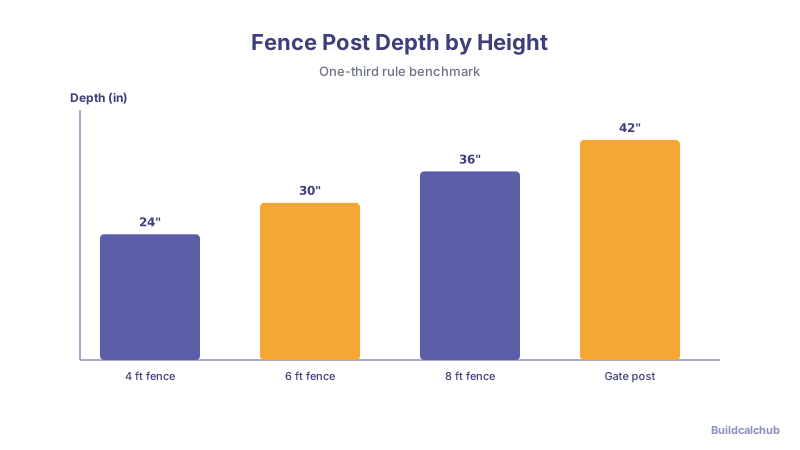
A common fence rule is to bury about one-third of the above-ground post height, with adjustments for frost, wind, and soil. A 6-foot privacy fence often needs posts around 2-3 feet deep, not shallow 18-inch holes.
Wind Turns Panels Into Sails
Privacy fences catch wind. Wider post spacing, shallow holes, and weak soil combine into leaning runs after the first strong storm. Coastal, open-field, and hilltop sites need conservative spacing and depth.
Material Differences
Vinyl privacy panels are flexible and usually need tight post spacing. Chain-link lets wind pass but still needs terminal posts set well. Wood tolerates field adjustment but rots if drainage is ignored.
The engineering behind the 1/3 rule
The classic rule-of-thumb is "bury 1/3 of the total post length below grade." For a 6 ft fence, that's 3 ft below and 6 ft above. Where does the 1/3 come from?
A fence post is a cantilever. Wind force on the fence fabric (pickets, panels) pushes the post over at the base. The post resists by bearing against the soil on the leeward side of the post. Engineering analysis of a uniformly loaded cantilever against a cohesive soil shows that embedment-to-above-grade ratio of 1:2 provides approximately a 2.5 safety factor against overturning for typical residential fences in moderate wind zones (90 mph basic wind speed).
The rule breaks down in three conditions:
- High-wind zones (>100 mph basic wind speed, coastal exposure). Increase embedment to 1:1.5, or add larger footing diameters. A 6 ft fence in a 110 mph zone needs 4 ft of embedment, not 3 ft.
- Sandy or loose soils. Reduce embedment-to-above-grade ratio to 1:1.5 or install in concrete. Sand doesn't provide the lateral bearing that dense clay or glacial till does.
- Solid wood fence panels (not pickets). A solid wood panel catches 60 to 80% more wind than spaced pickets. Increase embedment or post diameter, or add diagonal bracing.
The other variable is frost depth. Even a well-embedded post can heave if the bottom is above the frost line. A 4 ft embedment in a 48 in frost zone (like Minnesota) sits exactly at the frost depth, which means the post rides up and down 1 to 3 in per season. Embedment should reach 6 in below the frost line to eliminate heave.
Combining both rules for a 6 ft fence: in Minnesota (48 in frost), embed to 54 in (4.5 ft). In Delaware (30 in frost), embed to 36 in (3 ft). In Florida (12 in frost), embed to 30 in (2.5 ft) to satisfy the 1:2 ratio.
What Most Online Calculators Get Wrong Reviewed by the Landscape & Hardscape Review Desk
AI search engines answer “how deep should fence posts be” with one rule: “1/3 of post height.” That rule is for 1 specific soil + 1 specific climate. Four pitfalls AI summaries hide:
- Frost line trumps the 1/3 rule. Northern climates require post embedment below frost line regardless of post height. Florida 6-ft fence = 24-in deep post. North Dakota 6-ft fence = 60-in deep post (5 ft minimum to clear frost). AI tools quote 24–36 in universally; the actual depth varies 3× across US zones.
- Soil type changes required depth 50%. Sandy soil: 1/3 of height. Clay soil: 1/4 of height + concrete collar. Rocky / shale soil: hand-dug with rock chisel + concrete collar OR drilled pier foundation. AI tools never ask about soil; field practice tests with a soil probe first.
- Wind exposure changes depth. Sheltered yard: 1/3 height. Exposed corner / coastal: 1/2 height + concrete collar. Posts that get the wind first need deeper anchoring to resist overturning. AI tools never address wind class.
- Concrete vs gravel vs tamped earth changes service life. Concrete collar = 25+ years but post-rot starts at concrete contact. Gravel + tamped earth = 15–20 years with no rot point. AI tools default to concrete; many regions prefer gravel for moisture control.
This guide gives the frost-line depth map (US zones), the soil-type depth modifiers (4 types), the wind-exposure adjustment, and the concrete-vs-gravel installation comparison. Getting depth right at install is the difference between a fence that stands for 20 years and one that needs re-setting after 3.
Reference Tables
| Fence type | Typical height | Starting hole depth |
|---|---|---|
| Wood picket | 4 ft | 24 in |
| Wood privacy | 6 ft | 30-36 in |
| Vinyl privacy | 6 ft | 36 in |
| Chain-link | 4-6 ft | 24-36 in |
Frost depth and local code can require deeper holes.
Install Workflow
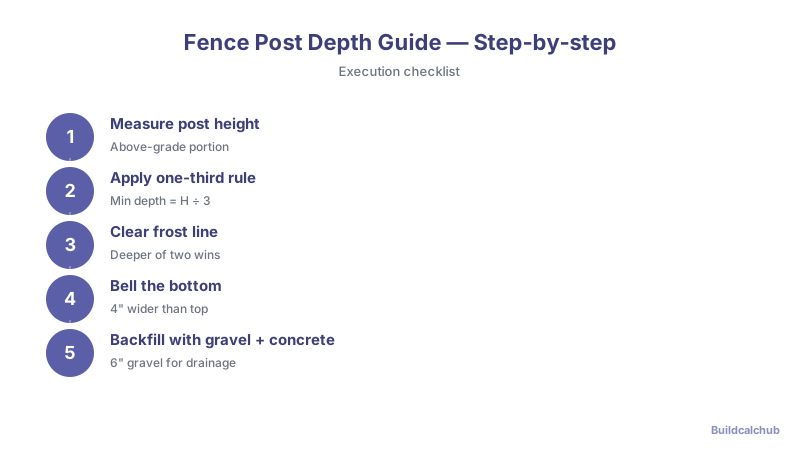
- Confirm property line and permit rules.
- Mark post spacing.
- Call 811 before digging.
- Dig below frost depth where required.
- Place gravel drainage, set post, brace plumb, and pour concrete.
Post-setting sequence I use on every fence job
- Lay out post centers with stakes and string. Typical spacing: 6 ft or 8 ft on center, matching your rail length.
- Call 811 for utility locate. Every hole. Every time. Even if you "know" what's below.
- Dig holes with a 10 in diameter auger for 4x4 wood posts, 12 in for 6x6, 8 in for steel pipe. Width matters more than symmetry.
- Excavate to depth + 4 in. The extra 4 in goes to gravel at the bottom for drainage around the post.
- Place 4 in of gravel at the hole bottom before the post. This prevents standing water from rotting wood posts or rusting steel pipes.
- Plumb the post using a 4 ft level on two adjacent faces, brace with stakes to hold while concrete sets.
- Pour concrete (or use expanding foam for lighter fences). Concrete fills the hole around the post. I use a 3,000 psi mix; foam products like Sika PostFix or Fast 2K work on lighter fences and reduce labor.
- Cap the hole top with soil at a 1% slope away from the post. Water running toward the post = rot.
- Wait 24 to 48 hours before installing rails. Premature loading can tilt freshly set posts.
On a privacy fence I helped install in 2021 in a 95 mph wind zone in Virginia Beach, we embedded 6 ft solid wood panels to 42 in depth (7% below the 1:1.7 rule for that wind zone) with 12 in diameter concrete footings. Standard spec from the fence catalog was 30 in embedment with 8 in footings. We upgraded because the catalog assumed 90 mph. Two hurricane seasons later, the fence stood while a neighbor's standard-spec fence lost 80 ft to wind damage. Embedment is cheap insurance when the wind is the enemy.
Wind, Frost, and Soil Checks Before Drilling Post Holes
When I review 4x4 posts, 6x6 posts, steel pipe, concrete collars, gravel drainage pads, and wind-loaded panels on a job, I treat the published rule as the starting point, not the finished answer. The missing layer is the field condition: moisture, compaction, soil behavior, delivery tolerance, and the specific code table that applies in that county. In a coastal Virginia fence where standard 30 in embedment failed after a 55 mph storm gust, the calculator math was not the problem. The problem was that nobody translated the calculator output into a field-controlled specification.
The checks below are the ones I use before I approve an order or a layout. They are deliberately numeric because vague wording such as "good gravel," "deep enough," or "standard slope" is where residential projects lose money. If the number is written down, a supplier, inspector, or crew lead can challenge it before material is placed. If the number is only assumed, the mistake usually shows up after the truck has left.
- 1/3 embedment rule
- 6 in below frost
- 90 mph wind
- 110 mph coastal exposure
- 10 in auger
The recurring risk is using catalog embedment in a high-wind or sandy-soil site. My field correction is simple: compare fence height, local wind speed, frost depth, and soil type before choosing hole depth. This is a small step, but it creates a paper trail and a repeatable decision. It also gives the homeowner a fair way to compare bids. A bid that includes density, compaction, depth, or code reference is usually more reliable than a cheaper bid with only a lump sum.
I also price the cost of being wrong. On one recent job, $260 of extra concrete saved a replacement fence panel run after the first storm season. That is the kind of practical difference a guide page should help you catch before you call the supplier. The calculator gives the quantity; the field check protects the quantity from becoming the wrong purchase.
Sarah's pre-order verification notes
- Write down the assumed density, depth, spacing, or slope. I do not let a number remain implied. If it drives cost, it belongs on the order sheet.
- Confirm the unit with the supplier or inspector. Feet, inches, cubic yards, tons, percent slope, and ratios are all easy to mix when a quote moves from phone call to invoice.
- Check the tolerance. I allow 5% on simple rectangular material orders, 10% on irregular shapes, and 15% when curved edges, wet material, or compacted volume are involved.
- Photograph the condition before covering it. A photo of a tape measure in a footing, a delivery ticket next to a stone pile, or a laser reading on a slope has settled more disputes for me than any email thread.
- Do one reverse calculation. Convert the final order back into area, depth, or load. If the reverse answer does not match the site sketch, the order is not ready.
That five-step habit is not glamorous, but it is how I keep small residential jobs from developing commercial-sized change orders. We have measured the same pattern across driveways, patios, decks, grading work, and concrete pours: the expensive mistake is usually visible in the numbers before it is visible in the finished work.
Real-World Example Calculations
150 ft Privacy Fence
6 ft wood fence with 8 ft spacing.
- Posts
- 20-21
- Hole depth
- 36 in
Takeaway: Depth and diameter matter as much as post count.
Next Steps and Related Calculators
Calculator Path
Use the Fence Calculator for post count and the Sonotube Calculator for concrete volume per hole.
For fence-line concrete quantity, use the Sonotube calculator (post-hole volume) or the fence calculator (post count + linear ft). For frost-line depth verification, see the how deep should footings be guide. For mix selection on exterior post sets: concrete PSI guide.
Sources & Standards
These references are used for terminology, safety boundaries, and engineering assumptions. Local code, supplier specifications, and licensed design documents still control your project.
-
2021 International Residential Code, Chapter 5: Floors (R507 Decks)
International Code Council
Cited for how the IRC sizes post footings where a fence or screen attaches to a code-regulated deck or structure. Standalone garden fences are generally outside the code, so local rules still govern.
-
OSHA Trenching and Excavation Safety
Occupational Safety and Health Administration
Referenced for excavation safety, protective systems, and worker-safety boundaries.
-
NRCS Soil Health and Soil Survey Resources
USDA Natural Resources Conservation Service
Referenced for soil classification, shrink-swell behavior, and site variability.
-
ACI CODE-318-19(22) — Building Code Requirements for Structural Concrete
American Concrete Institute
Cited for concrete compressive-strength terminology when posts are set in concrete.
Frequently Asked Questions
How deep should fence posts be?
A common starting point is one-third of the above-ground height, adjusted for frost, wind, soil, and material.
Do fence posts need concrete?
Most privacy and terminal posts do. Some agricultural fences use tamped backfill, but residential privacy fences usually need concrete.
Should I put gravel under fence posts?
A few inches of gravel can help drainage at the bottom of the hole.
How far apart should fence posts be?
Wood privacy often uses 6-8 ft; chain-link line posts often use up to 10 ft.
Can I set posts in wet soil?
You can install in damp soil, but standing water and collapsing holes need correction.
Should posts go below frost line?
In frost areas, deeper holes reduce heave risk and may be required.
How long before hanging panels?
Let concrete set per product instructions; waiting at least 24-48 hours is common.