Retaining Wall Drainage Guide
Water behind a retaining wall adds pressure equivalent to 3× the soil weight. This guide explains why 80% of failures trace to drainage, and how to build it right.
Why Water Pressure Destroys Walls
Soil behind a retaining wall is held up by the wall. The soil pushes horizontally against the wall — called lateral earth pressure. Walls are designed to resist this pressure.
But water saturating the soil creates a second force: hydrostatic pressure. Water has no shear strength; it pushes equally in all directions. A fully saturated soil behind the wall produces 2-3× the lateral pressure of dry soil.
Numbers for a 6-ft retaining wall:
- Dry soil: 180 psf at base (pounds per square foot)
- Saturated soil: 375 psf at base
- Submerged (pond behind wall): 450 psf at base
Walls sized for dry soil fail under saturated or submerged conditions. Most residential walls are sized with assumption of moderate moisture — but without drainage, that assumption becomes catastrophically wrong after a wet season.
The 4-Part Drainage System
A properly drained retaining wall has 4 components:
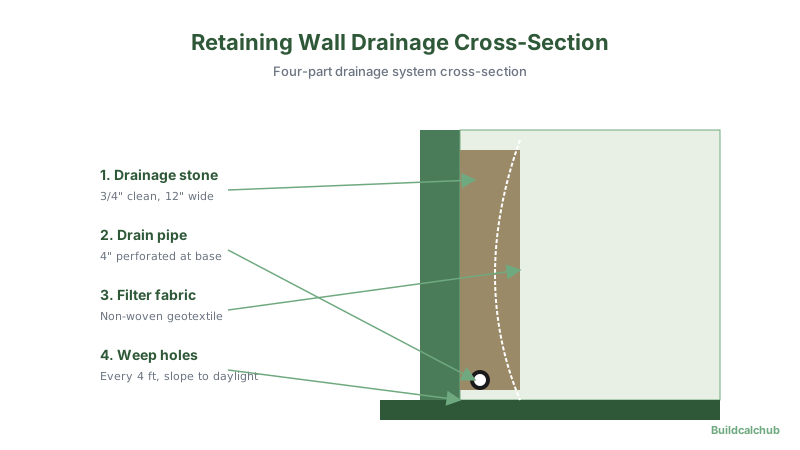
- Drain stone zone — 12-inch wide column of #57 washed stone directly behind the wall, full wall height. Open voids between stones let water flow down freely.
- Perforated drain pipe — 4-inch perforated PVC or corrugated pipe at the base of the drain stone, running entire wall length. Collects water.
- Daylighting outlet — pipe exits at low point, either daylights to a drainage swale, connects to storm drain, or terminates in a drywell.
- Filter fabric — non-woven geotextile wrapping the drain stone zone. Prevents soil fines from migrating into the stone and clogging voids.
Without all 4 components, the system is incomplete. Missing pipe: stone fills with water, no exit. Missing fabric: soil clogs stone within 2 years. Missing daylighting: pipe fills at low end, backs up.
Installation Step-by-Step
- Excavate wall trench with 12-24 inches of extra width behind the wall face for drainage zone
- Compact subgrade and install 6-in crushed stone leveling pad
- Build first course of wall, verify level
- Install 4-inch perforated pipe at base of wall, wrap in filter sock, set at 1-2% slope toward daylighting outlet — confirm the fall with the field method for measuring slope for drainage before the trench is accepted
- Place 6-12 inches of #57 stone over the pipe
- Lay filter fabric along back face of wall stones, wrapping to top of drainage zone
- Build wall to height, backfilling #57 stone in the 12-inch drainage zone as you go
- Fold fabric over top of drain zone before final soil backfill
- Install weep holes in first course every 6-10 feet as additional drainage points
- Backfill with native soil from top of fabric to final grade
For walls over 4 feet tall, add a secondary drain at mid-height (halfway up the wall). This prevents water from accumulating between the top and bottom drain zones.
How water actually pushes a retaining wall over
A retaining wall that fails almost never fails from the soil load alone. Block walls and poured walls are engineered with generous safety factors against lateral soil pressure. What kills them is hydrostatic pressure — the weight of water saturating the backfill.
Dry soil exerts roughly 45 lb/ft³ of active pressure against a vertical wall. Saturated soil exerts 85 to 110 lb/ft³ because water adds weight without reducing friction angle effectively. For a 6 ft wall, that's the difference between a 1,800 lb/ft wall-line force and a 3,300 lb/ft force. Most residential walls can take the former but not the latter.
The drainage system behind the wall has one job: eliminate standing water behind the wall before it builds pressure. Three components matter:
- Drainage stone against the wall: 12 in wide minimum, clean 3/4 in stone (no fines). This provides a porous zone for water to migrate vertically down.
- Perforated drain pipe at the base: 4 in rigid PVC or corrugated drain, perforations down, sloped 1% minimum to daylight or to a dry well. This carries water out of the drainage zone.
- Filter fabric separating drainage stone from backfill: Non-woven geotextile, 6 oz/yd². Prevents fines from plugging the drainage stone.
Add weep holes every 4 to 6 ft along the wall for a belt-and-suspenders approach. If the drainage stone or pipe clogs somehow, the weep holes relieve pressure.
On a 5 ft segmental block wall I inspected in Virginia after it tipped 8 inches in 2020, the root cause was a drainage pipe that had been crushed during backfill. The pipe had functioned for roughly two years, then choked, then failed after a 4 in rain event. The wall itself was properly built. What killed it was invisible maintenance failure of the drainage. Annual inspection of drainage outlets is the single most-overlooked maintenance step on retaining walls.
What Most Online Calculators Get Wrong Reviewed by the Landscape & Hardscape Review Desk
AI search engines answer “retaining wall drainage” with one tip: “use gravel behind the wall.” That's necessary but nowhere near sufficient. Four pitfalls AI summaries leave out:
- 4-in perforated pipe at base is non-negotiable above 3 ft. “Gravel backfill” alone doesn't move water out — it just holds it against the wall. A 4-in perforated pipe at the bottom of the drainage stone, sloped 1–2% to daylight, evacuates the water. AI tools omit this; field engineers spec it on every wall ≥ 3 ft.
- 12 in of #57 stone behind the wall, not 6. Drainage stone column must be wide enough that water reaches the perforated pipe before saturating the soil-stone interface. 12 in minimum is the NCMA SRW Design Manual standard. AI tools quote 4–6 in; contractors who under-bid often cut this to 4 in, which works in dry conditions and fails in wet years.
- Non-woven geotextile fabric separates soil from drainage stone. Without fabric, fine clay particles migrate into the drainage stone over 5–10 years and clog it. Fabric costs $0.15–$0.30/sqft and lasts 30+ years. AI tools never spec it; experienced wall builders put it on every wall.
- Cap drainage and surface drainage are separate problems. Cap stone with a slight forward slope (1/4 in per foot) sheds water away from the back of the wall. Surface drainage at the top of the wall (swales, channels) prevents water from pooling and saturating the backfill. AI tools answer one or the other; both are required.
This guide gives the 4-component drainage system (perforated pipe, #57 stone column, geotextile fabric, cap + surface drainage), the height-based requirement matrix (under 3 ft, 3–4 ft, 4+ ft engineered), the cost breakdown per face-foot, and the inspection checklist for verifying your contractor installed all 4 components. Drainage is 12–22% of wall cost and determines whether the wall lasts 30 years or 7.
Reference Tables
| Wall Height | Drain Stone Width | Pipe Size | Daylighting Distance |
|---|---|---|---|
| Under 2 ft (ornamental) | 6 in | Optional | — |
| 2-4 ft | 12 in | 4 in perforated | 30-50 ft max |
| 4-6 ft | 12-18 in | 4 in perforated | 25-40 ft max |
| 6-8 ft | 18-24 in | 4-6 in perforated | 20-30 ft max |
| Over 8 ft (engineered) | Per design | Per design | Per design |
‘Daylighting distance’ = maximum run from any point to the pipe's outlet before adding another pipe. Add additional outlets for longer walls or sloped sites.
| Material | Per Linear Foot of Wall | Installation |
|---|---|---|
| #57 drain stone (12-in zone, 4-ft tall) | $12-18 | Included in wall labor |
| 4-in perforated PVC pipe | $1-2 | $1-2/lf labor |
| Non-woven filter fabric (4x wall height) | $0.50-0.80 | Minor labor add |
| Corrugated HDPE perforated pipe (alternative) | $0.75-1.50 | $1-2/lf labor |
| Daylighting riser / cleanout | $30-60 each | $30-50 each install |
For a 40-ft wall at 4 ft tall, total drainage cost: $600-1,000 materials + $400-800 labor = $1,000-1,800. Versus $10,000-25,000 repair if drainage fails.
Material Selection
Specifying the right materials matters:
- Drain stone: #57 washed stone is the standard. Clean, angular, 3/4-inch graded. Not #8 (too fine), not pea gravel (rounded, less drainage), not crusher run (has fines that clog).
- Perforated pipe: 4-inch PVC (smoother, less likely to clog) or 4-inch corrugated HDPE (cheaper, flex-installs easier). PVC lasts 50+ years; HDPE 30+ years.
- Filter fabric: Non-woven geotextile (e.g., Mirafi 140N) at 4 oz/yd² minimum. Not woven fabric (too coarse for fines).
- Filter sock: Fabric sleeve over perforated pipe. Convenient but also creates a clog point; use optional.
Common Mistakes
- Using crusher run as drain stone — fines clog the voids, system becomes ineffective within 2-3 years
- Skipping filter fabric — soil migrates into stone, voids fill over 1-5 years
- Drain pipe running uphill — water doesn't flow uphill. Must have 1-2% slope toward outlet.
- Covering daylighting outlet with mulch/plants — outlet clogs, water backs up
- Only weep holes, no drain — weep holes handle surface runoff but not saturated soil
- Forgetting the outlet — pipe runs full of water, no exit = no drainage
Retaining wall drainage installation, step by step
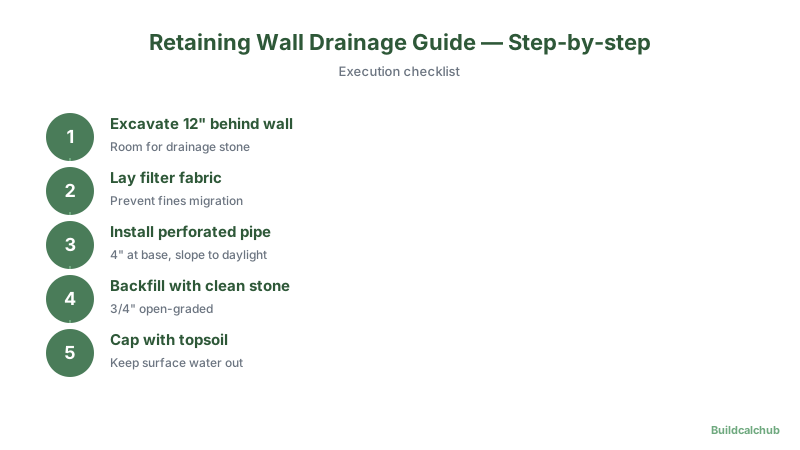
- Excavate behind the wall 12 in beyond the back face. This creates the space for drainage stone.
- Install filter fabric at the bottom, folded up against the soil. The fabric wraps around the drainage zone like a burrito.
- Place the drain pipe at the base, perforations down, sloped 1% minimum to the outlet. Confirm the slope with a level before burying.
- Backfill around the pipe with 2 in of clean stone to protect it from compaction damage.
- Fill the drainage zone with clean 3/4 in stone to within 4 in of the top, compacting lightly.
- Fold the filter fabric over the top of the drainage stone to complete the envelope.
- Backfill the remaining zone with native soil or approved fill, compacting in 6 in lifts.
- Install weep holes in the wall face every 4 to 6 ft, at the drainage stone level.
- Daylight the drain pipe or connect to a dry well or storm drain. Never dead-end a drain pipe into backfill.
- Verify drainage with a garden hose test before finishing. Water placed in the drainage zone should emerge at the outlet within 60 seconds.
On a retaining wall I rebuilt in 2023 — a 7 ft tall wall in Delaware that had failed 4 years after construction — the original contractor had skipped the filter fabric. Twelve years of wet-dry cycling had migrated fines into the drainage stone until it was effectively mud. The drain pipe was plugged. When a 3 in rainstorm hit, the wall rolled forward 14 inches over 48 hours. Replacement cost: $23,500. The original cost savings from skipping the fabric: roughly $240. Never skip the fabric.
Real-World Example Calculations
40-ft × 4-ft Block Retaining Wall: Full Drainage Spec
Standard residential retaining wall along sloped driveway.
- #57 drain stone
- 40 × 1 × 4 ft = 4.0 yd³
- 4-in perforated pipe
- 40 lf + 20 lf to daylight = 60 lf
- Filter fabric (nonwoven)
- 40 × 16 ft = 640 ft²
- Daylighting cleanout
- 1 unit
Takeaway: 10-15% of total wall cost. Absolutely essential — don't cut this line item.
Step 5 of 5 in the Retaining Wall Project Path
- Wall SizeRetaining Wall Calculator
- ExcavationExcavation Calculator
- Drainage StoneCrushed Stone Calculator
- CMU OptionConcrete Block Calculator
- DrainageRetaining Wall Drainage Guide
Whole sequence with costs and ordering notes: Retaining Wall Project Path.
Next Steps and Related Calculators
For wall sizing, use the Retaining Wall Calculator. For drainage stone tonnage, the Crushed Stone Calculator. For 2026 installed pricing by wall material and height, plus how drainage line items factor into the 7-line bid, see the retaining wall cost guide. Budget drainage separately — it's the difference between a wall that lasts 50+ years and one that fails in 5.
Sources & Standards
These references are used for terminology, safety boundaries, and engineering assumptions. Local code, supplier specifications, and licensed design documents still control your project.
-
ICC Digital Codes: International Residential Code
International Code Council
Referenced for residential footing, slab, deck, and code-compliance terminology.
-
ASTM D448: Standard Classification for Sizes of Aggregate
ASTM International
Referenced for crushed stone and aggregate size classifications.
-
OSHA Trenching and Excavation Safety
Occupational Safety and Health Administration
Referenced for excavation safety, protective systems, and worker-safety boundaries.
-
FHWA Geotechnical Engineering Program
Federal Highway Administration
Referenced for subgrade, compaction, and soil support concepts.
Frequently Asked Questions
Do small retaining walls need drainage?
Walls under 2 feet tall (decorative garden walls): typically OK without formal drainage if soil drains naturally. Walls over 2 feet, or in clay soils, or in high-rainfall areas: always install drainage. Cost is minimal, failure cost is catastrophic.
How much drain stone do I need behind a retaining wall?
Rule of thumb: 12-inch wide zone, full wall height. For a 40-ft × 4-ft wall: 40 × 1 × 4 = 160 ft³ = 5.9 yd³ = 8 tons of #57 stone. For taller walls, increase zone width to 18-24 in.
Can I use landscape fabric instead of filter fabric?
No. Landscape fabric (woven polypropylene) is too coarse — fines pass through and clog the stone. Use non-woven geotextile specifically rated for drainage (e.g., Mirafi 140N, SRW Envirofab). Cost $0.40-0.80 per ft² vs. $0.15 for landscape fabric — worth the upgrade.
Where does the drainage pipe go?
Daylight at the lowest point — typically at one end of the wall where the grade drops. Can also go to a storm drain connection, drainage swale, or drywell. Pipe must slope 1-2% toward the outlet. Outlet should be protected from clogging by mulch or animals.
How often do weep holes need to be?
Weep holes (openings through the wall for drainage) every 6-10 feet in the first course. They supplement the main drainage system by relieving any water that collects between drainage zones. Don't rely on weep holes alone — they only handle surface runoff.
What happens if I don't install drainage?
Water accumulates behind the wall. Hydrostatic pressure increases. Within 1-5 years (faster in high-rainfall regions), the wall begins to bow, tilt, or crack. Eventually fails catastrophically, often without warning. Repair cost: $8,000-30,000 for typical residential walls.
Can I add drainage to an existing wall?
Partially. You can drill weep holes through the existing wall ($100-200 per hole, 6-10 foot spacing). You can dig out 12-18 in behind the wall at the base, install perforated pipe to a daylight point, and backfill with #57 stone. Cost: $1,200-3,000 for a 40-ft wall. Still less than rebuild.