Base Rock Calculator — California / West Coast Class 2 Sub-Base
Sized for West Coast “base rock” / Class 2 language. National crusher-run / DGA math with loose→compacted ordering lives on the crusher run calculator.
Base Rock Calculator
Enter project dimensions below — results update instantly. Switch units freely.
Estimates assume typical industry density and waste factors. Always verify with your supplier and local building code before purchasing material.
Why the Same Material Has Five Different Names
Dense-graded aggregate sub-base goes by a regionally-specific name in every US market. The product spec is essentially the same; the name changes with where you're buying it:
- California / Oregon / Washington: Base rock, 3/4-inch minus, Class 2 base
- Nevada / Arizona: Aggregate base, ABC (aggregate base course)
- Texas / Oklahoma: Flex base, Type A base
- Midwest (IA, WI, MN): Class 5, breaker run
- Northeast (NY, NJ, PA): DGA (Dense-Graded Aggregate), crusher run, modified stone
- Southeast (FL, GA): GAB (Graded Aggregate Base), ABC
Ordering tip: use the local name when calling quarries. Calling California suppliers and asking for ‘crusher run’ gets confused looks; calling for ‘base rock’ gets a price quote.
This calculator uses 110 lb/ft³ density (standard for dense-graded base rock). Your supplier's spec sheet may list 108-115 lb/ft³ — use their exact value for ordering.
How to Calculate Base Rock Calculator
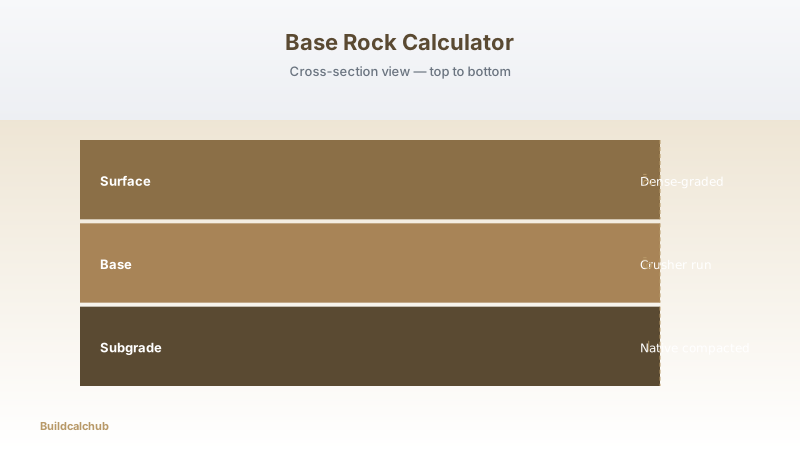
For West Coast projects referencing Caltrans Section 26 specifications:
- Class 2 Aggregate Base — 3/4 in or 1-1/2 in max size, fully graded
- R-value ≥ 78 minimum (measures resistance to deformation under load)
- Plasticity index < 10 (keeps material stable when wet)
- Durability index ≥ 35 (resists weathering)
Common base rock thickness by Caltrans / WSDOT / ODOT specs:
- Residential driveway: 4 in min
- Residential street: 8-12 in
- Collector road: 10-14 in
- Arterial / highway: 12-18 in
Western US projects often include geotextile fabric under the base rock to prevent clay infiltration — essential on expansive soils.
Once the Base Rock Calculator result looks reasonable, cross-check the next job decision with the Crusher Run Calculator and the Gravel Calculator. That keeps the quantity, cost, and field assumption tied together before you call a supplier.
For the broader project context: the cubic yards vs tons conversion guide covers material-specific density (the 1.4 t/yd³ vs 2.0 t/yd³ question), the crushed stone sizes guide walks the #57 / #67 / #8 gradations, and the gravel depth chart sets coverage by application. For a full cluster overview see the aggregate & base pillar.
What Most Online Calculators Get Wrong Reviewed by the Asphalt & Aggregates Review Desk
AI calculates base rock as “volume × 1.5.” Four pitfalls AI tools hide:
- DGA density 1.55 loose / 1.85 compacted — not 1.5 universal. AI quotes 1.5; the right value is state-dependent.
- 95% Modified Proctor (AASHTO T 180) is the spec. Not Standard Proctor (T 99) which AI sometimes uses. The 8–12% density difference is invoice-relevant.
- Compaction lift max 6–8 in. 12-in lift can't compact to 95% — only the top compacts; bottom stays loose.
- Cover at #200 sieve: max 8% fines. Too many fines = mud-pump under load; too few = no compaction. AI never addresses gradation.
This calculator outputs base rock tonnage at correct density, with lift-thickness limits + gradation reference + Modified Proctor compaction spec. Base rock is 4 specs, not just tonnage.
Base Rock Coverage Table and Material Reference
| Region | Product Name | Gradation | Typical Price/ton (2026) |
|---|---|---|---|
| West Coast (CA, OR, WA) | Base rock, 3/4 minus, Class 2 | 3/4 in max, fully graded | $26-38 |
| Southwest (NV, AZ) | Aggregate base, ABC | 3/4-1 in max, fully graded | $24-36 |
| Rocky Mountain (CO, UT) | Road base, 3/4 minus | 3/4 in max | $22-35 |
| Texas / Oklahoma | Flex base, Type A base | 1-1/2 in max | $20-30 |
| Midwest (IA, WI, MN) | Class 5, breaker run | 3/4-1 in max | $20-28 |
| Great Lakes (OH, MI, IL) | Modified stone, #22A | 1 in max | $22-30 |
| Northeast (NY, NJ, PA) | DGA, crusher run | 3/4 in max | $22-32 |
| Southeast (FL, GA, NC) | GAB, ABC | 1 in max | $18-28 |
Pricing at quarry gate. Delivery adds $50-180 per truckload depending on distance and truck size.
| Depth | ft² per Ton | ft² per yd³ | Tons per 100 ft² |
|---|---|---|---|
| 3 in | 73 ft² | 108 ft² | 1.38 tons |
| 4 in | 55 ft² | 81 ft² | 1.83 tons |
| 6 in | 36 ft² | 54 ft² | 2.75 tons |
| 8 in | 27 ft² | 40 ft² | 3.67 tons |
| 10 in | 22 ft² | 32 ft² | 4.58 tons |
| 12 in | 18 ft² | 27 ft² | 5.5 tons |
Based on 110 lb/ft³ compacted density. Order 10% extra for compaction shrinkage.
Real-World Example Calculations
Driveway Base 12 × 40 ft @ 4 in (California)
Residential driveway base under 3-in asphalt.
- Length × Width
- 40 × 12 ft
- Depth
- 4 in
- Density
- 110 lb/ft³
Takeaway: Single dump-truck delivery. Compact in 2-in lifts with plate compactor. Wet slightly before compacting for best density.
Commercial Lot Base 150 × 100 ft @ 8 in (Arizona)
Restaurant parking lot full sub-base replacement.
- Length × Width
- 150 × 100 ft
- Depth
- 8 in
- Density
- 110 lb/ft³
Takeaway: ~25 tri-axle deliveries. Vibratory roller required for 8-in compacted depth. R-value testing during placement.
Shop Floor Base 30 × 60 ft @ 12 in (Oregon)
Commercial shop floor base under reinforced concrete slab.
- Length × Width
- 60 × 30 ft
- Depth
- 12 in
- Density
- 110 lb/ft³
Takeaway: Place in 4-in lifts; compact to 95% Proctor. Level with grade stakes before final lift.
Sources & Standards
These references are used for terminology, safety boundaries, and engineering assumptions. Local code, supplier specifications, and licensed design documents still control your project.
-
AASHTO T 19/T 19M-22 — Standard Method of Test for Bulk Density (‘Unit Weight’) and Voids in Aggregate
AASHTO
Cited for the bulk density (loose-rodded unit weight) basis of all aggregate tons-per-cubic-yard figures.
-
ASTM C33/C33M-23 — Standard Specification for Concrete Aggregates
ASTM International
Cited for fine and coarse aggregate gradation requirements (#57, #67, #8 stone) referenced in the size and use-case tables.
-
ASTM D448-12(2017) — Standard Classification for Sizes of Aggregate for Road and Bridge Construction
ASTM International
Cited for the standardized aggregate gradation numbers (#1 through #67) used by aggregate suppliers.
-
AASHTO T 99-22 / T 180-22 — Standard Method of Test for Moisture-Density Relations of Soils Using a Standard Effort (Proctor)
AASHTO
Cited for the 95% Modified Proctor compaction standard used to derive the loose-to-compacted conversion factor.
-
FHWA Geotechnical Engineering Program
Federal Highway Administration
Cited for subgrade preparation and compaction practice underlying the base-course quantity calculations.
Frequently Asked Questions
What is base rock?
Base rock is the West Coast name for dense-graded crushed aggregate used as a sub-base under pavement, concrete, or compacted gravel. Same function as DGA (East Coast), crusher run (Northeast), or ABC (Southeast). Fully graded from dust to 3/4 or 1 inch maximum.
What is 3/4-inch base rock?
Base rock with a maximum particle size of 3/4 inch, with progressively smaller particles filling down to dust-sized fines. Caltrans Class 2 Aggregate Base spec. Compacts to a dense, solid sub-base at 95%+ of Proctor density.
How much does base rock cost?
In 2026 on the West Coast: $26-38 per ton at quarry, $45-70 delivered. Elsewhere in US (as DGA or equivalent): $18-32/ton. Always get delivered pricing when comparing suppliers — haul rates vary widely.
How many tons of base rock per yard?
At typical 110 lb/ft³ density: 1.49 tons per cubic yard. Heavier specialty base rocks (basaltic origin) can reach 1.65 tons/yd³; lighter volcanic-origin rock 1.35 tons/yd³.
How deep should base rock be under concrete?
Residential slab (patio, driveway): 4 inches minimum. Commercial slab: 6-8 in. Industrial / warehouse: 8-12 in. Over expansive clay soils, add another 2-4 in. Base rock creates a capillary break and frost protection; too thin and moisture wicks up into the slab.
What's the difference between base rock and crushed stone?
Base rock is a specific kind of crushed stone: dense-graded with fines. Most ‘crushed stone’ (like #57) is uniformly graded with open voids between similar-size stones. Uniformly graded stone is for drainage; dense-graded base rock is for structural compaction.
Can I install base rock myself?
Yes — one of the easiest DIY projects. Shovel spread, rake level, rent a plate compactor ($60/day) for 2-4 in lifts, or a vibratory roller ($300-450/day) for 6-8 in lifts. Keep slightly moist during compaction for best density.