Driveway Base Layers Explained
The aggregate stack beneath every durable driveway — from compacted subgrade to final surface. This guide breaks down each layer, what it does, and how thick it should be.
The 4 Layers of a Driveway
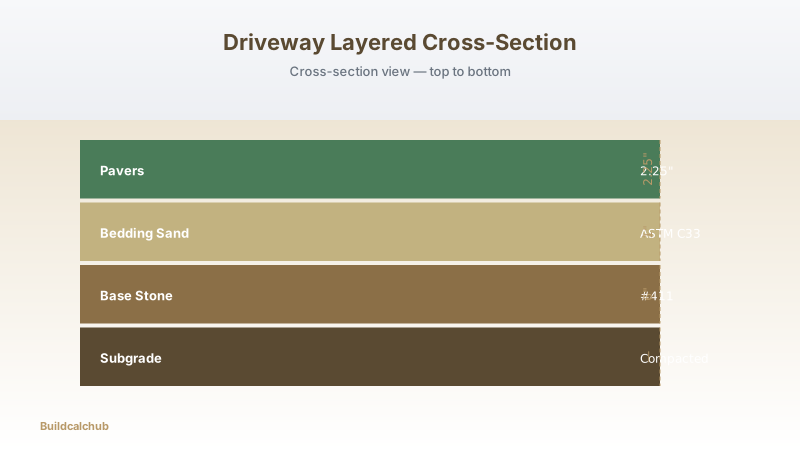
Every durable driveway — whether gravel, asphalt, concrete, or pavers — consists of 4 distinct layers working together:
- Subgrade — the native soil after stripping organic material and compacting
- Aggregate base course — compacted dense-graded crushed stone
- Bedding — only required for pavers; 1-inch of sand or stone dust
- Surface course — the visible finish material (asphalt, concrete, pavers, or gravel top)
The surface gets all the attention but the base does all the structural work. A 4-inch asphalt over 8 inches of compacted base outlasts 6 inches of asphalt over loose dirt — every time.
Layer 1: Subgrade Preparation
The subgrade is the native soil beneath everything else. Steps:
- Strip organic material — grass, topsoil, roots, and any debris. Minimum 6 inches below final grade.
- Test bearing capacity — walk the site after rain. Soft spots that hold your footprint are problem areas needing excavation and replacement fill.
- Compact subgrade — pass over with vibratory plate (small driveway) or smooth-drum roller (larger areas). Target 90-95% Proctor density.
- Install geotextile fabric on clay subgrades — prevents soil migration into base. Costs $0.30-0.60 per ft², prevents $3,000+ in remediation if soil-aggregate mixing occurs.
Soft subgrades (clay, silt, organic) may require over-excavation and replacement with structural fill. A 6-inch layer of crusher run compacted into soft clay creates a stable working platform. Extra cost: $2-5 per ft². Worth every penny.
Layer 2: Aggregate Base Course
This is the critical structural layer. Dense-graded aggregate (road base, crusher run, DGA) compacted to 95%+ Proctor density distributes wheel loads over the subgrade.
Thickness by application:
- Light residential gravel driveway: 4 in base
- Residential asphalt driveway: 4-6 in base
- Residential concrete driveway: 4 in base (concrete adds its own strength)
- Heavy residential (RV, work truck): 6-8 in base
- Commercial asphalt: 6-8 in base
- Industrial, trucks, heavy equipment: 10-12 in base
Compact in lifts of 2-4 inches. Taller lifts don't reach specified density at the bottom — the pavement fails from below within 2-3 years.
Layer 3: Bedding (Paver Driveways Only)
Pavers require a 1-inch layer of coarse bedding sand or stone dust between the base course and the pavers. This layer:
- Allows fine adjustment of paver elevation during install
- Provides bedding material that won't shift under load (when using angular stone dust or coarse paver sand)
- Prevents direct paver-to-base contact which would transmit bumps
Use coarse paver bedding sand (1/8-inch washed) or stone dust (quarry screenings). Do NOT use fine play sand — it washes out and compacts unevenly.
For concrete and asphalt driveways, no bedding layer — the surface material is placed directly on the compacted base.
Layer 4: Surface Course
The visible driveway surface:
- Gravel: 2-3 inches of #57 or pea gravel on top of the compacted base. Rakes smooth, walks on same day.
- Asphalt: 2-4 inches hot-mix asphalt placed and rolled. Drive on in 24-48 hours.
- Concrete: 4-6 inches placed and finished. Drive on in 7 days.
- Pavers: 2-3/8 to 3-1/8 inch thick pavers set on 1 in bedding. Drive on immediately after joint sand.
Why layered bases work better than a single thick layer
The instinct is to think "more stone equals more strength," and to put down 10 in of base in one mass. That approach fails two ways. First, you can't compact a single 10 in lift effectively; the top 4 in hit density but the bottom 6 in stay loose. Second, a monolithic base has no drainage path; water percolating down has nowhere to go and saturates the subgrade.
Effective driveway bases are layered, with each layer serving a specific function:
- Subgrade prep (top 6 in of native soil): compacted to 90 to 95% Standard Proctor before any stone goes down. If the subgrade is soft clay or organic, stripped to mineral soil and replaced with imported fill.
- Geotextile fabric (optional, strongly recommended on clay): non-woven fabric separates subgrade from base to prevent fines migration. $0.25 to $0.35/ft² installed.
- Sub-base (4 to 6 in of large crushed stone, 2 to 3 in nominal): this is the capillary break layer. Water percolating through the upper layers drains horizontally through this layer. Compacted to refusal but not tightly.
- Base (4 to 6 in of dense-graded crushed stone, crusher run): this is the structural layer. Well-graded, compacts tightly, distributes vehicle load across the sub-base.
- Bedding / leveling (1 to 2 in of fine crushed stone or stone dust): smooth surface for pavers or asphalt placement.
- Surface (pavers, asphalt, or gravel top layer): the wear surface.
This layered approach gives you a 10 to 12 in total base section that compacts uniformly (because each layer is compacted individually) and drains effectively (because the sub-base creates a horizontal drainage path).
On a gravel driveway I rebuilt in 2023 in Pennsylvania, the failed original had 6 in of "modified" stone (which is a vague supplier term for a mix) placed directly on clay subgrade. No fabric, no sub-base layer. After 8 years, the clay had pumped up into the stone during wet spring cycles, and the driveway surface was 30% mud by volume. The rebuild used a geotextile, 4 in of 2-3 in minus as sub-base, 4 in of crusher run as base, and 2 in of 3/8 in minus as the surface. Total 10 in installed, uniformly compacted in 4 in lifts. Three wet springs later, no pumping.
What Most Online Calculators Get Wrong Reviewed by the Asphalt & Aggregates Review Desk
AI search engines describe a driveway as “3 layers: dirt, gravel, asphalt.” The actual structure is 5–6 distinct engineered layers, each doing a specific job. Four pitfalls the 3-layer shorthand collapses:
- Subgrade prep is layer 0 and the single most-skipped step. 4–6 in of native soil must be excavated, compacted to 95% Modified Proctor, and proof-rolled before any base material goes down. Skipping this step (which AI tools never mention) is the #1 cause of premature pavement failure — subgrade settles, everything above cracks.
- Geotextile fabric (layer 1) costs $0.15–$0.30/sqft and is non-optional on clay soil. Non-woven geotextile separates fine clay from coarse base aggregate, preventing the clay from pumping up into the base during freeze-thaw. AI tools omit it; experienced contractors put it in on any soil with ≥ 30% fines.
- Two base layers (sub-base + base course), not one. 6–8 in of #57 stone or crushed run = drainage / structure layer. 2–4 in of DGA on top = leveling course. AI tools quote “gravel base”; field practice uses two different aggregates for two different jobs.
- Tack coat between binder and surface lift is layer 4.5. 0.05–0.10 gal/yd² of asphalt emulsion sprayed between the two HMA lifts. Bonds them together. AI tools quote “asphalt” as one layer; field practice always has a tack coat between binder and surface.
This guide gives the full 5–6 layer stack (subgrade prep, geotextile, sub-base, base, tack coat, binder, surface), the depth ranges by load class, the geotextile / fabric decision matrix, and the cost breakdown by line item. Knowing the full stack lets you spec the right driveway for the right life expectancy; cutting any single layer kills the whole structure.
Reference Tables
| Surface Type | Subgrade Prep | Base Course | Bedding | Surface Course | Total |
|---|---|---|---|---|---|
| Gravel (light) | Compact native | 4 in crusher run | — | 2 in #57 | 6 in |
| Gravel (country) | Compact + fabric | 6 in crusher run | — | 3 in #57 | 9 in |
| Asphalt (residential) | Compact native | 4-6 in base | — | 3 in asphalt | 7-9 in |
| Asphalt (commercial) | Compact + fabric | 6-8 in base | — | 3-4 in asphalt | 9-12 in |
| Concrete (residential) | Compact native | 4 in base | — | 4-5 in concrete | 8-9 in |
| Pavers (residential) | Compact native | 4-6 in base | 1 in sand | 2-3 in paver | 7-10 in |
| Pavers (driveway heavy) | Compact + fabric | 6-8 in base | 1 in sand | 3 in paver | 10-12 in |
All base course and surface thicknesses are compacted depths. Order 10-15% extra aggregate for compaction loss.
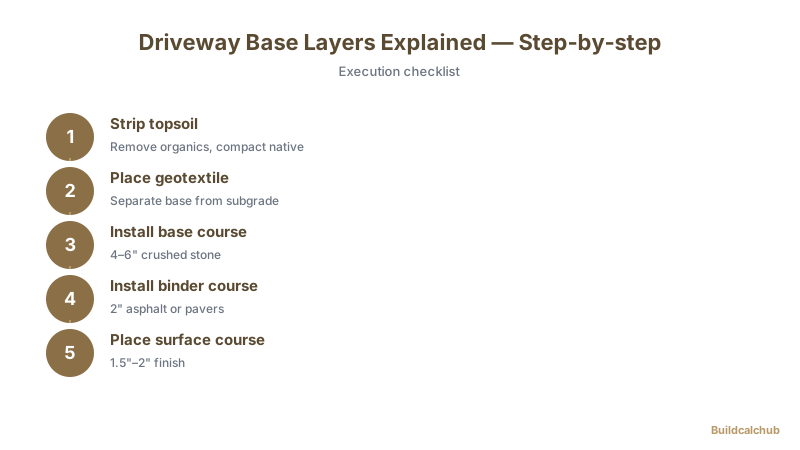
Total excavation depth = sum of all layers plus 2-3 inches extra for over-excavation allowance. For a standard 3-in asphalt driveway over 6 in base: 9-in minimum excavation, 11 in recommended.
Tool requirements for a DIY driveway:
- Compact plate (rental $60/day) for small driveways under 1,000 ft²
- Vibratory roller (rental $350/day) for 1,000+ ft² or depth > 6 inches
- Skid steer or tractor with bucket (rental $250-400/day) for spreading aggregate
- Straight edge / grade rake for final leveling
- Laser level with grade rod for long driveways
Installation sequence that prevents later failure
- Verify subgrade strength before stone arrives. Penetrometer at 10 locations. Any reading below 1,000 psf is soft and requires stabilization or over-excavation.
- Strip organics to mineral soil. Grass, topsoil, root mat — all out. Any remaining organic material is a future low spot.
- Grade the subgrade with 1 to 2% cross slope toward the edge or toward a swale. Flat subgrade ponds water.
- Install geotextile fabric if subgrade is clay or silt. Overlap seams 12 in minimum.
- Place sub-base stone in a 4 in lift, compact with plate compactor or roller until refusal.
- Place base stone in 3 in lifts, compact each lift. Total 4 to 6 in of base, depending on traffic.
- Verify elevation and crown before placing bedding or surface layer. A string line from edge to edge catches dips and peaks.
- Place bedding and surface layers per the specific surface material's installation guide.
- Final pass with roller or plate, confirm no weak spots.
I keep a dynamic cone penetrometer in my truck for subgrade verification. It's a 20-year-old Forestry Service tool that cost $180 new. On every driveway project I run 10 locations of DCP tests; any spot that penetrates more than 1.5 in under 10 blows gets dug out and replaced. The 45 minutes of pre-work saves weeks of post-construction complaints.
Real-World Example Calculations
Standard 12 × 50 ft Asphalt Driveway Build-Up
New residential driveway from dirt to finished asphalt.
- Layer 1: Strip organics
- 600 ft² × 4 in removed = 7.4 yd³
- Layer 2: Base course 6 in
- 16.5 tons crusher run
- Layer 3: (skip for asphalt)
- —
- Layer 4: Asphalt 3 in surface
- 11.5 tons hot-mix asphalt
Takeaway: Materials: $400 base + $1,400 asphalt = $1,800 + labor. Expected life 20-25 years.
Next Steps and Related Calculators
Use the Crusher Run Calculator for base course tonnage. The Driveway Asphalt Calculator or Concrete Slab Calculator for the surface course. The Excavation Calculator for the earth removal volume.
Sources & Standards
These references are used for terminology, safety boundaries, and engineering assumptions. Local code, supplier specifications, and licensed design documents still control your project.
-
FHWA Pavement Program
Federal Highway Administration
Referenced for pavement performance, asphalt structure, and roadway material context.
-
ASTM D448: Standard Classification for Sizes of Aggregate
ASTM International
Referenced for crushed stone and aggregate size classifications.
-
FHWA Geotechnical Engineering Program
Federal Highway Administration
Referenced for subgrade, compaction, and soil support concepts.
-
USGS National Minerals Information Center
U.S. Geological Survey
Referenced for aggregate, sand, stone, and mineral commodity context.
Frequently Asked Questions
How deep should a driveway be excavated?
Total of all layers plus 2-3 inches over-excavation allowance. Standard asphalt driveway: 4-in strip + 6-in base + 3-in asphalt = 13 inches minimum. Add extra on soft subgrades.
What's the best base for a driveway?
Dense-graded aggregate (crusher run, DGA, road base) compacted in 2-4 inch lifts. 4-6 inches depth for residential, 6-8 inches for commercial. Never use uniformly graded stone (#57 alone) as a structural base — it doesn't compact.
Do I need fabric under my driveway?
Highly recommended on clay soils or soils that hold water. Geotextile fabric ($0.30-0.60/ft²) prevents soil migration into base aggregate, extending driveway life by 10+ years. On sandy, well-drained subgrades, fabric is optional.
Can I build a driveway over topsoil?
No — always strip topsoil first. Topsoil has high organic content that decomposes and settles over time, causing driveway settlement. Remove 4-6 inches of topsoil before any driveway construction.
How long should the aggregate base cure before paving?
Aggregate base doesn't ‘cure’ — it's mechanical compaction, not chemical. You can pave immediately after compaction and grade verification. Some contractors let the base ‘settle’ for 1-2 weeks under traffic, but this is optional and rarely necessary.
Should the driveway be crowned or flat?
Crowned (higher in center, lower at edges) by 2-3%. Promotes water runoff to the sides. Flat driveways hold water, causing premature failure. For gravel driveways: crown of 1-2 inches center-to-edge. For paved: 1-1.5 inches.
How long does a driveway last?
With proper base prep: asphalt 20-25 years, concrete 30-50 years, pavers 30-50 years, gravel 5-15 years (needs periodic top-dressing). Without proper base: half those numbers or less.