Fill Dirt vs Topsoil
Fill dirt builds grade. Topsoil grows plants. Mixing those jobs causes settlement, drainage problems, and weak lawns.
The Difference
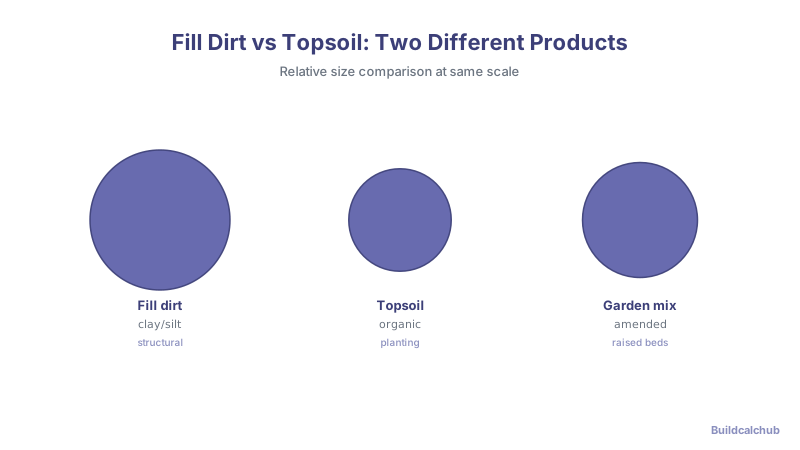
Fill dirt is low-organic soil used to change grade and fill voids. Topsoil is organic-rich growing soil used near the surface. Fill should compact; topsoil should support roots.
Where Fill Dirt Belongs
Use fill dirt for rough grading, backfill away from structural drainage zones, and raising low spots before the final growing layer. Avoid roots, trash, large organics, and frozen clods.
Where Topsoil Belongs
Use topsoil only in the top 4-6 inches for lawns and planting beds. Buried topsoil decomposes and settles, which is why it performs badly as structural fill.
Chemical and physical differences that matter
Fill dirt and topsoil are priced differently ($12 to $20/yd³ for fill vs $35 to $55/yd³ for topsoil) because they are different products. Using fill where you need topsoil destroys plantings. Using topsoil where you need fill wastes money and creates structural problems.
Topsoil has these characteristics:
- Organic matter 3 to 6% (screened quality ranges higher for premium "garden soil")
- pH 6.0 to 7.2 (suitable for most plants)
- Good particle size distribution with silt and clay balanced with sand
- Retains moisture without becoming anaerobic
- Supports root systems and soil microbiology
- Compaction density 90 to 100 lb/ft³ loose; does not compact well
Fill dirt has very different characteristics:
- Organic matter less than 1% (by intent — organic matter decomposes and causes settling)
- pH can vary 5.0 to 8.5 depending on source
- Variable particle size — often clay-heavy from construction site excavation
- Poor drainage when heavy clay
- Compacts well, which is its main purpose (structural fill)
- Compaction density 110 to 130 lb/ft³ compacted
Fill dirt is for structural purposes: raising grade, filling voids, creating foundations for hardscape. Topsoil is for growing things. A lawn over fill dirt will struggle until at least 4 in of topsoil is added on top. Shrubs and trees need 8 to 12 in of topsoil in the root zone.
On a residential grade-raising project in Delaware in 2022, the client wanted to raise 1,200 ft² of back yard by 18 in to improve drainage. We placed 67 yd³ of fill dirt compacted in 6 in lifts ($1,140 material + placement), then added 22 yd³ of screened topsoil on top ($1,760 material + placement). Total raise: 18 in. The layered approach gave the client a structural rise (preventing future settlement) with a plantable surface. A topsoil-only approach would have settled 3 to 5 in over 2 years and still been expensive. Specifying the right material for each function saves money across the project life.
What Most Online Calculators Get Wrong Reviewed by the Landscape & Hardscape Review Desk
AI search engines treat “fill dirt” and “topsoil” as “just two kinds of dirt.” They're priced at $8–$15/yd³ vs $25–$45/yd³ respectively and used for completely opposite jobs. Four pitfalls AI summaries silently conflate:
- Fill dirt is structural; topsoil is biological. Fill dirt (clean subsoil with 0–3% organic matter) compacts to 95% Modified Proctor and stays compacted. Topsoil (15–30% organic matter) decomposes, settles, and never reaches structural density. AI tools call both “dirt”; using topsoil for structural fill creates settling within 12 months. Using fill dirt under landscape beds kills plants.
- Topsoil quality varies 10×. “Screened topsoil” can mean anything from native loam at $45/yd³ (excellent) to construction-debris-laden sand at $20/yd³ (useless). AI tools quote one price range; experienced specifiers ask for a soil test (or at minimum a sample) before ordering.
- Moisture state affects price 25–40%. “Wet topsoil” from a winter delivery may be 20–30% water by weight — you're paying for water by the cubic yard. AI tools quote “dry weight” pricing; suppliers ticket on as-delivered weight. Always confirm dry vs wet at the time of quote.
- The shrink-swell factor for cut/fill balance is invisible. 1 yd³ bank-run dirt = 0.85–0.90 yd³ compacted in place. Topsoil shrinks even more after decomposition over 2–3 years (0.75 yd³ ratio). AI tools quote volume one-to-one; field engineers always factor 15–25% shrinkage on cut/fill balance.
This guide gives the structural-vs-biological distinction, the quality grading for topsoil (3 tiers), the moisture-state pricing correction, the shrink-swell factor for cut/fill balance, and the failure-cost analysis (what happens when you use the wrong one). Knowing which one you need before the dump truck arrives saves $300–$1,500 per project.
Reference Tables
| Material | Organic content | Compaction | Best use |
|---|---|---|---|
| Fill dirt | Low | Medium-high | Rough grade |
| Screened fill | Low-medium | Medium | Cleaner grading |
| Topsoil | High | Low | Growing layer |
| Compost blend | Very high | Very low | Garden amendment |
Do not bury topsoil under structural surfaces.
Correct Layering Method
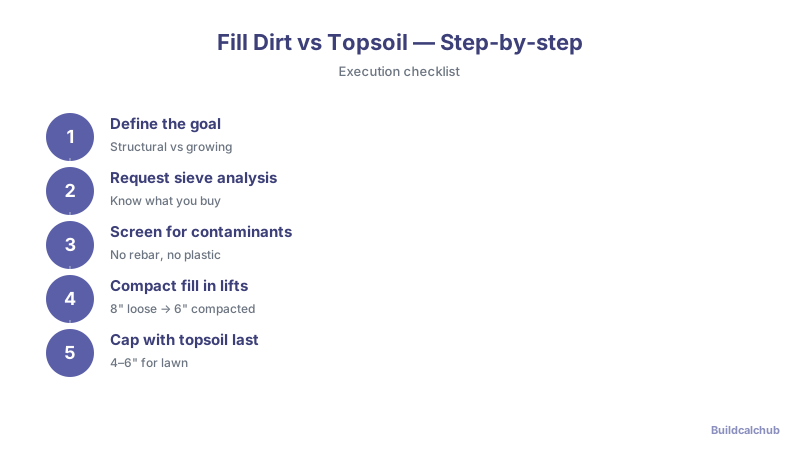
- Strip organics before structural fill.
- Place fill dirt in lifts and compact.
- Rough grade for drainage slope.
- Add topsoil as the final growing layer.
- Seed or plant after final rake-out.
How to verify what's actually showing up on the truck
- Ask for the source. Topsoil should come from a topsoil producer or a screened-from-stripping pile, not from a random excavation. Fill can come from any construction excavation.
- Check organic matter visibly. Topsoil should be dark and crumbly. Fill should be lighter brown to tan and may contain clods.
- Squeeze test. A handful of moist topsoil holds its shape but crumbles when touched. A handful of clay fill molds into a solid lump that doesn't crumble.
- Look for debris. Fill dirt is allowed to contain minor debris (roots, small stones). Topsoil should be essentially debris-free. Premium screened topsoil is guaranteed free of particles over 1/2 in.
- Ask for a lab test. Bulk topsoil for landscaping should come with a recent soil test showing organic matter percent, pH, and major nutrients. This costs the supplier nothing to provide if they already test regularly.
- Compaction test for fill. If fill is for structural purposes, the supplier or your contractor should verify 95% Standard Proctor after placement. A field density test runs $80 to $120.
On a lawn reseed project in 2023, a client had purchased "topsoil" at $28/yd³ from a discount supplier. When delivered, it was clearly fill dirt with some organic material mixed in. I tested pH at 5.3 and organic matter at less than 1%. The client called the supplier for a refund; they offered a $8/yd³ credit instead. We ended up amending the soil with compost and lime, spending an extra $320 to make it plantable. Paying $55/yd³ for verified topsoil would have saved $200 and two weeks of delay.
Soil Testing Before You Buy a Truckload
When I review structural fill, screened topsoil, compost blend, clay fill, sandy loam, and amended garden soil on a job, I treat the published rule as the starting point, not the finished answer. The missing layer is the field condition: moisture, compaction, soil behavior, delivery tolerance, and the specific code table that applies in that county. In a Newark lawn repair where discount topsoil tested at pH 5.3 and less than 1% organic matter, the calculator math was not the problem. The problem was that nobody translated the calculator output into a field-controlled specification.
The checks below are the ones I use before I approve an order or a layout. They are deliberately numeric because vague wording such as "good gravel," "deep enough," or "standard slope" is where residential projects lose money. If the number is written down, a supplier, inspector, or crew lead can challenge it before material is placed. If the number is only assumed, the mistake usually shows up after the truck has left.
- 3-6% organic matter
- pH 6.0-7.2
- 110-130 lb/ft3 compacted fill
- 4 in topsoil cap
- 95% Proctor fill
The recurring risk is using topsoil as structural fill or fill dirt as planting media. My field correction is simple: ask for pH, organic matter, and texture before approving delivery. This is a small step, but it creates a paper trail and a repeatable decision. It also gives the homeowner a fair way to compare bids. A bid that includes density, compaction, depth, or code reference is usually more reliable than a cheaper bid with only a lump sum.
I also price the cost of being wrong. On one recent job, $320 of compost and lime corrected a bad load that should have been rejected at the curb. That is the kind of practical difference a guide page should help you catch before you call the supplier. The calculator gives the quantity; the field check protects the quantity from becoming the wrong purchase.
Sarah's pre-order verification notes
- Write down the assumed density, depth, spacing, or slope. I do not let a number remain implied. If it drives cost, it belongs on the order sheet.
- Confirm the unit with the supplier or inspector. Feet, inches, cubic yards, tons, percent slope, and ratios are all easy to mix when a quote moves from phone call to invoice.
- Check the tolerance. I allow 5% on simple rectangular material orders, 10% on irregular shapes, and 15% when curved edges, wet material, or compacted volume are involved.
- Photograph the condition before covering it. A photo of a tape measure in a footing, a delivery ticket next to a stone pile, or a laser reading on a slope has settled more disputes for me than any email thread.
- Do one reverse calculation. Convert the final order back into area, depth, or load. If the reverse answer does not match the site sketch, the order is not ready.
That five-step habit is not glamorous, but it is how I keep small residential jobs from developing commercial-sized change orders. We have measured the same pattern across driveways, patios, decks, grading work, and concrete pours: the expensive mistake is usually visible in the numbers before it is visible in the finished work.
Real-World Example Calculations
Raise a Yard Before Seeding
1,200 ft² area raised 6 inches with final 4 inches topsoil.
- Fill layer
- 2 in
- Topsoil layer
- 4 in
Takeaway: Separate structural grade from growing layer.
Next Steps and Related Calculators
Ordering Impact
Use the Fill Dirt Calculator for compacted volume and the Topsoil Calculator for the final growing layer.
For volume math (topsoil or fill), use the topsoil calculator or fill dirt calculator. For drainage / compaction context, see the base rock density guide. For the broader earthwork view, see the excavation calculator and aggregate & base pillar.
Sources & Standards
These references are used for terminology, safety boundaries, and engineering assumptions. Local code, supplier specifications, and licensed design documents still control your project.
-
NRCS Soil Health and Soil Survey Resources
USDA Natural Resources Conservation Service
Referenced for soil classification, shrink-swell behavior, and site variability.
-
USGS National Minerals Information Center
U.S. Geological Survey
Referenced for aggregate, sand, stone, and mineral commodity context.
-
FHWA Geotechnical Engineering Program
Federal Highway Administration
Referenced for subgrade, compaction, and soil support concepts.
-
OSHA Trenching and Excavation Safety
Occupational Safety and Health Administration
Referenced for excavation safety, protective systems, and worker-safety boundaries.
Frequently Asked Questions
Can I use topsoil as fill?
Not for structural grade. Topsoil settles and holds water because it contains organic matter.
Can grass grow on fill dirt?
Poorly. Add 4-6 inches of topsoil for lawns.
What is screened fill?
Fill dirt screened to remove large rocks and debris.
Should fill dirt be compacted?
Yes, especially under surfaces or near structures.
How much topsoil do I need for grass?
Four inches is a common minimum; six inches is better for new lawns.
Is clay good fill dirt?
Clay can be good for shaping grade but needs moisture control and compaction.
Can I mix compost into fill?
Use compost near the surface, not in compacted fill layers.