Aggregate Calculator — Tons from Spec-Sheet Density
Use when you have a spec-sheet density for an uncommon stone product. Named products (gravel, #57, crusher run) have dedicated calculators.
Aggregate Calculator (Custom Density)
Enter project dimensions below — results update instantly. Switch units freely.
Estimates assume typical industry density and waste factors. Always verify with your supplier and local building code before purchasing material.
Why Aggregate Calculator Estimates Go Wrong
Most aggregate calculators hard-code a density (usually 100 lb/ft³). But specialty aggregates range from 60 lb/ft³ (lightweight expanded shale) to 140 lb/ft³ (iron-rich ballast). Using a default density when ordering specialty material can short your order by 15-30%.
When custom density matters:
- Decorative stone — lava rock 45 lb/ft³, glass aggregate 65 lb/ft³
- Heavy aggregate — iron ore ballast 140 lb/ft³, basalt 115 lb/ft³
- Recycled materials — crushed concrete 110 lb/ft³, recycled glass 60 lb/ft³
- Specialty bedding — fine quarry dust 120 lb/ft³, coarse #2 80 lb/ft³
Ask your supplier for the exact density listed on the spec sheet (often called ‘unit weight’ or ‘loose unit weight’). Use that number in this calculator.
Universal Aggregate Formula
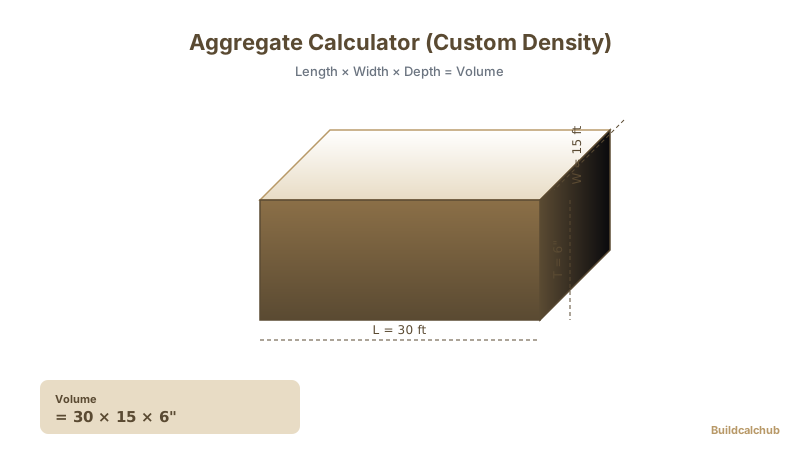
Works for any aggregate product — just swap the density value.
A quick density lookup without the calculator:
- Lava rock, pumice: 40-50 lb/ft³
- Recycled glass, lightweight aggregate: 55-70 lb/ft³
- Topsoil, organic loam: 70-80 lb/ft³
- Sandy fill, pea gravel: 90-95 lb/ft³
- #57 crushed stone, typical driveway: 95-105 lb/ft³
- DGA, crusher run: 110-120 lb/ft³
- Iron-rich ballast, basalt: 120-140 lb/ft³
Units matter: convert kg/m³ by dividing by 16.018 for lb/ft³. Example: 1,600 kg/m³ ÷ 16.018 = 99.9 lb/ft³.
Once the Aggregate Calculator result looks reasonable, cross-check the next job decision with the Gravel Calculator and the Crushed Stone Calculator. That keeps the quantity, cost, and field assumption tied together before you call a supplier.
For specific aggregate types: the gravel calculator handles river / pea / decorative; the crushed stone calculator handles #57 / #67 / #8 angular base; the sand calculator handles bedding sand. For the conversion math context, see the cubic yards vs tons guide.
What Most Online Calculators Get Wrong Reviewed by the Asphalt & Aggregates Review Desk
AI tools calculate aggregate as L×W×D × density. Four pitfalls AI summaries hide:
- Density spans 1.20–1.85 t/yd³ by material. Granite #57: 1.20 loose. DGA: 1.55 loose, 1.85 compacted. Limestone 3/4-in: 1.45/1.75. AI quotes universal 1.5; field practice always picks by material.
- Loose vs compacted is 1.15–1.25× multiplier. Order 8 yd³ in-place compacted = 9.6–10 yd³ loose at delivery. AI confuses the two.
- Moisture shifts density 8–15%. Dry sand 1.35; saturated 1.55. Supplier weighs as-delivered.
- Voids ratio matters for drainage applications. #57: 36–42% voids (drainage). DGA: 18–22% (structural). AI quotes density only.
This calculator outputs tonnage with material-specific density, loose-vs-compacted state, moisture correction, and voids-ratio reference. Aggregate ordering is 4 inputs: material + state + moisture + voids — AI's single-density answer misses 75%.
Aggregate Coverage Table and Material Reference
| Material | Density (lb/ft³) | Density (kg/m³) | Tons per yd³ |
|---|---|---|---|
| Pumice stone | 40-50 | 640-800 | 0.54-0.68 |
| Lava rock, decorative | 45-55 | 720-880 | 0.61-0.74 |
| Lightweight aggregate (expanded) | 55-70 | 880-1,120 | 0.74-0.95 |
| Recycled glass cullet | 60-70 | 960-1,120 | 0.81-0.95 |
| Topsoil (loose) | 70-80 | 1,120-1,280 | 0.95-1.08 |
| Sand (dry, loose) | 85-95 | 1,360-1,520 | 1.15-1.28 |
| Pea gravel | 90-95 | 1,440-1,520 | 1.22-1.28 |
| #57 stone, clean | 95-105 | 1,520-1,680 | 1.28-1.42 |
| Crushed limestone | 95-110 | 1,520-1,760 | 1.28-1.49 |
| Crushed granite | 100-110 | 1,600-1,760 | 1.35-1.49 |
| DGA, crusher run | 110-120 | 1,760-1,920 | 1.49-1.62 |
| Crushed concrete (recycled) | 105-115 | 1,680-1,840 | 1.42-1.55 |
| Basalt, dense stone | 115-130 | 1,840-2,080 | 1.55-1.76 |
| Iron ore ballast | 130-145 | 2,080-2,320 | 1.76-1.96 |
Loose (uncompacted) density shown. Compacted density is 10-15% higher. Always request exact density from supplier for specialty materials.
Real-World Example Calculations
Decorative Lava Rock Bed 20 × 15 ft @ 3 in
Ornamental garden bed with black lava rock ground cover.
- Length × Width
- 20 × 15 ft
- Depth
- 3 in
- Density
- 48 lb/ft³
Takeaway: Use landscape fabric underneath. Lava rock is low-weight but more expensive — confirm density to avoid over-ordering.
Crushed Recycled Concrete Base 30 × 12 ft @ 4 in
Eco-friendly driveway base using recycled concrete aggregate.
- Length × Width
- 30 × 12 ft
- Depth
- 4 in
- Density
- 110 lb/ft³
Takeaway: Recycled concrete is ~40% cheaper than virgin crushed stone and performs identically as sub-base.
Railroad Ballast Pad 20 × 100 ft @ 6 in
Heavy-duty ballast pad for equipment staging.
- Length × Width
- 100 × 20 ft
- Depth
- 6 in
- Density
- 130 lb/ft³
Takeaway: High-density ballast resists displacement under heavy loads. Use #4 stone gradation for maximum interlock.
Sources & Standards
These references are used for terminology, safety boundaries, and engineering assumptions. Local code, supplier specifications, and licensed design documents still control your project.
-
AASHTO T 19/T 19M-22 — Standard Method of Test for Bulk Density (‘Unit Weight’) and Voids in Aggregate
AASHTO
Cited for the bulk density (loose-rodded unit weight) basis of all aggregate tons-per-cubic-yard figures.
-
ASTM C33/C33M-23 — Standard Specification for Concrete Aggregates
ASTM International
Cited for fine and coarse aggregate gradation requirements (#57, #67, #8 stone) referenced in the size and use-case tables.
-
ASTM D448-12(2017) — Standard Classification for Sizes of Aggregate for Road and Bridge Construction
ASTM International
Cited for the standardized aggregate gradation numbers (#1 through #67) used by aggregate suppliers.
-
AASHTO T 99-22 / T 180-22 — Standard Method of Test for Moisture-Density Relations of Soils Using a Standard Effort (Proctor)
AASHTO
Cited for the 95% Modified Proctor compaction standard used to derive the loose-to-compacted conversion factor.
-
FHWA Geotechnical Engineering Program
Federal Highway Administration
Cited for subgrade preparation and compaction practice underlying the base-course quantity calculations.
Frequently Asked Questions
What density should I use for aggregate calculations?
Always use the supplier's spec sheet value. If unavailable, typical defaults: 100 lb/ft³ for general crushed stone, 95 lb/ft³ for pea gravel, 110 lb/ft³ for crusher run/DGA, 75 lb/ft³ for topsoil. Specialty materials (lava, glass, expanded shale) vary widely — always ask.
How many tons in a cubic yard of aggregate?
Depends on density: 1.35 tons/yd³ at 100 lb/ft³ density, 1.49 tons/yd³ at 110 lb/ft³ (crusher run), 1.22 tons/yd³ at 90 lb/ft³ (pea gravel), 1.76 tons/yd³ at 130 lb/ft³ (basalt).
What's the difference between loose and compacted density?
Loose density: material as-delivered from the supplier. Compacted density: 10-15% higher after rolling or plate-compaction. Aggregate is sold by loose weight; the in-place volume after compaction is less than what you ordered.
How much does aggregate cost?
Standard residential: $22-40 per ton at the quarry. Decorative stone: $45-120 per ton. Specialty (lava, colored glass, recycled glass): $60-150 per ton. Delivery adds $50-150 per load to residential sites. Bulk truckload delivery is always cheaper per ton than bagged material.
How do I convert aggregate from kg/m³ to lb/ft³?
Divide kg/m³ by 16.018. Example: 1,600 kg/m³ ÷ 16.018 = 99.9 lb/ft³. For a quick mental check: 1,600 kg/m³ ≈ 100 lb/ft³ (the density of typical crushed stone).
Does aggregate settle over time?
Yes — even after placement and compaction, aggregate typically settles 2-5% in the first year under vehicle loading or weather. For driveways and critical bearing surfaces, roll aggressively during installation and expect to top-dress after 6-12 months.
Can I substitute different aggregate types?
Yes, with density adjustment. For structural applications, match by gradation (size distribution), not by name. #57 stone from any source is interchangeable. DGA from any source is interchangeable. For decorative, aesthetics matter more than spec so pick by color and shape, then calculate tons using the specific density.