Asphalt Depth Calculator — Compacted Depth by Project Type
Choose a compacted asphalt depth for the job type you are paving, then see how that depth changes the tons you will order.
Asphalt Depth Calculator
Enter project dimensions below — results update instantly. Switch units freely.
Estimates assume typical industry density and waste factors. Always verify with your supplier and local building code before purchasing material.
Why 'How Deep Should Asphalt Be?' Doesn't Have a Single Answer
The depth question only makes sense once you answer two others: what drives on it, and what's underneath it.
A 2-inch driveway over 8 inches of compacted gravel base will outlast a 4-inch driveway placed directly on soft clay. The asphalt mat is just the surface; the structural strength lives in what's below.
Common depth mistakes that wreck DIY paving jobs:
- Going too thin to save money — under 2 in compacted, the mat cracks within one freeze-thaw cycle
- Going too thick without base prep — 4 in of asphalt over uncompacted dirt sinks unevenly within a year
- Using a single thick lift — rollers can't compact below 2.5-3 inches per lift
Use the presets below to match depth to your real use case.
How Compacted Depth Changes the Tons You Order
This calculator sizes a single compacted HMA surface for DIY and residential jobs—not a full AASHTO multi-layer section. Depth in the formula is the finished mat after rolling.
Default density 145 lb/ft³ dense-graded HMA. Depth must be compacted inches converted to feet (3 in = 0.25 ft).
- Every +1 in of depth raises tonnage about 25% at the same footprint (2→3 in, 3→4 in).
- Order ~1.20× design depth as loose lift so rollers finish at the compacted target.
- Max lift ~2.5–3 in per roller pass—a 4 in residential mat is usually two lifts, not one pour.
- Minimum plant ticket is often 6–8 tons; very small pads may force a short-load fee even when math is lower.
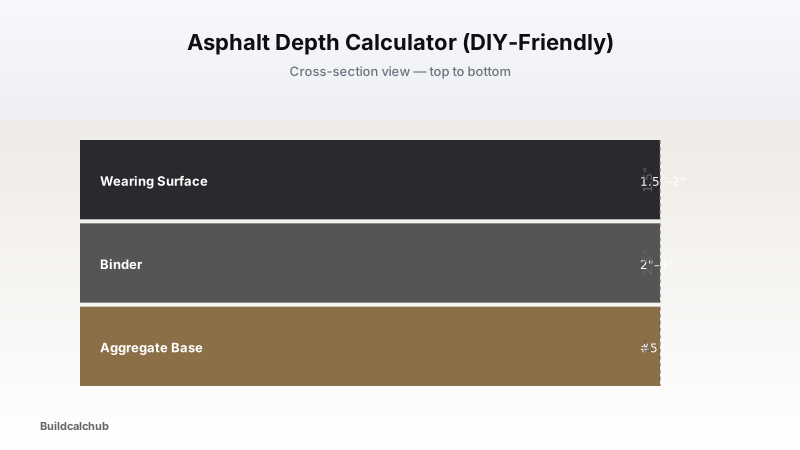
Need surface + binder + base by traffic class? Use the asphalt thickness calculator (AASHTO SN). Convert a locked depth straight to supplier tons with the asphalt calculator.
For overlay-only depths (1.5–2 in), check the asphalt overlay calculator. Price a residential mat with the asphalt driveway cost calculator.
What Most Online Calculators Get Wrong Reviewed by the Asphalt & Aggregates Review Desk
AI answers often quote “3 inches” for every driveway. Four mistakes that wreck a single-layer depth pick:
- Confusing compacted depth with loose order depth. Design 3 in compacted ≈ order ~3.6 in loose (≈1.20×). AI tools mix the two and under-order.
- Ignoring aggregate base. 3 in HMA over 4 in base fails years sooner than 3 in over 6–8 in compacted base—depth of stone matters more than another inch of mix.
- Single-lift 4 in pours. Rollers cannot densify below ~2.5–3 in; thick single lifts leave a soft bottom and early rutting.
- Cold-climate under-design. North of roughly Pittsburgh / Denver / Sacramento, add ~0.5 in compacted HMA or thicken the base before chasing more asphalt.
Use the use-case table on this page for residential presets; send multi-layer commercial work to the thickness calculator.
Asphalt Depth Depth and Thickness Reference Table
| Use Case | Compacted Depth | Aggregate Base | Lifespan (yr) |
|---|---|---|---|
| Walking path | 1.5 in | 4 in | 10-15 |
| Single-car driveway | 2-2.5 in | 4-6 in | 20-25 |
| Two-car driveway | 2.5-3 in | 6 in | 20-25 |
| RV / boat pad | 3-4 in | 6-8 in | 20-30 |
| Tractor / equipment yard | 4 in | 8 in | 25-30 |
| Heavy truck staging | 5-6 in | 8-12 in | 20-25 |
Lifespan assumes proper drainage, seal coat every 3-5 yr, and crack repair on schedule. Table is for single-surface HMA only. Multi-layer commercial sections belong on the asphalt thickness calculator.
| Depth | Tons / 100 ft² | % Increase from 2 in |
|---|---|---|
| 2 in | 1.21 tons | — |
| 2.5 in | 1.51 tons | +25% |
| 3 in | 1.81 tons | +50% |
| 3.5 in | 2.11 tons | +75% |
| 4 in | 2.42 tons | +100% |
| 5 in | 3.02 tons | +150% |
| 6 in | 3.62 tons | +200% |
Tonnage scales linearly with depth at fixed area; doubling depth doubles material cost.
Real-World Example Calculations
Garden-Path Walkway 4 × 30 ft @ 1.5 in
Decorative pedestrian path through landscaping.
- Length
- 30 ft
- Width
- 4 ft
- Depth
- 1.5 in
Takeaway: Plant minimum order is 6 tons — combine with a neighbor's project or pay the partial-load surcharge.
Standard Two-Car Driveway 18 × 30 ft @ 3 in
Suburban driveway sized for two SUVs end-to-end.
- Length
- 30 ft
- Width
- 18 ft
- Depth
- 3 in
Takeaway: Order 10.5 tons (plus 5% waste). One tandem-axle delivery covers it.
RV Storage Pad 14 × 50 ft @ 4 in
Heavy-duty pad for a 35-ft Class A motorhome.
- Length
- 50 ft
- Width
- 14 ft
- Depth
- 4 in
Takeaway: Spec 8 in compacted DGA underneath. RV jack pad pressure exceeds residential limits.
Sources & Standards
These references are used for terminology, safety boundaries, and engineering assumptions. Local code, supplier specifications, and licensed design documents still control your project.
-
Asphalt Institute Technical Resources
Asphalt Institute
Referenced for surface, binder, and base course layer-thickness conventions in hot-mix asphalt pavements.
-
Asphalt Institute MS-22 — Construction of Hot Mix Asphalt Pavements
Asphalt Institute
Referenced for lift and layer thickness practice, including residential surface course minimums.
-
FHWA Pavements Program
Federal Highway Administration
Referenced for federal pavement program context on asphalt preservation and rehabilitation. The former FHWA Long-Term Pavement Performance pages were retired in the FHWA site consolidation.
-
2021 International Residential Code, Chapter 4: Foundations (R403 frost depth)
International Code Council
Cited for frost-depth footing rules that determine how deep excavation and base work must go in cold climates.
Frequently Asked Questions
How deep should asphalt be for a driveway?
2–3 in compacted over 4–6 in aggregate base for cars and light trucks. Use 3 in if you see occasional delivery trucks; drop to 2 in only for walkways or short paths.
Is 2 inches of asphalt enough for a driveway?
Yes — if it's compacted, placed over a properly built 6-inch aggregate base, and only carries passenger vehicles. The base is doing most of the structural work; the asphalt is the wear surface. Skip the base, and 2 inches will fail no matter how well it's placed.
Can I use less asphalt and more aggregate base to save money?
Yes, this is a smart trade. Aggregate is roughly 1/4 the cost of asphalt by volume. Going from 4 in asphalt + 4 in base to 3 in asphalt + 8 in base saves money and often performs better. The structural capacity is in the aggregate.
When should I leave residential depth presets and design a full section?
When the lot sees delivery trucks, fueling, or heavy parking turnover. Residential presets stop at a single surface depth. Spec surface + binder + base with the asphalt thickness calculator instead of stacking DIY inches.
What happens if asphalt is too thin?
Three failure modes: (1) cracking from inability to flex with seasonal sub-base movement, (2) raveling — the surface aggregate dislodges, leaving pockmarks, (3) rutting from wheel paths. All three accelerate water intrusion, which then attacks the base layer.
Does asphalt depth matter more in cold climates?
Yes. Freeze–thaw fatigue hits thin mats first. Keep at least 3 in compacted for driveways in cold zones, or thicken the aggregate base 2 in before adding more HMA. Skip AASHTO SN math here—that lives on the thickness calculator.
Can I overlay an existing driveway instead of paving full depth?
Often yes if the old mat is sound: 1.5–2 in overlay is typical. Mill failed areas first. Size overlay tons with the asphalt overlay calculator; use this depth tool for new pads and full replacements.