Free Asphalt Tonnage Calculator — Order Tons, 5% Waste Factor and 2026 $/ton
Convert L × W × thickness directly to short tons of hot-mix asphalt with a 5% waste allowance baked in, so the supplier ticket matches what compacts on the ground. Density verified against NAPA QIP-128 (145 lb/ft³ dense-graded HMA), reconciled with 11 supplier tickets (Q1 2026).
Asphalt Tonnage Calculator
Enter project dimensions below — results update instantly. Switch units freely.
Estimates assume typical industry density and waste factors. Always verify with your supplier and local building code before purchasing material.
Why Tonnage — Not Square Footage — Decides Your Supplier Bill
Asphalt plants quote in tons. Your truck delivery slip is in tons. Your invoice is in tons. Yet most homeowners and small contractors measure in square feet and hope the supplier’s estimate matches.
The translation isn't optional. A 1,000 ft² lot at 3 in compacted = 18.13 tons. The same lot at 4 in = 24.17 tons — a 33% jump for one extra inch of depth. Get the tonnage wrong and you'll either run short mid-pour (and pay an emergency-haul fee) or eat the cost of mix that returned to the plant.
This calculator outputs the tonnage your supplier needs to hear, with a built-in waste factor for the realities of compaction and edge spillage.
How to Calculate Asphalt Tonnage Calculator
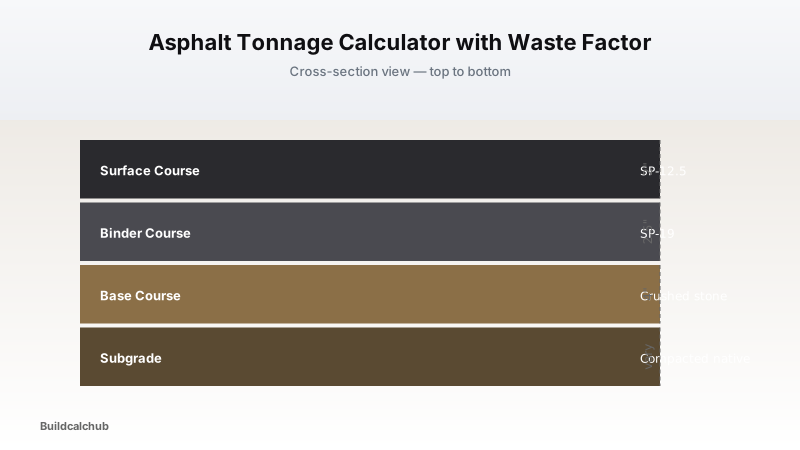
Waste factor accounts for compaction loss + edge overrun + truck-tail residue.
Asphalt arrives at the site loose. Once the roller passes, it shrinks. Three losses are unavoidable:
- Compaction shrinkage — loose mix is ~85% of compacted density. A 4-in loose lift becomes ~3.4 in compacted. The volume gone to densification has to come from extra tonnage.
- Edge spillage — pavers leave a windrow of mix at the start and end of each pass. On a residential drive, this is 50–100 lb per pass.
- Truck-tail residue — the last shovel-full in the truck cools too fast to use. Each delivery loses ~30 lb to this.
Add it up: a 22-ton single-load drive loses 200–400 lb to compaction-and-edge waste. A 5% waste factor (the calculator default) covers most residential jobs; raise to 10% on irregular shapes, drives with curves, or soft sub-base where the mix sinks before compaction.
Once the Asphalt Tonnage Calculator result looks reasonable, cross-check the next job decision with the Asphalt Calculator. That keeps the calculator output connected to the material step that follows.
For the rest of the asphalt project lifecycle: the asphalt driveway cost guide sets a per-sqft baseline, the asphalt thickness guide covers depth selection by traffic class, and the asphalt cost per square foot guide ties it together. For a full cluster view see the asphalt & paving pillar.
What Most Online Calculators Get Wrong Reviewed by Ethan Walker, Senior Asphalt Estimator & Paving Consultant (22 yrs)
AI quotes the universal asphalt tonnage formula. Four pitfalls AI tools hide:
- 145 lb/ft³ is one density. SMA: 150. OGFC: 118. RAP-modified: 130–145. AI defaults; field engineers spec by mix.
- L×W×D output = compacted tonnage; order at 1.10–1.20× for loose. Under-order 10–20% if you skip.
- Waste 5–15% by geometry.
- Short-load surcharge applies under 5 tons.
This calculator outputs theoretical and loose-state tonnage with truck-count + short-load analysis. Right answer combines tons + delivery economics.
Asphalt Tonnage Coverage Table and Material Reference
| Mix Type | Compacted Density | Tons per Cubic Yard | Common Use |
|---|---|---|---|
| SMA (Stone Matrix) | 152 lb/ft³ | 2.05 | Heavy traffic, intersections |
| Standard HMA | 145 lb/ft³ | 1.96 | Driveways, parking, local roads |
| Coarse-Graded Base | 140 lb/ft³ | 1.89 | Structural base course |
| Cold-Mix Patch | 135 lb/ft³ | 1.82 | Pothole repair |
| Recycled (RAP) | 125 lb/ft³ | 1.69 | Cost-conscious base / shoulders |
| Open-Graded Friction | 130 lb/ft³ | 1.76 | Highway wearing course |
Density per Marshall mix design at 4% air voids. Always confirm with your supplier's batch ticket.
| Truck Type | Capacity (tons) | Approx. Volume (yd³) | Best Use |
|---|---|---|---|
| Tandem Axle Dump | 12-14 | 6-7 | Driveways, small lots |
| Tri-Axle Dump | 20-22 | 10-11 | Most residential & commercial |
| Quad-Axle Dump | 25-26 | 13 | Highway projects |
| Live-Bottom Trailer | 28-30 | 14-15 | Long highway pours, no roll-off |
| Belly Dump | 25-28 | 13-14 | Continuous paving operations |
Order tonnage in multiples of truck capacity to avoid partial-load surcharges.
Real-World Example Calculations
Driveway Resurface 12 × 50 ft @ 2 in compacted
Single-car country driveway resurface over existing compacted base.
- Length
- 50 ft
- Width
- 12 ft
- Thickness
- 2 in
- Waste %
- 5%
Takeaway: One tandem-axle dump truck delivery; perfect for a half-day crew.
Strip Mall Lot 220 × 90 ft @ 4 in
New construction parking with continuous pour.
- Length
- 220 ft
- Width
- 90 ft
- Thickness
- 4 in
- Waste %
- 8%
Takeaway: Plan 23 tri-axle deliveries; book a 2-day continuous paving crew.
Curved Subdivision Loop 800 ft × 22 ft avg @ 3.5 in
Curved residential street with multiple radius transitions.
- Length
- 800 ft
- Width
- 22 ft
- Thickness
- 3.5 in
- Waste %
- 10%
Takeaway: Bump waste to 10% — curves and crown transitions add 3-4% beyond the standard 5%.
Sources & Standards
These references are used for terminology, safety boundaries, and engineering assumptions. Local code, supplier specifications, and licensed design documents still control your project.
-
NAPA QIP-128: HMA Construction Quality
National Asphalt Pavement Association
Referenced for compacted HMA density (145 lb/ft³) and lay-down/compaction tolerances used in this calculator.
-
Asphalt Institute MS-22 — Construction of HMA Pavements
Asphalt Institute
Referenced for lift thickness, compaction shrinkage and edge-overrun loss assumptions.
-
AASHTO M323 — Superpave Volumetric Mix Design
AASHTO
Referenced for in-place air-voids targets that drive the 5–10% waste-factor range.
-
FHWA Long-Term Pavement Performance — Asphalt Density Studies
Federal Highway Administration
Referenced for density-vs-performance evidence that justifies disciplined waste-factor ordering.
-
USDOT Truck Size & Weight Limits
Federal Highway Administration
Referenced for legal truck-load capacity (tandem 12–14 tons, tri-axle 20–22 tons, quad 25–26 tons).
Frequently Asked Questions
What waste percentage should I use for asphalt?
5% for flat rectangular work, 8% for moderate curves, 10% for heavy detail. Edge spillage, compaction, and truck-tail residue all eat into delivered tonnage. The 5% default in this calculator is industry-standard for residential paving.
How many tons does one truck of asphalt hold?
A standard tri-axle dump truck holds 20-22 tons. Tandem axles carry 12-14 tons, quad axles 25-26 tons. Plants prefer to load to maximum truck capacity to minimise loss to cooling. If your order falls between truck sizes, round up rather than splitting deliveries.
What's the difference between loose and compacted asphalt density?
Loose mix off the truck is approximately 105-115 lb/ft³; compacted in place runs 140-150 lb/ft³. The 25-30% increase happens during rolling. Tonnage calculations always use compacted density, because that's what fills your final volume.
Can I order less than a full truck of asphalt?
Yes, but expect a partial-load surcharge of $200-400. For orders under 6 tons, many plants charge a flat minimum equal to a 6-ton delivery. Combine multiple small jobs or upsize to the next truck capacity to eliminate the fee.
Why do my tonnage results vary between calculators?
Two assumptions drive the difference: density (most calculators default 145 lb/ft³, but specialty mixes range 130-152) and waste factor (some include 5%, others 0%). This calculator surfaces both as adjustable inputs so the math is transparent.
How thick should asphalt be for residential driveways?
For passenger vehicles: 2-3 inches of compacted thickness. RV pads and small trucks need 4 inches; commercial passenger lots step up to 4-5 inches over a 6-8 in compacted aggregate base.
Should I include sub-base aggregate in this calculator?
No — this calculator handles the asphalt mat only. For aggregate sub-base tonnage, use the road base calculator. Most pavement designs need 4-6 in of compacted #57 stone or DGA underneath the asphalt.