Asphalt Cost Calculator — Contractor Bid vs DIY Material Cost
Switch between contractor bid mode (material + labor + overhead) and DIY material-only mode to sanity-check quotes against editable 2026 $/ton defaults.
Asphalt Cost Calculator
Enter project dimensions below — results update instantly. Switch units freely.
Estimates assume typical industry density and waste factors. Always verify with your supplier and local building code before purchasing material.
Why Material Cost Is Only 40-50% of Your Asphalt Bill
If a contractor's bid for your driveway is $4,800 and you priced the asphalt at $1,800 wholesale, the gap isn't markup — it's labor, equipment, and overhead.
A typical breakdown:
- Material (40-55%) — mix at the plant, plus haul trucks.
- Labor (25-35%) — paver operator, screed person, raker, roller operator, foreman.
- Equipment (10-15%) — paver, roller, broom truck, transfer machine.
- Overhead & profit (10-20%) — insurance, permits, supervision, profit margin.
This calculator separates these so you can compare apples to apples between bids. If two contractors quote $5,000 and $7,000 on identical specs, the difference shows up here, not in the asphalt itself.
How to Calculate Asphalt Cost Calculator
Labor = ft² × $/ft²
Total = (Material + Labor) × (1 + Overhead %)
Labor in $/ft² is how most paving contractors quote because it scales with surface area regardless of mat thickness. Typical 2026 labor rates:
- Driveways (residential): $1.20-1.80 per ft²
- Parking lots (commercial): $1.00-1.50 per ft² — lower per-ft² because crews work longer continuous runs
- Highway (DOT contracts): $0.80-1.20 per ft² — volume discounts
- Repair / patch (small jobs): $3.00-5.00 per ft² — mobilization is fixed cost
Overhead percentages run 12-18% on private work and 15-25% on prevailing-wage public projects.
DIY Self-Install vs Contractor Bid
Switch the calculator to DIY self-install to zero out labor and overhead, add roller or plate-compactor rental (typical $150–$250/day), and apply a 5% contingency for tack coat, edge restraint, and short-load surprises. The results panel shows DIY savings vs contractor using your labor $/ft² as a reference bid line.
DIY works for small residential overlays (<600 ft²) when you can hand-rake and rent a roller. It does not replace a crew for tear-out, base remediation, or night/weekend paving. Budget these add-ons separately:
- Tack coat — $0.15–$0.25/ft² material + labor if you hire help
- Edge restraint — $2–$4/LF for plastic or steel paver edge
- Short-load fee — plants often charge 3–5 ton minimum; order to the next half-ton
Pair the cost result with the asphalt calculator for tons, or the asphalt driveway cost calculator when the bid is residential installed work.
If you want the full line-item breakdown behind a residential bid — mobilization, demo, base, tack, surface, edge work — read our 2026 asphalt driveway cost guide; it includes a side-by-side decoding of three real Mid-Atlantic quotes on the same 950 sqft driveway. Still choosing between materials? The asphalt vs concrete driveway comparison shows where each one actually wins on cost, lifespan, climate, repair and resale.
What Most Online Calculators Get Wrong Reviewed by the Asphalt & Aggregates Review Desk
AI tools quote asphalt cost as “$3–$7/sqft” universally. Four pitfalls AI summaries hide:
- $/sqft is scope-dependent, not material-dependent. Same HMA = $3.20/sqft as overlay, $5.50/sqft as new install (includes base + tear-out), $7.50/sqft as small driveway (mobilization-heavy). AI quotes one range; the answer always requires scope.
- Material cost ($60–$95/ton plant gate) is 30–50% of installed. Labor + equipment + overhead = the other 50–70%. AI tools sometimes equate ton cost with installed cost. 9-ton driveway = $810 material + $1,500–$2,200 labor = $2,310–$3,010 total.
- DIY mode omits tack coat, edge restraint, and short-load fees. AI “DIY savings” quotes often subtract labor only. This calculator adds equipment rental and 5% contingency but you must still price tack ($0.15–$0.25/ft²) and edge restraint ($2–$4/LF) before comparing to a contractor bid.
- Regional multiplier is ±30%. Mid-Atlantic baseline = 1.0×. Northeast = 1.20–1.35×. Southeast = 0.85–1.0×. Mountain West = 1.10–1.25×. AI tools quote “US average”; field practice always uses local data.
This calculator separates contractor vs DIY modes, material from installed cost, and shows DIY savings against a reference labor line. Asphalt cost is always 3 numbers: tons, $/ton, total installed — never just one.
Asphalt Cost Cost Reference Table
| Region | Hot-Mix $/ton | Recycled (RAP) $/ton | Premium SMA $/ton |
|---|---|---|---|
| Northeast (NY, NJ, PA, MA) | $130-150 | $30-40 | $170-200 |
| Mid-Atlantic (DE, MD, VA) | $120-140 | $25-35 | $160-185 |
| Southeast (FL, GA, NC) | $105-125 | $20-30 | $140-165 |
| Midwest (OH, IL, MI) | $115-135 | $25-35 | $155-180 |
| South (TX, OK, LA) | $95-115 | $18-28 | $130-155 |
| Mountain (CO, UT, WY) | $135-160 | $30-45 | $175-205 |
| Pacific (CA, OR, WA) | $140-170 | $35-50 | $185-220 |
Prices include plant-side haul. Long-haul deliveries (>30 mi) add $0.10-0.15 per ton-mile.
| Condition | Cost Impact | Why |
|---|---|---|
| Demo of existing pavement | +$1.00-2.00/ft² | Saw-cut, milling, hauling debris |
| Soft sub-base remediation | +15-30% | Extra excavation + structural fill |
| Tight access (no truck swing) | +20-35% | Hand placement, slower production |
| Curves and circles | +10-15% | More waste, slower paver speed |
| Night work | +25-40% | Wage premium + lighting |
| Winter / cold weather | +10-20% | Mix temp loss, slower compaction |
Always specify these conditions to bidders to ensure apples-to-apples comparison.
| Line item | Contractor mode | DIY mode |
|---|---|---|
| Material (9.2 tons) | $1,242 | $1,242 |
| Labor @ $1.50/ft² | $900 | $0 |
| Equipment rental | $0 (in crew rate) | $200 roller/day |
| Contingency (5%) | $0 | $62 |
| Overhead @ 15% | $321 | $0 |
| Total | $2,463 | $1,504 |
| Cost per ft² | $4.11 | $2.51 |
DIY savings shown in calculator results assume you supply labor and accept compaction risk on small residential pours. Add tack coat, edge restraint, and short-load fees before comparing to a written contractor bid.
Real-World Example Calculations
Residential Driveway 600 ft² @ 3 in
Standard 24×25 ft single-family driveway in suburban Pennsylvania.
- Length × Width
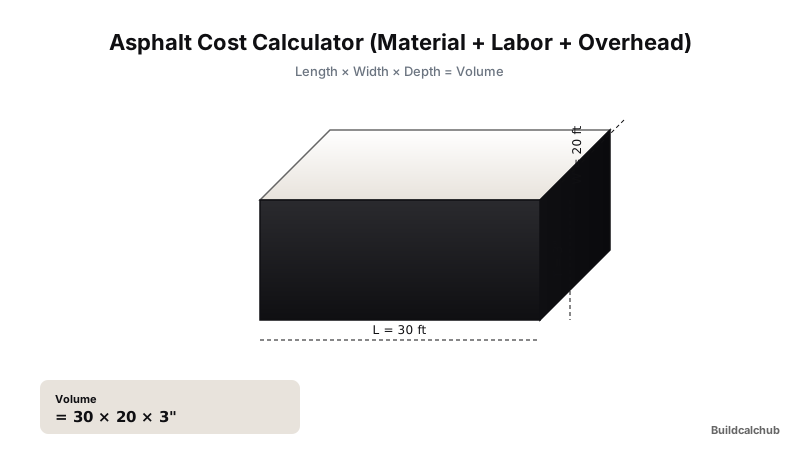
- 30 × 20 ft
- Thickness
- 3 in
- Material $/ton
- $135
- Labor $/ft²
- $1.50
Takeaway: Material 54%, labor 33%, overhead 13%. Typical bid range: $2,500-3,200.
Commercial Parking Lot 8,000 ft² @ 4 in
Office park resurface with full demo of existing pavement.
- Length × Width
- 100 × 80 ft
- Thickness
- 4 in
- Material $/ton
- $125
- Labor $/ft²
- $1.20
Takeaway: Add ~$10,000 for demo if existing pavement isn't milled. Always get written demo scope.
Town Road Overlay 0.25 mi × 22 ft @ 2 in
Municipal overlay project, prevailing wage labor.
- Length × Width
- 1,320 × 22 ft
- Thickness
- 2 in
- Material $/ton
- $115
- Labor $/ft²
- $0.95
- Overhead
- 20%
Takeaway: Public-bid overhead runs 18-22% with prevailing wage and bonding requirements.
Step 6 of 6 in the Asphalt Driveway Project Path
- Measure AreaSquare Footage Calculator
- ExcavationExcavation Calculator
- Road BaseCrusher Run Calculator
- ThicknessAsphalt Thickness Calculator
- TonnageHot Mix Asphalt Calculator
- CostAsphalt Cost Calculator
Whole sequence with costs and ordering notes: Asphalt Driveway Project Path.
Sources & Standards
These references are used for terminology, safety boundaries, and engineering assumptions. Local code, supplier specifications, and licensed design documents still control your project.
-
NAPA Asphalt Pavement Magazine — Industry Pricing Data
National Asphalt Pavement Association
Referenced for 2026 $/ton HMA pricing trend and labor-cost benchmarks used in this calculator.
-
Asphalt Institute MS-19 — Asphalt Construction Economics
Asphalt Institute
Referenced for material vs labor vs overhead ratios on residential and commercial paving.
-
USGS Mineral Commodity Summaries — Asphalt & Petroleum
U.S. Geological Survey
Referenced for liquid-asphalt-binder price trend and regional supply variation.
-
U.S. Bureau of Labor Statistics — Construction Labor Costs
BLS
Referenced for 2026 paving crew wage benchmarks and overhead percentages.
-
FHWA Pavement Performance — Cost-Benefit Analysis
Federal Highway Administration
Referenced for long-term cost-per-year-of-service economics.
Frequently Asked Questions
Can I pave a driveway myself and save money?
On small residential jobs (<600 ft²), DIY can save 35–45% versus a full contractor bid if you hand-rake, rent a plate compactor or roller ($150–$250/day), and accept compaction risk. Switch the calculator to DIY mode to see material + equipment + 5% contingency with labor and overhead zeroed out. You still need to budget tack coat, edge restraint, and possible short-load minimums separately — those are the items most DIY estimates miss.
How much does asphalt cost per square foot installed?
For 2-3 in residential driveways: $3-7 per square foot installed. Commercial parking at 4 in runs $4-9 per ft². Heavy-duty industrial surfaces hit $8-12 per ft². The wide range reflects regional labor costs, mat thickness, and project complexity.
What's the average cost to pave a residential driveway?
For an average 600 ft² driveway in 2026: $3,000-5,000 total. Tear-out of old pavement adds $800-1,200. Edging, sealing, and curb work add another $500-1,500.
Why are asphalt prices so different between contractors?
Three reasons: (1) plant relationships — long-term contractors get 5-10% off list price, (2) crew efficiency — some crews place 400 tons/day, others 200, (3) overhead structure — small operators run leaner but skimp on insurance. Always verify insurance and bonding before signing.
Should I use recycled asphalt to save money?
For driveways and rural roads, RAP saves 60-75% on material cost. Trade-off: a slightly darker, less smooth surface. Mix RAP with 20-30% virgin binder for the best balance of cost and appearance. Not recommended for high-visibility commercial entrances.
What does 'overhead and profit' include in a paving bid?
Insurance, bonding, vehicle/equipment depreciation, supervision, mobilization to/from site, profit margin. Industry standard 12-18% on private work, 18-22% on public/prevailing-wage. Bids without an overhead line are usually missing one of these costs — usually insurance.
How can I get the best price on asphalt paving?
Three tactics: (1) bid the project in spring or fall when crews aren't booked solid, (2) bundle multiple driveways with neighbors for shared mobilization, (3) accept RAP base course with virgin surface course — saves 25% with no visible difference once cured.
Are asphalt prices going up or down in 2026?
Material prices are up 8-12% year-over-year on rising oil and aggregate costs. Labor up 6-10% with construction worker shortage. Lock in a price in writing if you're scheduling work more than 30 days out — suppliers' quotes typically expire after 30 days.