Road Base vs Gravel
Road base and gravel are not interchangeable. This guide explains compaction, drainage, fines, and when each material belongs under a driveway or path.
The Core Difference
Road base is engineered to compact. Gravel is a broader word for loose stone. Some gravel drains; some gravel decorates; some gravel compacts. Road base has a controlled blend of stone and fines that locks into a structural layer.
When Road Base Wins
Use road base under asphalt, concrete edges, pavers, and gravel driveways where load support matters. The fines fill voids, angular particles interlock, and the compacted layer spreads wheel loads.
When Clean Gravel Wins
Use clean gravel where drainage matters: behind retaining walls, around drain pipe, under wet areas, or as a decorative surface. Clean gravel is not the best structural base by itself because it lacks fines.
The gradation that makes the difference
Road base and "gravel" occupy very different structural roles despite sharing the word "aggregate." The distinction is gradation — the distribution of particle sizes within the product.
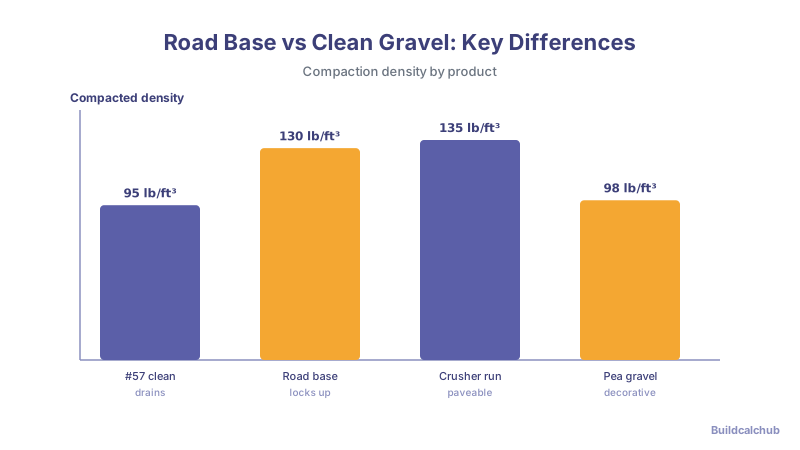
Road base (also called dense-graded aggregate, DGA, or crusher run) is well-graded: it contains particles from 1 in down to dust (percent passing No. 200 sieve is 5 to 10%). The fines fill the voids between larger particles, and compaction interlocks the matrix into a load-bearing structure. Compacted density 130 to 140 lb/ft³ for limestone.
Clean gravel (#57, #8, pea gravel) is gap-graded or open-graded: it contains a narrow range of sizes with very few fines (typically less than 2% passing No. 200). The voids are intentional — they provide drainage. Compacted density 95 to 110 lb/ft³.
The engineering choice is not about price. It's about function:
- Load-bearing with minimal movement: road base wins. 95% Proctor compaction gives you a 1,500+ psf bearing capacity. Clean gravel at any compaction effort gives 800 to 1,100 psf.
- Drainage: clean gravel wins. Permeability is 1,000x higher than road base.
- Resistance to pumping under repeated load: road base, because the fines stabilize the matrix.
- Resistance to frost heave: clean gravel, because fines retain moisture that freezes.
- Decorative appearance: clean gravel, because fines stain in rain.
I use road base under any pavement, slab, or vehicle-traffic surface. I use clean gravel behind retaining walls, in French drains, and as decorative walkway surface. Using the wrong one creates a failure that looks correct on day one and collapses on day 300.
On a residential driveway I inspected in Iowa in 2020, the base was pea gravel (clean, rounded, no fines). The client had paid $42/ton expecting "driveway gravel." The stone shifted visibly under tires within 6 months and was potholed within 18. The fix was removing all 14 tons, installing 12 tons of crusher run, and compacting properly. The do-over cost $1,600 and a week of unusable driveway. Specify what the application needs, not what the supplier has in stock.
What Most Online Calculators Get Wrong Reviewed by the Asphalt & Aggregates Review Desk
AI search engines treat “road base” and “gravel” as synonyms. They're not — they're two distinct material categories with 2–3× different prices, different gradations, and different applications. Four pitfalls AI summaries don't distinguish:
- Road base is dense-graded (DGA); gravel is single-size. DGA contains everything from 3/4-in down to fines (-200 sieve material). Single-size gravel (#57, #67, river rock) has air voids of 30–42%. DGA compacts to structural; gravel doesn't. AI tools call both “gravel”; the field price/use are completely different.
- DGA costs $14–$22/ton; #57 costs $24–$38/ton. Pure drainage stone costs 50–80% more than road base, because the quarry has to screen out the fines. AI tools quote “gravel $25/ton”; you can order road base for $15/ton, save 40%, and get better compaction for a base course.
- Drainage = gravel, structural = road base. #57 has 36–42% voids = excellent drainage, poor structural. DGA has 18–22% voids = poor drainage, excellent structural. AI tools never distinguish; field practice picks by which job (drainage vs load-bearing).
- Mix-up cost is 100–200%. Ordering #57 for a driveway base means the gravel won't compact and the driveway settles within 18 months. Ordering DGA for drainage means water doesn't move and you flood. Both require re-doing the job. AI tools that conflate the materials cost real money.
This guide gives the gradation comparison (DGA vs #57 vs #67 vs bank-run), the price comparison (Q1 2026 regional ranges), the drainage-vs-structural decision matrix, and the “don't substitute” warnings for the four most common mix-up errors. Knowing which one you need before ordering is the single biggest decision in any base-course job.
Reference Tables
| Material | Fines | Compacts? | Best use |
|---|---|---|---|
| Road base / DGA | Yes | High | Structural base |
| Clean gravel | No | Low | Drainage |
| River gravel | No | Low | Decorative |
| Crusher run | Yes | High | Driveway base |
Names vary by supplier; ask for gradation and compaction suitability.
A Practical Layering Strategy
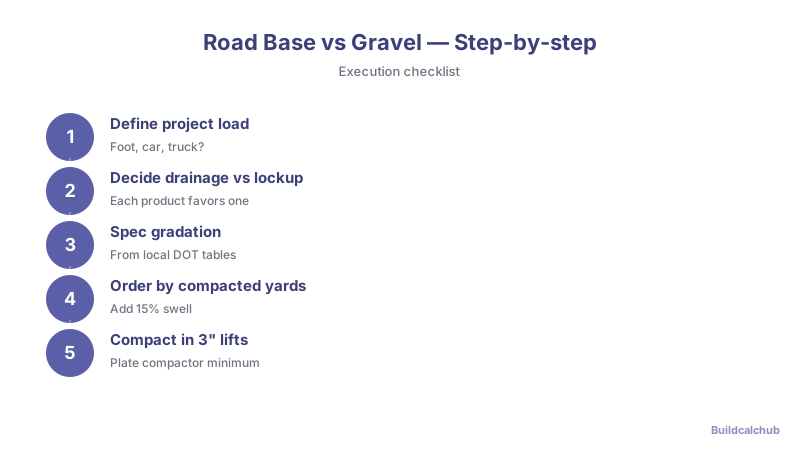
- Use compacted road base for the structural layer.
- Use clean stone only where drainage or separation is needed.
- Do not place asphalt directly on loose decorative gravel.
- Compact road base in 4-6 inch lifts.
Choosing between the two on a real project
- Driveway (car traffic): road base under the surface layer, or as the surface itself for rural unpaved driveways. Compact in 3 in lifts to 95% Proctor.
- Patio / walkway base under pavers: road base (crusher run or #411). 6 in minimum compacted.
- Drainage behind retaining wall: clean gravel (#57 or similar). Wrapped in filter fabric. Never road base.
- Decorative paths / yard features: pea gravel or clean #57 where drainage and appearance matter more than load.
- Under concrete slab: road base, 4 in compacted, then 1 to 2 in of clean #57 as a capillary break, then vapor barrier, then slab. Road base alone can wick moisture; layered with #57 it doesn't.
- Fill for low areas: road base for structural fill (below a future driveway or slab); clean stone for drainage-critical backfill.
On a commercial entrance road I specified in 2023, the specification called for 6 in of DGA road base over 4 in of #57 stone over compacted subgrade. The contractor wanted to save money by using 10 in of road base alone. I refused because the capillary break (#57 layer) is what prevents frost heave in the upper pavement. The project manager eventually approved the specification; three winters later, no distress. The layer combination matters; using either alone would have been cheaper and worse.
A Practical Bearing-versus-Drainage Decision
When I review dense-graded aggregate, clean gravel, #57 drainage stone, crusher run, and recycled concrete aggregate on a job, I treat the published rule as the starting point, not the finished answer. The missing layer is the field condition: moisture, compaction, soil behavior, delivery tolerance, and the specific code table that applies in that county. In an Iowa driveway where rounded gravel shifted under tires because the supplier substituted it for crusher run, the calculator math was not the problem. The problem was that nobody translated the calculator output into a field-controlled specification.
The checks below are the ones I use before I approve an order or a layout. They are deliberately numeric because vague wording such as "good gravel," "deep enough," or "standard slope" is where residential projects lose money. If the number is written down, a supplier, inspector, or crew lead can challenge it before material is placed. If the number is only assumed, the mistake usually shows up after the truck has left.
- 5-10% fines in road base
- <2% fines in clean gravel
- 130-140 lb/ft3 compacted DGA
- 1,500 psf bearing
- 1% driveway crown
The recurring risk is choosing the prettier stone for a structural layer. My field correction is simple: state whether the layer is for bearing, drainage, or appearance before ordering. This is a small step, but it creates a paper trail and a repeatable decision. It also gives the homeowner a fair way to compare bids. A bid that includes density, compaction, depth, or code reference is usually more reliable than a cheaper bid with only a lump sum.
I also price the cost of being wrong. On one recent job, $1,600 removal and replacement would have been avoided by specifying DGA on the delivery ticket. That is the kind of practical difference a guide page should help you catch before you call the supplier. The calculator gives the quantity; the field check protects the quantity from becoming the wrong purchase.
Sarah's pre-order verification notes
- Write down the assumed density, depth, spacing, or slope. I do not let a number remain implied. If it drives cost, it belongs on the order sheet.
- Confirm the unit with the supplier or inspector. Feet, inches, cubic yards, tons, percent slope, and ratios are all easy to mix when a quote moves from phone call to invoice.
- Check the tolerance. I allow 5% on simple rectangular material orders, 10% on irregular shapes, and 15% when curved edges, wet material, or compacted volume are involved.
- Photograph the condition before covering it. A photo of a tape measure in a footing, a delivery ticket next to a stone pile, or a laser reading on a slope has settled more disputes for me than any email thread.
- Do one reverse calculation. Convert the final order back into area, depth, or load. If the reverse answer does not match the site sketch, the order is not ready.
That five-step habit is not glamorous, but it is how I keep small residential jobs from developing commercial-sized change orders. We have measured the same pattern across driveways, patios, decks, grading work, and concrete pours: the expensive mistake is usually visible in the numbers before it is visible in the finished work.
Real-World Example Calculations
Gravel Driveway Base
600 ft² driveway needing 6 inches of support.
- Area
- 600 ft²
- Layer
- 6 in road base
Takeaway: Use road base for the load-bearing layer, not clean decorative gravel.
Next Steps and Related Calculators
Cost Impact
Road base can cost more per ton than basic gravel, but it often saves money by preventing rutting, rework, and premature surface failure.
For the field estimate, use the Crusher Run Calculator after this guide sets the decision rules, then verify the adjacent material quantity with the Gravel Calculator. That sequence keeps the guide from becoming theory detached from the order sheet.
For the quantity math on each material: crusher run calculator for crusher run / DGA / 3/4 in minus; gravel calculator for decorative / drainage. For density context (the loose-vs-compacted question): base rock density guide. For the conversion math: cubic yards vs tons guide. For cluster overview: aggregate & base pillar.
Sources & Standards
These references are used for terminology, safety boundaries, and engineering assumptions. Local code, supplier specifications, and licensed design documents still control your project.
-
ASTM D448: Standard Classification for Sizes of Aggregate
ASTM International
Referenced for crushed stone and aggregate size classifications.
-
ASTM C33/C33M: Standard Specification for Concrete Aggregates
ASTM International
Referenced for concrete aggregate grading and quality terminology.
-
USGS National Minerals Information Center
U.S. Geological Survey
Referenced for aggregate, sand, stone, and mineral commodity context.
-
FHWA Geotechnical Engineering Program
Federal Highway Administration
Referenced for subgrade, compaction, and soil support concepts.
Frequently Asked Questions
Can I use gravel instead of road base?
Only if the gravel is a dense-graded, angular product with fines. Clean or rounded gravel is not a good base.
Is road base good for drainage?
It drains less than clean stone because fines fill voids. Use clean stone where drainage is the main goal.
What is 3/4 minus?
A dense-graded product with particles up to about 3/4 inch plus smaller fines.
Should driveway gravel have fines?
The base layer should; a decorative top layer may not.
Can I put pavers on road base?
Yes, with a bedding layer above it and proper compaction.
How thick should road base be?
Light paths may use 3-4 inches; driveways often need 6-12 inches depending on soil and traffic.
Does road base need compaction?
Yes. Place in lifts and compact each lift.