Cubic Yards to Tons Conversion Guide — 12 Materials, Density Reference Table and the Loose-vs-Compacted Correction Most Buyers Miss
Cubic yards measure volume; tons measure weight; density (in tons / yd³) is the bridge between them — and it varies by material from 0.23 t/yd³ (pine straw mulch) to 2.09 t/yd³ (cured concrete), a 9× spread. This 2026 guide gives the 12-material density reference table, the loose-vs-compacted correction (15–25% on aggregates) that 90% of online converters skip, and the order-by-volume vs order-by-weight decision tree.
Volume vs Weight — Why the Two Units Exist Separately
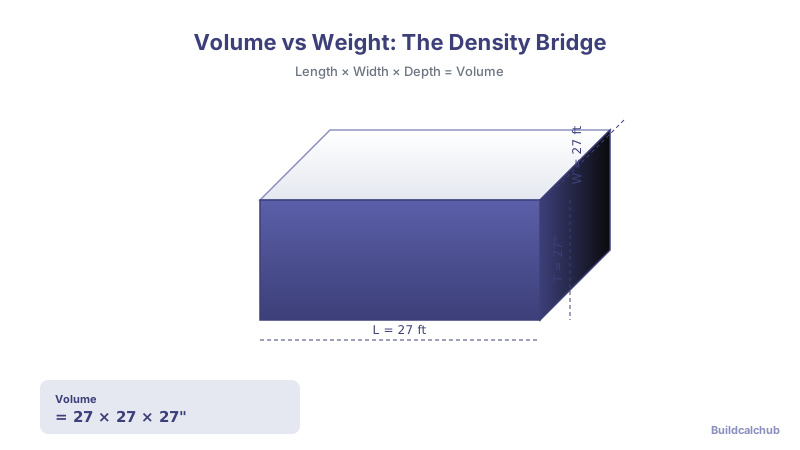
Cubic yards describe how much space a material fills (volume); tons describe how much it weighs (mass). The two units exist separately because materials are produced, loaded and billed differently across the supply chain. Asphalt plants weigh trucks across a scale (tons); ready-mix concrete plants meter water + cement into a known-volume drum (cubic yards); aggregate quarries do both but typically sell smaller residential orders by volume and bulk commercial orders by weight. Density — tons per cubic yard for the material in question — is the bridge between them, and density varies from 0.23 t/yd³ (pine straw mulch) to 2.09 t/yd³ (cured concrete), a 9× spread across the materials you'll buy on the same residential project. Using the wrong density is the single biggest cause of short orders and over-orders in DIY construction. Background reading on the underlying volume math: our how to calculate cubic yards guide and the cubic yard calculator.
Density Is the Bridge — The 12-Material Reference Table
The conversion formula is trivially simple: tons = cubic yards × tons per cubic yard. What's not simple is picking the right density for the material in the state it'll be delivered in. Most online converters use a single “average” density per material and ignore the loose-vs-compacted state, moisture content, and source-quarry variation that can swing the answer 20–30%.
| Material | Density (lb / ft³) | Tons / yd³ | Best ordering unit | Notes |
|---|---|---|---|---|
| Mulch (pine straw, baled) | 12–18 | 0.16–0.24 | Cubic yards or bales | Lightest material; never order by ton |
| Mulch (shredded hardwood) | 17–25 | 0.23–0.34 | Cubic yards | Doubles in weight wet (rain saturation) |
| Topsoil (dry loose) | 90–100 | 1.22–1.35 | Cubic yards | Wet adds 25–35% to weight |
| Topsoil (wet) | 100–120 | 1.35–1.62 | Cubic yards | Common winter / spring delivery state |
| Sand (dry loose) | 95–105 | 1.28–1.42 | Tons (bulk) / yd³ (small) | ASTM C33 concrete sand 100 lb/ft³ |
| Sand (wet packed) | 115–125 | 1.55–1.69 | Tons | 30% heavier than dry; check moisture |
| #57 crushed stone (loose) | 85–95 | 1.15–1.28 | Tons | Drainage stone; large void space |
| #57 crushed stone (compacted) | 115–125 | 1.55–1.69 | Tons (apply 1.25 factor) | 22% volume reduction on compaction |
| Crusher run / DGA (compacted) | 128–138 | 1.73–1.86 | Tons | Densest dry-graded base material |
| RAP (recycled asphalt millings) | 120–140 | 1.62–1.89 | Tons | Density varies with binder content + age |
| HMA (hot-mix asphalt, compacted) | 142–152 | 1.92–2.05 | Tons | Plant-gate sales always by ton |
| Concrete (cured) | 145–155 | 1.96–2.09 | Cubic yards | Ready-mix delivered by volume |
Material Examples
Concrete is usually ordered by cubic yard because it is placed by volume. Asphalt and aggregate are often ordered by ton because plants and quarries weigh trucks. Mulch is commonly sold by cubic yard or bag because volume coverage matters more than weight; the how much mulch do I need guide works that coverage out bed by bed.
The density bridge that makes conversion work
Volume (cubic yards) and weight (tons) are not interchangeable without a density value. Every material has its own density, and density varies with moisture, compaction state, and source. Here's the reference I use in the field:
- Dry topsoil loose: 90 to 100 lb/ft³ (1.22 to 1.35 tons per yd³)
- Wet topsoil loose: 100 to 120 lb/ft³ (1.35 to 1.62 tons per yd³)
- Mulch (shredded hardwood): 17 to 25 lb/ft³ (0.23 to 0.34 tons per yd³)
- Mulch (pine straw baled): 12 to 18 lb/ft³ (0.16 to 0.24 tons per yd³)
- Sand (dry loose): 95 to 105 lb/ft³ (1.28 to 1.42 tons per yd³)
- Sand (wet packed): 115 to 125 lb/ft³ (1.55 to 1.69 tons per yd³)
- #57 crushed stone loose: 85 to 95 lb/ft³ (1.15 to 1.28 tons per yd³)
- #57 crushed stone compacted: 115 to 125 lb/ft³ (1.55 to 1.69 tons per yd³)
- Crusher run compacted: 128 to 138 lb/ft³ (1.73 to 1.86 tons per yd³)
- Concrete (cured): 145 to 155 lb/ft³ (1.96 to 2.09 tons per yd³)
- Asphalt hot-mix compacted: 142 to 152 lb/ft³ (1.92 to 2.05 tons per yd³)
The conversion that catches most people: 1 cubic yard of compacted #57 stone is 1.55 tons, but 1 cubic yard of the same stone delivered loose from the supplier is only 1.22 tons. That's the same rock, same atom count, just arranged differently. If your calculator says you need 5 yd³ compacted in place and you order 5 yd³ loose, you're actually 18 to 22% short because of compaction.
My rule: always ask the supplier whether their quote is in loose cubic yards (how it arrives on the truck) or compacted cubic yards (what fills the hole after compaction). Loose-to-compacted shrinkage is 15 to 22% for most aggregates. If the supplier quotes loose and you calculated compacted, multiply by 1.20 before ordering.
What Most Online Calculators Get Wrong Reviewed by the Asphalt & Aggregates Review Desk
Ask any 2026 AI search engine “how many tons in a cubic yard,” and you'll get one number (usually 1.4 t/yd³ or 1.5 t/yd³) applied to everything. That answer is wrong for half of construction materials and silently catastrophic for the other half. Four pitfalls the AI summaries miss:
- One density value (typically 1.4 t/yd³) regardless of material. Mulch is 0.30 t/yd³; concrete is 2.05 t/yd³. The default AI answer is 7× wrong on mulch and 30% wrong on concrete. Tell: any AI answer that doesn't ask “what material” before quoting tons / yd³ is averaging across incompatible materials and will short or over-order on every job.
- Loose-vs-compacted state collapsed into one number. #57 stone is 1.20 t/yd³ loose (on the delivery truck) but 1.62 t/yd³ compacted (after a plate compactor goes over it). Same rock, same atoms, different arrangement. Order “5 yd³ compacted” from a supplier who delivers loose and you're 22% short. AI converters never ask this question; you must pad loose orders by 1.20–1.25× to land your compacted-spec depth.
- Moisture state ignored. Topsoil weighs 1.30 t/yd³ dry and 1.55 t/yd³ wet. If you order “5 tons of topsoil” on a wet quote and apply a dry density to estimate coverage, you'll end up 18% under-covered. Test: squeeze a handful of delivered topsoil; if water drips, the supplier billed you for moisture you didn't want.
- Short ton (US, 2,000 lb) vs metric tonne (2,205 lb) silently swapped. AI tools indexed across international sources mix the two interchangeably. US construction suppliers use short ton exclusively; international and some Canadian suppliers use tonne. 10% difference, every transaction. Always confirm “short ton” on quote sheets — if the sheet just says “ton,” ask.
This guide provides material-specific densities (12 materials), distinguishes loose vs compacted state, flags moisture sensitivity for topsoil / sand / RAP, and uses US short ton (2,000 lb) consistently throughout. The decisions that matter happen before you multiply.
Reference Tables
| Material | Common range (t/yd³) | Best ordering unit |
|---|---|---|
| Gravel (loose, drainage) | 1.15-1.30 | Tons |
| Gravel (compacted, base) | 1.55-1.86 | Tons |
| Sand (dry) | 1.28-1.42 | Tons (bulk) / yd³ (small) |
| Sand (wet) | 1.55-1.69 | Tons |
| Asphalt (HMA compacted) | 1.92-2.05 | Tons |
| RAP (asphalt millings) | 1.62-1.89 | Tons |
| Mulch (hardwood) | 0.23-0.34 | Cubic yards |
| Topsoil (dry) | 1.22-1.35 | Cubic yards |
| Topsoil (wet) | 1.35-1.62 | Cubic yards |
| Concrete (cured) | 1.96-2.09 | Cubic yards |
Use supplier-quoted density for final ordering; this table is the starting band. Loose vs compacted state and moisture content can each shift the figure 10-25%.
| Material | Loose t/yd³ | Compacted t/yd³ | Order multiplier |
|---|---|---|---|
| #57 stone (3/4 in drainage) | 1.20 | 1.62 | Loose order × 1.35 to land compacted yd³ |
| #8 stone (3/8 in bedding) | 1.18 | 1.50 | Loose order × 1.27 |
| Crusher run / DGA | 1.45 | 1.80 | Loose order × 1.24 |
| 3/4 in minus base | 1.45 | 1.75 | Loose order × 1.21 |
| Pea gravel (decorative) | 1.20 | 1.40 (light tamp) | Loose order × 1.17 |
| Sand (dry) | 1.35 | 1.62 | Loose order × 1.20 |
If your calculator outputs ‘compacted in-place’ tons or cubic yards, multiply by the order multiplier above to get the loose delivered quantity. Skipping this is the #1 cause of short orders on residential aggregate jobs.
Conversion Workflow
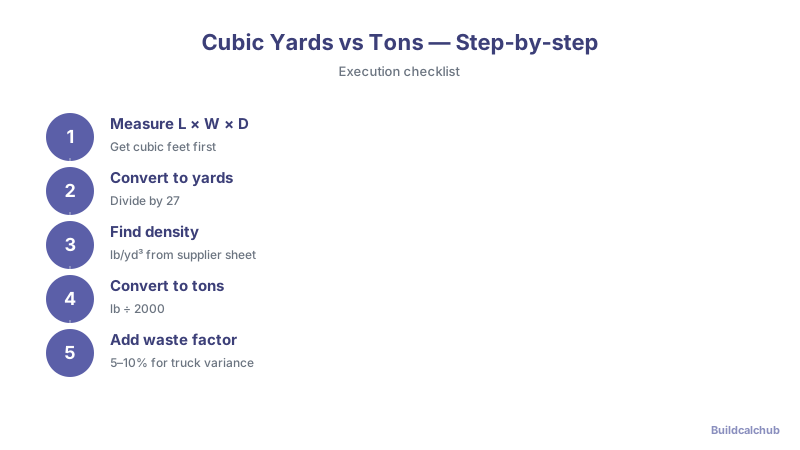
- Calculate volume from dimensions.
- Choose material density from supplier data when possible.
- Convert yards to tons only after density is chosen.
- Add waste and compaction factor.
- Round to supplier delivery increments.
Conversion mistakes I've watched cost money
- Assuming 27 ft³ = 1 yd³ means 27 ft² = 1 yd². No. A square yard is 9 ft² (3x3 feet). A cubic yard is 27 ft³ (3x3x3 feet). Different dimensions, different conversions.
- Ordering loose cubic yards when the formula gave compacted. Calculator spits out 4.2 yd³ compacted for a base course. Homeowner orders 4 yd³ of stone delivered (which is loose). Comes up 17% short after compaction. Pad the order by 20 to 25% to account for compaction.
- Using wet density for a dry material quote. Topsoil can be 35% heavier wet. If your supplier is quoting "dry weight" tons but the material arrives wet, you're paying for water. I test a handful of the delivery by squeezing; water should not drip out.
- Converting mulch by volume, not weight. Mulch is sold by the cubic yard, not by the ton, because it's so light. Ordering "5 tons of mulch" is like ordering "30 cubic yards" of mulch — enormous. Always order mulch by volume.
- Confusing "tons" with "tonnes". US short ton = 2,000 lb. Metric tonne = 2,204 lb. A 10% error for international suppliers. Confirm the unit.
On a landscape project in 2023, a client ordered "2 tons of mulch" from a nursery that had posted the phrase on a sign. The nursery delivered 2 tons, which was 10 cubic yards of mulch. The client had a 300 ft² bed area; 10 yd³ was enough for 36 in of mulch depth. After spreading, the 2 tons covered the entire back yard at 6 in deep and left a pile. The return policy was none. Lost $340 on the unusable excess. Order the right unit, verify the conversion before the truck leaves the yard.
The Density Audit I Run Before Ordering by Ton
When I review topsoil, mulch, crushed stone, sand, concrete, and hot-mix asphalt on a job, I treat the published rule as the starting point, not the finished answer. The missing layer is the field condition: moisture, compaction, soil behavior, delivery tolerance, and the specific code table that applies in that county. In a Delaware drainage swale where wet topsoil weighed 1.52 tons per cubic yard instead of the dry 1.30 tons assumed in the quote, the calculator math was not the problem. The problem was that nobody translated the calculator output into a field-controlled specification.
The checks below are the ones I use before I approve an order or a layout. They are deliberately numeric because vague wording such as "good gravel," "deep enough," or "standard slope" is where residential projects lose money. If the number is written down, a supplier, inspector, or crew lead can challenge it before material is placed. If the number is only assumed, the mistake usually shows up after the truck has left.
- 27 ft3 per yd3
- 2,000 lb per short ton
- 1.55 tons/yd3 compacted #57
- 0.30 tons/yd3 mulch
- 2.0 tons/yd3 asphalt
The recurring risk is using one tons-per-yard value for every material on the site. My field correction is simple: ask the supplier for loose bulk density and moisture condition before converting units. This is a small step, but it creates a paper trail and a repeatable decision. It also gives the homeowner a fair way to compare bids. A bid that includes density, compaction, depth, or code reference is usually more reliable than a cheaper bid with only a lump sum.
I also price the cost of being wrong. On one recent job, $340 of excess mulch and $680 of second-trip stone fees were avoided on recent jobs by checking density first. That is the kind of practical difference a guide page should help you catch before you call the supplier. The calculator gives the quantity; the field check protects the quantity from becoming the wrong purchase.
Sarah's pre-order verification notes
- Write down the assumed density, depth, spacing, or slope. I do not let a number remain implied. If it drives cost, it belongs on the order sheet.
- Confirm the unit with the supplier or inspector. Feet, inches, cubic yards, tons, percent slope, and ratios are all easy to mix when a quote moves from phone call to invoice.
- Check the tolerance. I allow 5% on simple rectangular material orders, 10% on irregular shapes, and 15% when curved edges, wet material, or compacted volume are involved.
- Photograph the condition before covering it. A photo of a tape measure in a footing, a delivery ticket next to a stone pile, or a laser reading on a slope has settled more disputes for me than any email thread.
- Do one reverse calculation. Convert the final order back into area, depth, or load. If the reverse answer does not match the site sketch, the order is not ready.
That five-step habit is not glamorous, but it is how I keep small residential jobs from developing commercial-sized change orders. We have measured the same pattern across driveways, patios, decks, grading work, and concrete pours: the expensive mistake is usually visible in the numbers before it is visible in the finished work.
Real-World Example Calculations
Convert 12 yd³ Gravel to Tons
Crushed stone at 1.45 tons per yd³.
- Volume
- 12 yd³
- Density
- 1.45 tons/yd³
Takeaway: Density controls the answer.
Next Steps and Related Calculators
Order-by-Volume vs Order-by-Weight: The Decision Tree
| Material | Small (< 5 yd³) | Mid (5–25 yd³) | Large (> 25 yd³) |
|---|---|---|---|
| Mulch (any type) | Bags or yd³ | Cubic yards | Cubic yards (truck) |
| Topsoil | Bags or yd³ | Cubic yards | Tons (commercial) |
| Sand | Bags or yd³ | Tons | Tons |
| Pea gravel / decorative | Bags or yd³ | Tons | Tons |
| #57 / #67 drainage stone | Tons | Tons | Tons |
| Crusher run / DGA base | Tons | Tons | Tons |
| RAP (recycled millings) | Tons | Tons | Tons |
| Hot-mix asphalt (HMA) | Tons (plant min ~5 t) | Tons | Tons |
| Concrete (ready-mix) | Cubic yards (min 1 yd³) | Cubic yards | Cubic yards |
| Concrete (bagged) | 80-lb bags | Bags or cubic yards | Cubic yards (ready-mix) |
Conversion Workflow — 5 Steps Before You Click ‘Order’
The five-step verification I use on every order before approving:
- Write down the assumed density in tons / yd³ or lb / ft³. If it drives cost, it belongs on the order sheet.
- Confirm the unit with the supplier. Tons vs tonnes vs cubic yards vs cubic feet. Suppliers often have one unit on the website and another on the quote sheet; always confirm via phone or email before delivery.
- Check moisture state. For topsoil, sand and RAP, ask “is this dry or as-delivered weight?” If as-delivered, expect 20–35% extra weight in wet seasons.
- Apply the loose-to-compacted factor (1.20–1.25× for #57 stone, crusher run, DGA) if your calculator output is “compacted in-place”. Otherwise you'll be 18–22% short.
- Do one reverse calculation. Convert the final order back into area at a given depth. If the reverse math doesn't match the site sketch, the order is not ready.
For the volume math itself, use the cubic yard calculator. For material-specific conversion math: aggregate calculator handles all granular materials with the right loose-vs-compacted correction; asphalt calculator applies HMA density automatically; gravel calculator handles drainage and decorative stone. For depth-to-tons coverage tables across 10 materials, the companion square feet to tons formula guide turns this conversion into ready-to-order tonnage per the dimensions you measured. For density basis verification, the base rock density chart and asphalt density chart are calibrated to AASHTO T 19 / ASTM C29 and ASTM D2950 respectively.
Sources & Standards
These references are used for terminology, safety boundaries, and engineering assumptions. Local code, supplier specifications, and licensed design documents still control your project.
-
USGS National Minerals Information Center
U.S. Geological Survey
Referenced for aggregate, sand, stone, and mineral commodity context.
-
ASTM D448: Standard Classification for Sizes of Aggregate
ASTM International
Referenced for crushed stone and aggregate size classifications.
-
FHWA Pavement Program
Federal Highway Administration
Referenced for pavement performance, asphalt structure, and roadway material context.
-
FHWA Geotechnical Engineering Program
Federal Highway Administration
Referenced for subgrade, compaction, and soil support concepts.
-
AASHTO T 19 / ASTM C29 — Standard Test Method for Bulk Density (‘Unit Weight’) and Voids in Aggregate
AASHTO / ASTM International
Referenced for the bulk-density basis of all aggregate density figures in the 12-material reference table (loose-rodded unit weight by ASTM C29 method).
Frequently Asked Questions
Is a cubic yard the same as a ton?
No. A cubic yard is volume; a ton is weight.
How many tons are in a cubic yard of gravel?
Often 1.3-1.6 tons per cubic yard, depending on stone and moisture.
Why is concrete sold by cubic yard?
Because it is placed by volume into forms.
Why is asphalt sold by ton?
Plants weigh production and trucks by scale.
Can I use one density for all materials?
No. Material density varies widely.
Does moisture affect tons?
Yes. Wet material weighs more for the same volume.
Which calculator should I start with?
Start with volume, then use the material-specific calculator.