Crushed Stone Sizes Explained
A practical guide to common crushed stone sizes, what each grade does, and how to choose stone for drainage, base, bedding, and decorative work.
Why Crushed Stone Size Names Are Confusing
Stone names vary by quarry and region. #57, #4, #8, screenings, crusher run, and 3/4 minus describe gradation more than a single exact rock size. Always confirm the supplier gradation before ordering.
Common Crushed Stone Sizes
Open-graded stone such as #57 drains well but does not lock as tightly as dense-graded base. Dense-graded products include fines that help compaction but reduce drainage. Choosing between them is a function question, not a price question.
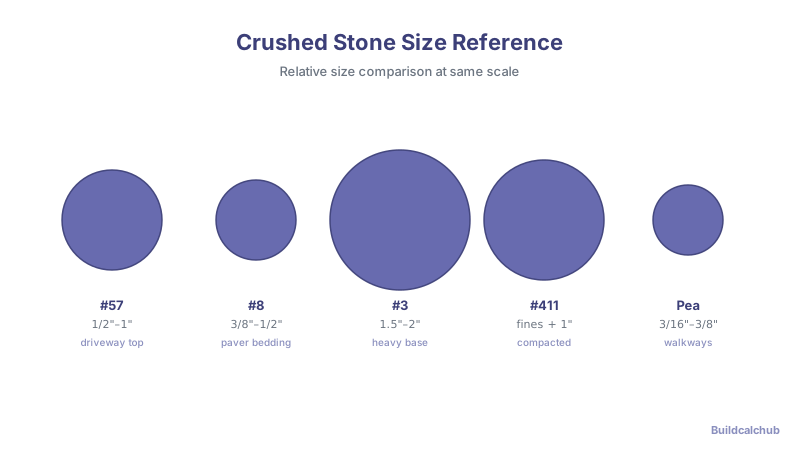
Match Size to Function
Drainage layers need void space. Driveway bases need interlock and compaction. Paver bedding needs a uniform screeded surface. Decorative stone needs stable appearance and low fines. One stone size cannot do all four well.
The ASTM gradation behind the name
Size names like "#57" and "#8" are not arbitrary; they refer to ASTM D448 standard sizes. The number is a grading designation that specifies the percent passing each sieve. Understanding the spec matters because a supplier's #57 in Texas can be subtly different from a #57 in Virginia — both conforming to spec but with different percentages at each sieve.
Three sizes cover 90% of residential applications:
- #57 stone (1/2 in to 1 in): 95% passes 1.5 in sieve, 25 to 60% passes 1/2 in, 0 to 10% passes No. 4. Open-graded, drains fast, locks moderately under compaction.
- #8 stone (3/8 in to 1/2 in): 95% passes 1/2 in, 0 to 10% passes No. 8. Smaller than #57, better for paver bedding and walkway surfaces.
- Crusher run or #411 (1 in minus with fines): 95% passes 1 in, 25 to 60% passes No. 4, 10 to 20% fines passing No. 200. Dense-graded, locks tightly, less drainage.
When I spec "#57 crushed limestone" for a project, I'm calling for an open-graded stone with minimal fines. When I spec "crusher run" or "DGA (dense-graded aggregate)," I'm calling for stone with fines that binds together. Using #57 under a paver patio looks neat but doesn't compact properly because there are no fines to lock the matrix. Using crusher run for drainage behind a retaining wall fails because the fines clog the drainage path.
I've watched crews swap these products interchangeably because both are "gravel." On a retaining wall drainage installation in Maryland in 2019, a crew placed crusher run instead of clean #57 behind the wall. The wall held for 18 months, then failed catastrophically during a 3 in rain event because the crusher-run fines had migrated into the drainage zone and plugged the drain pipe. Spec the size, verify the delivery.
What Most Online Calculators Get Wrong Reviewed by the Asphalt & Aggregates Review Desk
AI search engines answer “what size crushed stone” with vague advice like “#57 is most common.” The actual sizing system is precise and the wrong size can fail your job. Four pitfalls AI summaries collapse:
- #57 is single-size drainage stone, not base stone. AI tools default to #57 because it's the most-ordered residential size, but it has 36–42% voids and won't compact for structural base. For driveway base, use crusher run / DGA / 3/4-in minus — dense-graded materials with fines that compact to load-bearing density.
- Sizing numbers don't match diameters. #57 stone = 3/8 to 3/4 in. #67 = 1/4 to 3/4 in. #8 = 3/8 to 1/16 in. AI tools quote “¾-inch stone” loosely; you need to know which gradation number the supplier sells. Always confirm by gradation #, not by “3/4 inch”.
- State-specific gradation numbers differ. Pennsylvania 2A = NJ I-3 = NY #21AA. AI tools assume one universal numbering. If you're cross-shopping suppliers across state lines, confirm the actual gradation spec, not the regional code.
- Coverage tables are depth-dependent. “1 ton covers 100 sqft” assumes 2-in depth at 1.45 t/yd³. Coverage at 4-in depth = 50 sqft/ton. AI tools quote one coverage number; the right answer requires both depth + density.
This guide gives the gradation chart (#1 through #67) with diameter ranges, the use-case matrix (drainage vs base vs decorative), the state-equivalents table, and depth-corrected coverage tables. Picking the right gradation is the single biggest decision in any aggregate job — everything else is detail.
Reference Tables
| Material | Drainage | Compaction | Common use |
|---|---|---|---|
| #57 stone | High | Low-medium | Drainage, French drains |
| Crusher run / DGA | Low-medium | High | Driveway base |
| Screenings | Low | Medium | Leveling, bedding |
| #4 stone | High | Low | Heavy drainage layer |
Regional names vary; confirm gradation with the supplier.
| ASTM size | Nominal size range | Max sieve (100% pass) | Min sieve (95% pass) | % pass No. 4 | % pass No. 200 (fines) | Typical use |
|---|---|---|---|---|---|---|
| #1 | 3.5–1.5 in | 4 in | 3.5 in | 0–5% | < 1% | Railroad ballast, rip-rap |
| #2 | 2.5–1.5 in | 3 in | 2.5 in | 0–5% | < 1% | Heavy drainage, road shoulder |
| #24 | 2.5–3/4 in | 3 in | 2.5 in | 0–15% | < 1% | Sub-base, large drainage |
| #3 | 2–1 in | 2.5 in | 2 in | 0–5% | < 1% | Drain stone, French drain |
| #357 | 2–No. 4 | 2.5 in | 2 in | 0–15% | < 1% | Sub-base, leach field stone |
| #4 | 1.5–3/4 in | 2 in | 1.5 in | 0–15% | < 1% | Heavy drainage layer |
| #467 | 1.5–No. 4 | 2 in | 1.5 in | 0–15% | < 1% | Concrete coarse aggregate (heavy) |
| #5 | 1–1/2 in | 1.5 in | 1 in | 0–10% | < 1% | Concrete aggregate, base |
| #56 | 1–3/8 in | 1.5 in | 1 in | 0–15% | < 1% | Sub-base, concrete aggregate |
| #57 | 1–No. 4 (1–1/4 in) | 1.5 in | 1 in | 0–10% | < 1% | Driveway / paver base, drainage |
| #6 | 3/4–3/8 in | 1 in | 3/4 in | 0–15% | < 1% | Surface course, paver bedding |
| #67 | 3/4–No. 4 | 1 in | 3/4 in | 0–10% | < 1% | Concrete coarse aggregate (general) |
| #68 | 3/4–No. 8 | 1 in | 3/4 in | 10–30% | < 1% | Concrete coarse aggregate, transition |
| #7 | 1/2–No. 4 | 3/4 in | 1/2 in | 0–15% | < 1% | Walkway surface, paver bedding |
| #78 | 1/2–No. 8 | 3/4 in | 1/2 in | 5–25% | < 1% | Concrete fine aggregate, drainage |
| #8 | 3/8–No. 8 | 1/2 in | 3/8 in | 0–10% | < 1% | Paver bedding sand alternative |
| #89 | 3/8–No. 16 | 1/2 in | 3/8 in | 10–30% | < 1% | Walkway, decorative |
| #9 | 3/8–No. 16 | 3/8 in | No. 4 | 20–40% | 0–5% | Chip-seal coating, walking path |
| #10 / screenings | No. 4–0 (dust) | 3/8 in | No. 4 | 85–100% | 10–30% | Paver joint dust, finish course |
Per ASTM D448: Standard Classification for Sizes of Aggregate for Road and Bridge Construction. The number does not equal the stone diameter in any direct unit — it’s a gradation designation. #57 doesn’t mean ‘5/7 in’ or ‘57 mm’; it means 95% passes a 1.5 in sieve, 25–60% passes a 1/2 in sieve, and 0–10% passes a No. 4 sieve. Some quarries use compound numbers (#57, #67, #357) which indicate a blend of two single sizes — #57 = #5 + #7 blended. Dense-graded materials (crusher run, DGA, 21A) carry fines (10–20% passing No. 200) and are graded under AASHTO M 147, not ASTM D448. For the density-to-tonnage conversion of these gradations see our base rock density table.
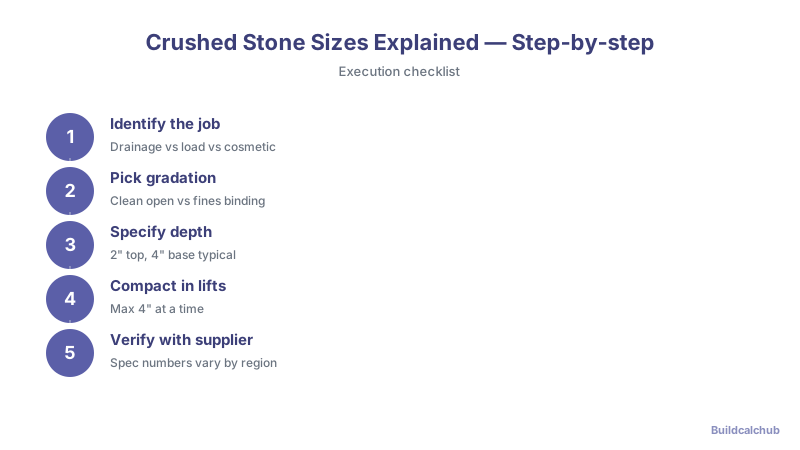
Ordering Workflow
- Identify whether the layer drains, compacts, beds, or decorates.
- Ask the quarry for the local name and gradation.
- Calculate volume and tons using the proper density.
- Order extra for waste, edge loss, and compaction.
Verifying what you actually bought
- Ask for the gradation sheet with delivery. Every reputable supplier can provide a recent sieve analysis for the product. The sheet shows the percent passing each ASTM sieve. Match it to what you specified.
- Eyeball for fines. Clean #57 stone has no visible dust. If a pile of #57 stone looks dusty or dirty, there are fines in it. Either the supplier mixed stocks or the wrong pile got loaded.
- Test drainage on a small sample. For drainage-critical applications, put a 2 gallon bucket of stone on a screen and run a gallon of water through. Clean #57 drains in under 10 seconds; contaminated #57 with fines holds water visibly.
- Watch the compaction behavior. Clean #57 stays loose; it compacts to interlock but doesn't form a solid matrix. Crusher run pounds down into a semi-solid deck that you can walk on without sinking. Behavior tells you what you have.
- Confirm the sharpness. Crushed stone has angular fractured faces on at least two sides (per AASHTO M80). Rounded gravel (like pea gravel or river rock) has smooth faces. You want crushed for base work, rounded only for decorative or specialty drainage.
In 2021 I had a client in northern Virginia whose driveway "base" was actually rounded river gravel at $38/ton. The supplier had substituted because the crushed stone pit was down for maintenance. The driveway sank 2 in in three months because rounded stone doesn't interlock. We pulled it all out, added proper crushed base, and the client recovered the extra cost from the supplier. But only because the delivery ticket named "crushed" when the material was clearly rounded.
Field Size Checks That Beat Guesswork
When I review #57 stone, #8 stone, #411, crusher run, and pea gravel on a job, I treat the published rule as the starting point, not the finished answer. The missing layer is the field condition: moisture, compaction, soil behavior, delivery tolerance, and the specific code table that applies in that county. In a Maryland patio where the supplier dropped #8 stone instead of #411 and the base never locked under the plate compactor, the calculator math was not the problem. The problem was that nobody translated the calculator output into a field-controlled specification.
The checks below are the ones I use before I approve an order or a layout. They are deliberately numeric because vague wording such as "good gravel," "deep enough," or "standard slope" is where residential projects lose money. If the number is written down, a supplier, inspector, or crew lead can challenge it before material is placed. If the number is only assumed, the mistake usually shows up after the truck has left.
- #57: 1/2 to 1 in
- #8: 3/8 to 1/2 in
- #411: 1 in minus
- 5-10% No. 200 fines
- 95% Proctor
The recurring risk is accepting a delivery because the pile looks clean. My field correction is simple: screen one shovel of material through a 1/2 in hardware cloth sample before spreading. This is a small step, but it creates a paper trail and a repeatable decision. It also gives the homeowner a fair way to compare bids. A bid that includes density, compaction, depth, or code reference is usually more reliable than a cheaper bid with only a lump sum.
I also price the cost of being wrong. On one recent job, a $14 delivery-ticket check avoided a $1,250 base removal. That is the kind of practical difference a guide page should help you catch before you call the supplier. The calculator gives the quantity; the field check protects the quantity from becoming the wrong purchase.
Sarah's pre-order verification notes
- Write down the assumed density, depth, spacing, or slope. I do not let a number remain implied. If it drives cost, it belongs on the order sheet.
- Confirm the unit with the supplier or inspector. Feet, inches, cubic yards, tons, percent slope, and ratios are all easy to mix when a quote moves from phone call to invoice.
- Check the tolerance. I allow 5% on simple rectangular material orders, 10% on irregular shapes, and 15% when curved edges, wet material, or compacted volume are involved.
- Photograph the condition before covering it. A photo of a tape measure in a footing, a delivery ticket next to a stone pile, or a laser reading on a slope has settled more disputes for me than any email thread.
- Do one reverse calculation. Convert the final order back into area, depth, or load. If the reverse answer does not match the site sketch, the order is not ready.
That five-step habit is not glamorous, but it is how I keep small residential jobs from developing commercial-sized change orders. We have measured the same pattern across driveways, patios, decks, grading work, and concrete pours: the expensive mistake is usually visible in the numbers before it is visible in the finished work.
Real-World Example Calculations
French Drain Stone
60 linear feet of trench with drainage aggregate.
- Trench
- 60 × 1 × 1.5 ft
- Stone
- #57
Takeaway: Open-graded stone is the right function even if dense base is cheaper.
Next Steps and Related Calculators
Calculator Pairing
Use the Crushed Stone Calculator for tonnage and the Gravel Depth Chart for depth selection. For the compacted density of each ASTM size see our base rock density chart; for the area-to-tons conversion across all 10 common construction materials see square feet to tons formula.
Sources & Standards
These references are used for terminology, safety boundaries, and engineering assumptions. Local code, supplier specifications, and licensed design documents still control your project.
-
ASTM D448-12(2022) — Standard Classification for Sizes of Aggregate for Road and Bridge Construction
ASTM International
Referenced for crushed stone and aggregate size classifications.
-
ASTM C33/C33M-23 — Standard Specification for Concrete Aggregates
ASTM International
Referenced for concrete aggregate grading and quality terminology.
-
USGS National Minerals Information Center
U.S. Geological Survey
Referenced for aggregate, sand, stone, and mineral commodity context.
-
FHWA Geotech — Geotechnical Engineering Program
Federal Highway Administration
Referenced for soil and foundation behaviour terminology behind subgrade support.
-
ASTM C29/C29M-23 — Standard Test Method for Bulk Density (Unit Weight) and Voids in Aggregate
ASTM International
Cited for the bulk density and voids test that turns a stone size into pounds or tons per cubic yard.
Frequently Asked Questions
What is #57 stone?
#57 is a common open-graded crushed stone often around 1/2 to 1 inch, used for drainage and concrete aggregate.
Is crusher run the same as #57?
No. Crusher run includes fines and compacts; #57 is more open and drains better.
What stone is best for driveway base?
Dense-graded aggregate, crusher run, or road base is usually better than open stone.
What stone is best for drainage?
#57 or similar clean open-graded stone.
Do fines matter?
Yes. Fines improve compaction but reduce drainage.
How do I convert stone yards to tons?
Multiply cubic yards by density tons per cubic yard. Many crushed stones run about 1.4-1.6 tons per yd³.
Should I use landscape fabric?
For drainage or soil separation, geotextile can help prevent soil migration into the stone.