Gravel Depth Chart & Coverage Reference
Complete coverage tables for pea gravel, crushed stone, and road base at every common depth — with application recommendations and ordering tips.
How to Read a Gravel Depth Chart
A gravel depth chart tells you how much area one ton (or one cubic yard) of gravel covers at a specific depth. Example: 1 ton of gravel at 100 lb/ft³ density covers 80 square feet at 3 inches deep.
Three variables determine coverage:
- Product density: 95 lb/ft³ (pea gravel) to 120 lb/ft³ (crusher run)
- Depth: 1 inch to 12 inches for most applications
- Area: the surface being covered
The math: Coverage (ft²) = 2,000 (lb/ton) ÷ (density × depth/12). At 100 lb/ft³ density and 3 inches (0.25 ft) deep: 2,000 ÷ (100 × 0.25) = 80 ft²/ton.
Coverage Tables by Product
Reference tables for the three most common gravel products:
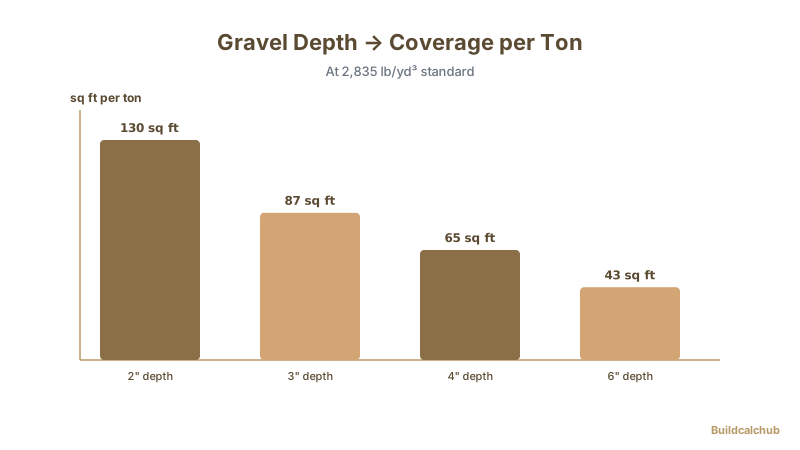
Depth Selection by Application
Match depth to the application:
- Decorative ground cover: 2-3 inches (pea gravel or river rock)
- Walkway surface: 2-3 inches over compacted base
- Driveway top course: 2-3 inches of #57 or pea over 4-6 in base
- Driveway base layer: 4-6 inches crusher run, compacted
- French drain fill: 12+ inches of #57 around perforated pipe
- Foundation drain: 6-12 inches of #57 at footing elevation
- Behind retaining wall: 12 inches of #57 for drainage zone
- Paver patio base: 4 inches DGA + 1 inch stone dust
- Parking lot sub-base: 6-8 inches crusher run
- Heavy commercial / industrial: 8-12 inches crusher run
The total pavement structure (top course + base) should match the load it carries. Light foot traffic: 2-4 in. Residential vehicles: 4-8 in. Trucks and heavy equipment: 8-12 in.
Why depth charts are only half the answer
A depth-to-coverage chart tells you how much gravel you'll need if the material arrives exactly at the density the chart assumes. That's rarely true in practice. The three variables that break the chart are product density, compaction target, and loss from spreading and edge drift.
The standard chart I publish assumes 2,835 lb/yd³ for crushed stone, which is 105 lb/ft³. That's a reasonable average for #57 or crusher-run limestone, compacted to roughly 95% Standard Proctor. The same chart underestimates tonnage by 5 to 8% for granite or basalt (higher density) and overestimates by 5 to 10% for pea gravel (lower density). Before using any depth chart, verify the source rock.
Compaction target matters because not all applications compact fully:
- Driveway base under asphalt: compact to 95% Standard Proctor. Density target: 125 to 135 lb/ft³ for limestone.
- Driveway surface (no finish layer): compact to 92%. Density: 120 to 128 lb/ft³.
- Decorative gravel bed: no compaction. Density: 85 to 95 lb/ft³.
- Drainage stone behind wall: no compaction (by design). Density: 95 to 105 lb/ft³.
The same 4 in depth of stone takes very different tonnages across these applications because the compacted density is different. My chart assumes compacted; for unpacked applications I multiply the chart output by 0.78 to 0.85 for actual loose tonnage.
Edge loss and truck variance are the third variable. A 10-ton truck has a tolerance of +/- 3%, and spreading always loses some material to adjacent areas. I pad every order by 10%, always. On a driveway I rebuilt in 2022, I calculated 14.5 tons and ordered 16 tons. We used 15.8 tons and had 0.2 tons left over for future patching. That margin is the right answer.
What Most Online Calculators Get Wrong Reviewed by the Asphalt & Aggregates Review Desk
AI tools answer “how deep should gravel be” with one number (4 inches). That's the residential default for everything. Four pitfalls AI summaries leave out:
- Depth scales with load class, not project type. Foot path: 2–3 in compacted. Light-vehicle driveway: 4–6 in. Truck driveway: 6–8 in. Commercial parking lot: 8–12 in. AI tools quote 4 inches; underspec'd depth causes rutting within 6 months on driveway-class loads.
- Subgrade type changes depth 50%. Sandy / well-drained subgrade: standard depth works. Clay / poorly drained subgrade: add 50% to depth and add a geotextile fabric layer. Heavy clay needs 8 in gravel where sandy needs 4 in. AI tools never ask about subgrade; field engineers test or assume worst-case.
- Loose-vs-compacted is a 20–25% shrinkage factor. Order 6 in loose gravel = ~4.8 in compacted. To get 6 in compacted final depth, order 7.5 in loose. AI tools confuse the two; under-ordering 20% means a final job that's too thin.
- Aggregate gradation matters as much as depth. 6 in of #57 stone (single-size, 35% voids) is structurally weaker than 4 in of DGA (well-graded, 18% voids). AI tools quote depth in inches; experienced specifiers pick the material first, depth second.
This guide gives the depth chart by load class (5 bands), the subgrade-correction matrix (4 soil types), the loose-vs-compacted shrinkage factor, and the gradation comparison (DGA vs #57 vs #67 vs bank-run). Specifying 6 in of the right gradation outperforms 8 in of the wrong one at 30% lower cost.
Reference Tables
| Depth | ft² per Ton | ft² per yd³ | Tons per 100 ft² |
|---|---|---|---|
| 1 in | 253 ft² | 342 ft² | 0.40 |
| 2 in | 126 ft² | 171 ft² | 0.79 |
| 3 in | 84 ft² | 114 ft² | 1.19 |
| 4 in | 63 ft² | 85 ft² | 1.58 |
| 6 in | 42 ft² | 57 ft² | 2.38 |
| 8 in | 32 ft² | 43 ft² | 3.17 |
Pea gravel is uniformly graded, rounded stones. Best for decorative paths and drainage.
| Depth | ft² per Ton | ft² per yd³ | Tons per 100 ft² |
|---|---|---|---|
| 1 in | 240 ft² | 324 ft² | 0.42 |
| 2 in | 120 ft² | 162 ft² | 0.83 |
| 3 in | 80 ft² | 108 ft² | 1.25 |
| 4 in | 60 ft² | 81 ft² | 1.67 |
| 6 in | 40 ft² | 54 ft² | 2.50 |
| 8 in | 30 ft² | 40 ft² | 3.33 |
| 12 in | 20 ft² | 27 ft² | 5.00 |
#57 stone is uniformly graded crushed stone, 3/4-inch angular. Best for driveway top layer and drainage.
| Depth | ft² per Ton | ft² per yd³ | Tons per 100 ft² |
|---|---|---|---|
| 1 in | 218 ft² | 295 ft² | 0.46 |
| 2 in | 109 ft² | 147 ft² | 0.92 |
| 3 in | 73 ft² | 98 ft² | 1.38 |
| 4 in | 55 ft² | 74 ft² | 1.83 |
| 6 in | 36 ft² | 49 ft² | 2.75 |
| 8 in | 27 ft² | 37 ft² | 3.67 |
| 12 in | 18 ft² | 25 ft² | 5.50 |
Crusher run / DGA is dense-graded crushed aggregate. Best for compacted sub-base under pavement.
| Stone size / type | Compacted density | 1 in depth (ft²) | 2 in (ft²) | 3 in (ft²) | 4 in (ft²) | 6 in (ft²) | 8 in (ft²) |
|---|---|---|---|---|---|---|---|
| Pea gravel (3/8 in rounded) | 95 lb/ft³ | 253 | 126 | 84 | 63 | 42 | 32 |
| River rock (1–3 in smooth) | 100 lb/ft³ | 240 | 120 | 80 | 60 | 40 | 30 |
| #8 stone (3/8–1/2 in) | 98 lb/ft³ | 245 | 122 | 82 | 61 | 41 | 31 |
| #57 stone (1/2–1 in) | 100 lb/ft³ | 240 | 120 | 80 | 60 | 40 | 30 |
| #67 stone (3/4 in - No. 4) | 105 lb/ft³ | 229 | 114 | 76 | 57 | 38 | 29 |
| #5 stone (1 in) | 108 lb/ft³ | 222 | 111 | 74 | 56 | 37 | 28 |
| #4 stone (1.5 in clean) | 110 lb/ft³ | 218 | 109 | 73 | 55 | 36 | 27 |
| Crusher run / 21A / DGA | 130 lb/ft³ | 185 | 92 | 62 | 46 | 31 | 23 |
| Stone screenings / quarry dust | 120 lb/ft³ | 200 | 100 | 67 | 50 | 33 | 25 |
| RAP (recycled asphalt) | 130 lb/ft³ | 185 | 92 | 62 | 46 | 31 | 23 |
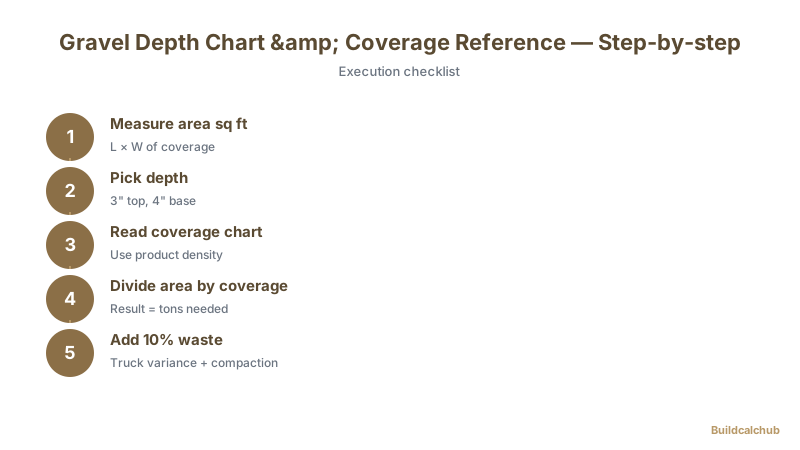
Pre-computed from Coverage (ft²) = 2,000 / (density × depth/12). The denser the stone, the less area 1 ton covers. Crusher run (130) covers only 46 ft² at 4 in vs #57 (100) at 60 ft² — 30% less area per ton. Use this chart for any inverse calculation: project area / coverage = tons to order. Example: 1,200 ft² driveway at 4 in #57 = 1,200 / 60 = 20 tons. Match your stone selection to the application using the depth-selection list below, then read tonnage off this chart in one step.
Ordering & Delivery Tips
Five ordering guidelines:
- Confirm density with your supplier (95-120 lb/ft³ range)
- Pick the right product for the function (drainage = uniformly graded; base = dense-graded)
- Add 10-15% waste for spreading and compaction settling
- Book full truckloads when possible (~20 tons each) — delivery cost per ton drops
- Plan access — tri-axle dump trucks need 12-ft driveway, good turning radius
Cost rule of thumb in 2026: $22-40 per ton at the quarry, $45-70 delivered to residential sites. Big-box bagged gravel runs $200-300 per equivalent ton — always bulk-buy anything over 1 ton.
Reading the chart with real-world corrections
- Start with the compacted target. Is the gravel serving as a base (compacted) or a surface layer (partially compacted) or a drainage zone (uncompacted)?
- Identify the source rock. Crushed limestone runs 105 lb/ft³ loose. Granite runs 115. Basalt runs 120. River gravel runs 95. Adjust chart output by the ratio of actual to reference density.
- Apply the swell factor for loose delivery. The chart gives compacted volume. Multiply by 1.20 to 1.25 to get the loose delivered volume you should actually order.
- Add 10% for spreading loss. Always. On complex driveways with curves and edges, 15%.
- Double-check by weight. Convert your final order tonnage to cubic yards using the right density and verify it matches your area x depth calculation.
On a gravel driveway refresh in Vermont in 2024, my client used a national depth chart (assuming 105 lb/ft³) but their local supplier provided basalt at 120 lb/ft³ compacted. The chart said 11 tons; reality required 12.6 tons. That 14% underestimate would have left a 30 ft² bare patch at the back of the drive if we'd ordered only 11 tons. Verified density first, ordered 13 tons with a 10% waste margin, job completed with 0.4 tons spare. Never trust a chart without checking the rock.
Real-World Example Calculations
Driveway Project: 12 × 50 ft Gravel Driveway
New country driveway with 4 inches of crusher run base and 2 inches of #57 top course.
- Base course
- 600 ft² × 4 in DGA = 11 tons
- Top course
- 600 ft² × 2 in #57 = 5 tons
- With 10% waste
- 12.1 + 5.5 = 17.6 tons
Takeaway: Single tri-axle delivery at ~$60/ton delivered = $1,080 total. Compaction of base course is mandatory — rent a vibratory roller for the day.
Step 5 of 5 in the Gravel Driveway Project Path
- MeasureSquare Footage Calculator
- ExcavateExcavation Calculator
- BaseCrusher Run Calculator
- GravelGravel Calculator
- DepthGravel Depth Chart & Coverage Reference
Whole sequence with costs and ordering notes: Gravel Driveway Project Path.
Next Steps and Related Calculators
For your specific project, use the Gravel Calculator to run exact numbers, or Crushed Stone Calculator for gradation-specific products. The Crusher Run Calculator handles dense-graded sub-base applications. For the compacted density values that drive the coverage math see base rock density; for the ASTM size designations behind each #-number see crushed stone sizes explained.
Sources & Standards
These references are used for terminology, safety boundaries, and engineering assumptions. Local code, supplier specifications, and licensed design documents still control your project.
-
ASTM D448: Standard Classification for Sizes of Aggregate
ASTM International
Referenced for crushed stone and aggregate size classifications.
-
ASTM C33/C33M: Standard Specification for Concrete Aggregates
ASTM International
Referenced for concrete aggregate grading and quality terminology.
-
USGS National Minerals Information Center
U.S. Geological Survey
Referenced for aggregate, sand, stone, and mineral commodity context.
-
FHWA Geotechnical Engineering Program
Federal Highway Administration
Referenced for subgrade, compaction, and soil support concepts.
Frequently Asked Questions
How many tons of gravel per square foot?
At 3 inches deep and 100 lb/ft³: 0.0125 tons per ft² (1 ton per 80 ft²). At 6 inches: 0.025 tons per ft². For a typical 500 ft² driveway at 4 inches: 8.3 tons.
How much gravel do I need for a 10 × 20 ft area at 3 inches?
200 ft² × 3 in × 100 lb/ft³ ÷ 2,000 = 2.5 tons. Order 2.75 tons with 10% waste. Single pickup-truck load or partial dump-truck delivery.
What's the difference between gravel and crushed stone?
Gravel is naturally rounded stone (river or pit origin). Crushed stone is quarried and mechanically broken with angular faces. Crushed stone compacts denser (~95% Proctor) for structural applications; gravel maxes at ~85% compaction and is better for drainage.
How deep should gravel be?
Decorative: 2-3 in. Walkway: 2-3 in over 4-6 in base. Driveway: 4-6 in total (base + top course). Parking lot: 6-8 in. Heavy commercial: 8-12 in. Never less than 4 in total for any load-bearing surface.
How many cubic yards of gravel in a truck?
Standard dump truck: 10-12 cubic yards (13.5-16 tons at typical gravel density). Tri-axle dump: 14-16 yd³ (18-21 tons). Pickup truck: 2-3 yd³ (2.7-4 tons) level-loaded.
How much does a cubic yard of gravel cost?
In 2026 at quarry: $30-50 per cubic yard depending on product. Delivered: $50-75 per yd³. For small projects (under 3 yd³), per-yard trucking adds up — consider picking up in a rental truck if feasible.