Cubic Feet Calculator for Small Volumes, Bags and Post Holes
Calculate cubic feet for small projects: post holes, planters, sonotubes, small slabs, and any fraction-of-a-yard volume where cubic yards would be overkill.
Cubic Feet Calculator
Enter project dimensions below — results update instantly. Switch units freely.
Estimates assume typical industry density and waste factors. Always verify with your supplier and local building code before purchasing material.
Why Cubic Feet Calculator Estimates Go Wrong
Cubic yards are the industry standard for bulk ordering, but for small projects cubic feet is more intuitive and more useful:
- Bagged concrete coverage — sold by cubic feet per bag yield
- Post holes, sonotubes — all under 1 yd³, typically 0.3-3 ft³
- Planter volumes — raised bed fills
- Small concrete pours — walkway sections, pad extensions
- Bag quantities — mulch, soil, and concrete mix all labeled in ft³
Bag yields to memorize:
- 40-lb concrete bag = 0.30 ft³
- 60-lb concrete bag = 0.45 ft³
- 80-lb concrete bag = 0.60 ft³
- 2-ft³ mulch bag = standard bag size
- 40-lb topsoil bag = ~0.5 ft³
Volume Formulas for Cubic Feet
Cylindrical: V = π × r² × h
Triangular prism: V = (b × h ÷ 2) × length
All in feet (convert inches by dividing by 12)
Cubic feet conversions:
- 1 ft³ = 1,728 in³ = 7.48 gallons = 28.32 liters
- 1 ft³ = 0.03704 yd³ = 0.02832 m³
- 1 yd³ = 27 ft³
- 1 m³ = 35.31 ft³
Once the Cubic Feet Calculator result looks reasonable, cross-check the next job decision with the Cubic Yard Calculator and the Volume Calculator. That keeps the quantity, cost, and field assumption tied together before you call a supplier.
For related measurement math: the cubic yard calculator for volume; the square footage calculator for area; the cubic yards vs tons guide for converting volume to ordering tonnage. For the cluster overview see the measurement & volume pillar.
What Most Online Calculators Get Wrong Reviewed by the Asphalt & Aggregates Review Desk
AI tools calculate cubic feet as L×W×H. Four pitfalls AI summaries hide:
- Units must match (all feet, all inches, all meters).
- If mixed, convert: inches ÷ 12 = feet.
- Cylinder volume uses πr²H.
- Cubic feet × 0.0283 = cubic meters.
This calculator outputs cubic feet with unit conversion + cylinder option + metric conversion. Always check units before calculating; mixed units = wrong answer.
Cubic Feet Unit Conversion and Measurement Reference Table
| Project | Dimensions | Volume | Bags 80-lb |
|---|---|---|---|
| Fence post hole (8 in × 2 ft) | 0.35 ft² × 2 ft | 0.70 ft³ | 2 |
| Mailbox post (10 in × 3 ft) | 0.55 ft² × 3 ft | 1.64 ft³ | 3 |
| Deck pier (12 in × 4 ft) | 0.79 ft² × 4 ft | 3.14 ft³ | 6 |
| Sonotube (12 in × 5 ft) | 0.79 ft² × 5 ft | 3.93 ft³ | 7 |
| Sidewalk panel (3 × 8 × 4 in) | 24 ft² × 0.33 ft | 8.0 ft³ | 14 |
| Stoop (4 × 5 × 4 in) | 20 ft² × 0.33 ft | 6.7 ft³ | 12 |
| Shower curb (6 × 6 in × 4 ft) | 0.25 ft² × 4 ft | 1.0 ft³ | 2 |
| Trench (2 × 6 in × 20 ft) | 1 ft² × 20 ft | 20 ft³ | 34 |
| Small footing (16 × 16 × 8 in) | 1.78 ft² × 0.67 ft | 1.19 ft³ | 2 |
80-lb bag of concrete yields 0.60 ft³. Round up bag counts. For volumes above 27 ft³ (1 yd³), consider ready-mix instead of bagged.
| Bag Type | Yield (ft³) | Bags per ft³ | Bags per yd³ (27 ft³) |
|---|---|---|---|
| 40-lb concrete | 0.30 | 3.33 | 90 |
| 60-lb concrete | 0.45 | 2.22 | 60 |
| 80-lb concrete | 0.60 | 1.67 | 45 |
| 50-lb mortar | 0.50 | 2.00 | 54 |
| 2-ft³ mulch bag | 2.00 | 0.50 | 13.5 |
| 3-ft³ mulch bag | 3.00 | 0.33 | 9 |
| 40-lb topsoil | 0.50 | 2.00 | 54 |
| 1-ft³ potting soil | 1.00 | 1.00 | 27 |
Always round up bag count. Return unused bags (most retailers accept sealed returns) rather than running short mid-project.
Real-World Example Calculations
Sonotube 12 in × 4 ft
Single deck support pier volume.
- Diameter
- 12 in (1 ft)
- Height
- 4 ft
Takeaway: 6 × 80-lb bags concrete. Order 7 to have margin.
Raised Bed 4 × 8 × 12 in
Raised garden bed fill with premium soil mix.
- Length × Width
- 8 × 4 ft
- Depth
- 12 in (1 ft)
Takeaway: 1.19 yd³ (right at the break between bags and bulk). Choose by supplier minimums; bagged premium mix averages $6/ft³ = $192; bulk $55/yd³ = $65.
Retaining Wall Drain 40 × 1 × 1 ft
Gravel drain zone directly behind retaining wall.
- Length × Width
- 40 × 1 ft
- Depth
- 12 in
Takeaway: 1.48 yd³ — order 1.5 yd³ of #57 stone bulk delivered.
Sources & Standards
These references are used for terminology, safety boundaries, and engineering assumptions. Local code, supplier specifications, and licensed design documents still control your project.
-
NIST Special Publication 811 — Guide for the Use of the International System of Units (SI)
National Institute of Standards and Technology
Cited for the official US conversion factors between US customary (inch, foot, yard) and SI (meter) units used in all volume and area calculations.
-
ASTM E1-14 — Standard Specification for ASTM Liquid-in-Glass Thermometers (and dimensional measurement standards)
ASTM International
Cited for measurement traceability and tolerance basis used in dimensional inputs.
-
USDA NRCS National Engineering Handbook — Earthwork
USDA Natural Resources Conservation Service
Cited for excavation volume math, shrink-swell factors, and cut-and-fill balance methodology.
-
USACE EM 1110-2-1906 — Laboratory Soils Testing
US Army Corps of Engineers
Cited for soil density, moisture content, and compaction methodology underlying volume-to-weight conversion.
-
IBC 2024 Table 1604.3 — Dead Loads
International Code Council
Cited for material dead-load values used in volume-to-weight conversions for slabs, decks, and structural members.
Frequently Asked Questions
How do I calculate cubic feet?
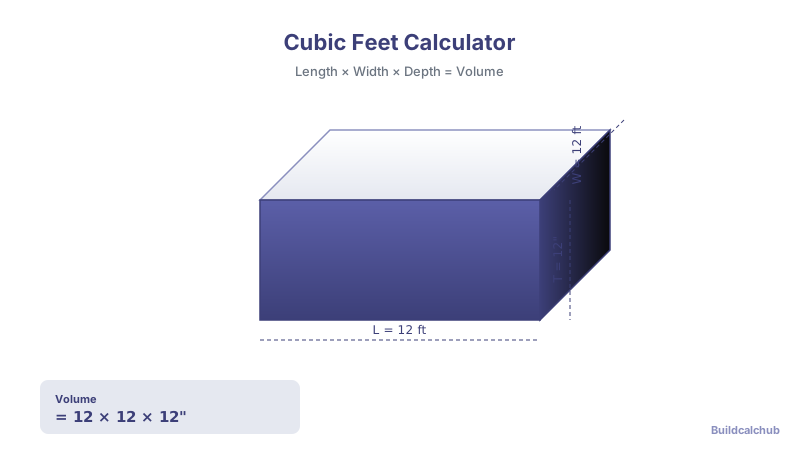
Multiply length × width × height (all in feet). For inches: divide by 12 first to get feet. Example: a 24 × 36 × 4 in area = 2 × 3 × 0.333 = 2.0 ft³.
How many cubic feet in a cubic yard?
Exactly 27 cubic feet. Convert yd³ to ft³ by multiplying by 27; convert ft³ to yd³ by dividing by 27.
How many cubic feet in a bag of concrete?
80-lb bag = 0.60 ft³. 60-lb bag = 0.45 ft³. 40-lb bag = 0.30 ft³. These are the most common bag sizes at US home centers.
How many cubic feet in a gallon?
One cubic foot holds ~7.48 US gallons. Reverse: 1 gallon = 0.134 ft³. Useful for pool and irrigation calculations.
How do I calculate cubic feet of a cylinder?
V = π × r² × h where r is radius in feet, h is height in feet. Example: 10-in diameter (radius 5 in = 0.417 ft) × 4 ft = π × 0.174 × 4 = 2.18 ft³.
Should I order by cubic feet or cubic yards?
Cubic feet for small projects (<1 yd³ = <27 ft³) that use bagged materials. Cubic yards for bulk deliveries (ready-mix, gravel, mulch). The break-even is roughly 1 yd³ = 27 ft³ — below that, bags are more convenient and often cheaper per unit.
How do I convert cubic feet to cubic meters?
Multiply by 0.02832. Example: 100 ft³ = 2.83 m³. Reverse: m³ × 35.31 = ft³.