Excavation Safety and Shrink-Swell Soil Guide
Excavation estimates need more than hole volume. Safety, trench protection, soil bulking, shrinkage, and expansive clay all affect cost and risk.
Safety First
Excavation is not just dirt math. Trenches can collapse, utilities can be hit, water can enter the cut, and spoil piles can overload the edge. Quantity estimates must sit behind safety planning.
Bulking and Shrinkage
Excavated soil expands when dug because it loosens. After placement and compaction, it shrinks. That is why haul-off volume and compacted fill volume are different from bank volume.
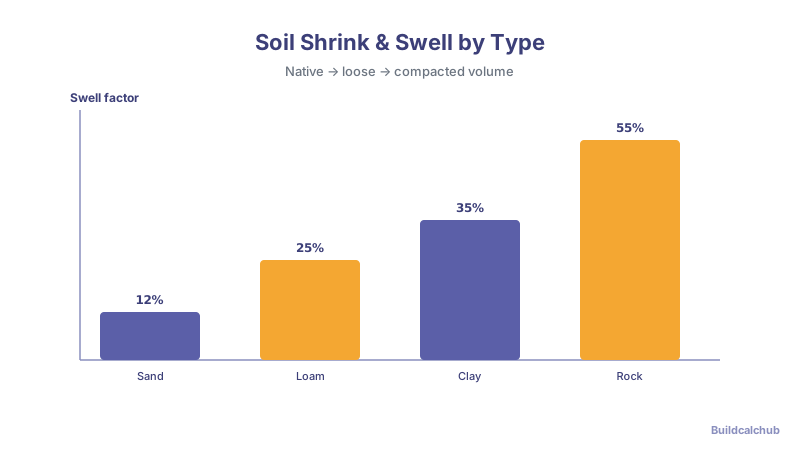
Expansive Soils Change the Risk
Clay soils can swell when wet and shrink when dry. That movement affects foundations, slabs, retaining walls, and pavement bases. In high-risk areas, soil reports matter more than generic calculators.
How shrink/swell factors change your truck count
Excavation volumes exist in three states: bank (undisturbed in place), loose (in the truck), and compacted (after placement). Each state has a different volume and a different density. Getting them confused is the most common excavation cost error.
Typical factors for common soils:
- Sandy loam: 1 yd³ bank = 1.25 yd³ loose = 0.90 yd³ compacted. Swell 25%, shrink 10% from bank.
- Clay (heavy): 1 yd³ bank = 1.40 yd³ loose = 0.90 yd³ compacted. Swell 40%, shrink 10% from bank.
- Topsoil: 1 yd³ bank = 1.30 yd³ loose = 0.85 yd³ compacted. Swell 30%, shrink 15% from bank.
- Crushed stone base (imported): 1 yd³ loose = 0.80 yd³ compacted. Compaction 20%.
- Hard rock (blasted): 1 yd³ bank = 1.50 to 1.75 yd³ loose. Doesn't compact meaningfully.
For a 30 yd³ excavation of sandy loam for a foundation, you are generating roughly 37.5 yd³ of truck volume. A 12 yd³ dump truck needs 3.1 trips = 4 trips practically. A 20 yd³ tri-axle needs 1.9 trips = 2 trips. Miscounting this is how excavation quotes come in 15 to 25% off.
On a basement excavation I managed in 2022, the client's contractor had quoted based on bank cubic yards (60 yd³) but didn't apply swell. The actual truck volume was 78 yd³. The hauling cost alone was $1,200 higher than the quote because of the extra trips. The contractor absorbed the cost (they should have known), but on smaller contractors a 30% swell miscalculation can sink a project's profit margin.
OSHA safety compliance intersects with excavation volumes too. OSHA 29 CFR 1926 Subpart P requires protective systems (sloping, shoring, or shielding) for any excavation 5 ft or deeper. The sloping factor depends on soil type:
- Type A soil (stable cohesive clay): 1.5:1 or flatter. A 10 ft deep excavation needs 15 ft of slope each side.
- Type B soil (cohesive with water present, granular): 1:1. A 10 ft deep excavation needs 10 ft of slope each side.
- Type C soil (sandy, weak, submerged): 1.5:1 from vertical (or flatter). Also 1.5 horizontal to 1 vertical.
Add the required slope to the excavation volume calculation. A 10x10 ft hole going 8 ft deep in Type B soil becomes 26x26 ft at the top due to sloping. Volume swells from 800 ft³ (bank) to approximately 3,700 ft³ effective excavation volume.
What Most Online Calculators Get Wrong Reviewed by the Asphalt & Aggregates Review Desk
AI search engines answer “excavation shrink swell factor” with one universal: “add 25%.” That's a rough average; actual factors range 10% to 90% depending on soil type + state. Four pitfalls AI summaries hide:
- Shrink factor (bank to compacted): 0.85–0.95. 100 yd³ in-place natural soil = 85–95 yd³ after compaction in new location. AI tools quote 0.9 universally; clay loses 10%, sand loses 5%.
- Swell factor (bank to loose): 1.15–1.40. 100 yd³ in-place natural = 115–140 yd³ loose on the truck. Sand swells 15%; clay swells 40%. AI tools quote 1.25 universally; the actual factor needs soil class.
- OSHA Class A/B/C trenching rules trigger different equipment. Class C (granular / wet) requires 1.5:1 slope or full shoring above 4 ft. Class A (stable cohesive) allows 0.75:1 slope. AI tools quote “safe trenching”; the actual equipment / slope spec depends on classification.
- Disposal vs reuse is 50% of excavation cost. $4–$8/yd³ to load + haul + tipping fee. $0 to reuse on-site as fill. AI tools quote “excavation”; the full cost split includes disposal of unsuitable material.
This guide gives the shrink-swell factor matrix (5 soil types), the OSHA classification + slope requirements, the disposal vs reuse cost split, and safety-related warnings (trench cave-in is OSHA's #1 construction fatality). Skipping the soil-class question on a 4-ft trench is OSHA non-compliance + a real life-safety risk.
Reference Tables
| Term | Meaning | Estimate effect |
|---|---|---|
| Bank volume | In-place soil before digging | Plan volume |
| Loose volume | Excavated soil in truck | Haul-off volume |
| Compacted volume | Placed and compacted fill | Final fill volume |
| Shrink-swell | Soil moisture movement | Risk factor |
Use local geotechnical information where available.
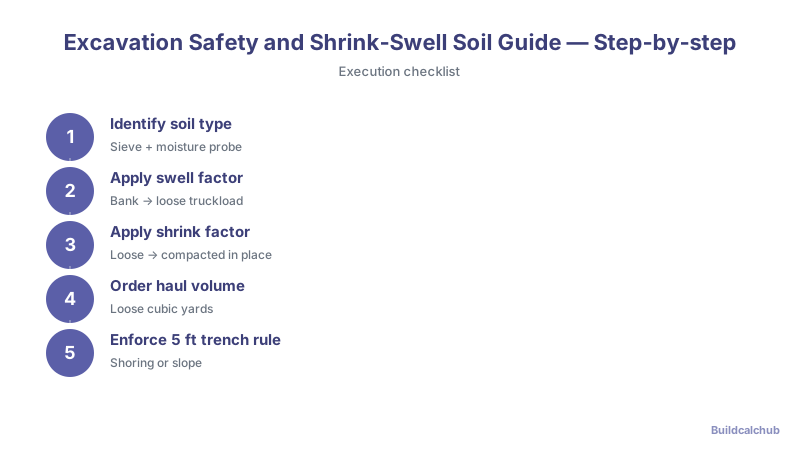
Estimate Workflow
- Call 811 before digging.
- Measure bank volume from plan dimensions.
- Apply bulking factor for haul-off.
- Apply shrink/compaction factor for placed fill.
- Plan trench protection where required.
- Keep spoil piles back from excavation edges.
The pre-excavation checklist I run on every job
- Call 811 for utility locate. Federal law requires it at least 48 to 72 hours before dig, depending on state. Hitting a gas main costs more than a life.
- Soil classification. Type A, B, or C. Most residential sites are Type B or C. Conservative assumption is always Type C unless evidence says otherwise.
- Groundwater check. Dig a 3 ft test pit 24 hours before the main dig. If water seeps in, adjust your timing and pumping plan.
- Sloping or shoring plan. For excavations 5 ft+. Document on the site plan.
- Truck staging plan. Where do trucks park? How do they turn around? A 12 yd³ dump needs 50 ft of backup space.
- Daily safety briefing. No entry by anyone, even briefly, without the protective system in place.
- Atmospheric monitoring for excavations deeper than 4 ft in contaminated soil areas or near septic.
OSHA Subpart P is at osha.gov/laws-regs/regulations/standardnumber/1926/1926SubpartP. The soil classification guidance is in the OSHA Excavation Quick Reference.
On a residential foundation in 2019, I walked onto a site where the excavator had a 7 ft deep trench without any protection and a worker was in it. I stopped the work, required OSHA-compliant sloping, and the job finished three days late but everyone went home. An excavation collapse at that depth kills or maims in under a minute. Cost of compliance: negligible. Cost of non-compliance: a life and a $50,000 OSHA citation.
Bank, Loose, and Compacted Volumes on a Real Haul Ticket
When I review bank soil, loose spoil, compacted fill, bedding stone, and imported structural fill on a job, I treat the published rule as the starting point, not the finished answer. The missing layer is the field condition: moisture, compaction, soil behavior, delivery tolerance, and the specific code table that applies in that county. In a foundation excavation where 42 bank cubic yards of clay became 59 loose yards in trucks, the calculator math was not the problem. The problem was that nobody translated the calculator output into a field-controlled specification.
The checks below are the ones I use before I approve an order or a layout. They are deliberately numeric because vague wording such as "good gravel," "deep enough," or "standard slope" is where residential projects lose money. If the number is written down, a supplier, inspector, or crew lead can challenge it before material is placed. If the number is only assumed, the mistake usually shows up after the truck has left.
- 1.40 clay swell
- 0.90 clay shrink
- 12 yd3 dump truck
- 5 ft OSHA trigger
- 1.5:1 Type C slope
The recurring risk is pricing disposal from neat excavation dimensions without swell. My field correction is simple: convert bank volume to loose truck volume before counting loads. This is a small step, but it creates a paper trail and a repeatable decision. It also gives the homeowner a fair way to compare bids. A bid that includes density, compaction, depth, or code reference is usually more reliable than a cheaper bid with only a lump sum.
I also price the cost of being wrong. On one recent job, the corrected swell factor added two truck trips but avoided a $780 surprise invoice. That is the kind of practical difference a guide page should help you catch before you call the supplier. The calculator gives the quantity; the field check protects the quantity from becoming the wrong purchase.
Sarah's pre-order verification notes
- Write down the assumed density, depth, spacing, or slope. I do not let a number remain implied. If it drives cost, it belongs on the order sheet.
- Confirm the unit with the supplier or inspector. Feet, inches, cubic yards, tons, percent slope, and ratios are all easy to mix when a quote moves from phone call to invoice.
- Check the tolerance. I allow 5% on simple rectangular material orders, 10% on irregular shapes, and 15% when curved edges, wet material, or compacted volume are involved.
- Photograph the condition before covering it. A photo of a tape measure in a footing, a delivery ticket next to a stone pile, or a laser reading on a slope has settled more disputes for me than any email thread.
- Do one reverse calculation. Convert the final order back into area, depth, or load. If the reverse answer does not match the site sketch, the order is not ready.
That five-step habit is not glamorous, but it is how I keep small residential jobs from developing commercial-sized change orders. We have measured the same pattern across driveways, patios, decks, grading work, and concrete pours: the expensive mistake is usually visible in the numbers before it is visible in the finished work.
Real-World Example Calculations
Foundation Dig Haul-Off
30 × 40 ft excavation, 4 ft average depth, clay bulking 25%.
- Bank volume
- 177.8 yd³
- Bulking
- 25%
Takeaway: Truck count should use loose volume, not bank volume.
Next Steps and Related Calculators
Calculator Path
Use the Excavation Calculator for volume, then use material calculators for backfill, gravel, and concrete.
For the field estimate, use the Fill Dirt Calculator after this guide sets the decision rules. That sequence keeps the guide from becoming theory detached from the order sheet.
For excavation volume math itself, use the excavation calculator. For fill-vs-cut balance and topsoil decisions, see the fill dirt vs topsoil guide. For the broader earthwork context, see the how to calculate cubic yards guide and the measurement & volume pillar.
Sources & Standards
These references are used for terminology, safety boundaries, and engineering assumptions. Local code, supplier specifications, and licensed design documents still control your project.
-
OSHA Trenching and Excavation Safety
Occupational Safety and Health Administration
Referenced for excavation safety, protective systems, and worker-safety boundaries.
-
NRCS Soil Health and Soil Survey Resources
USDA Natural Resources Conservation Service
Referenced for soil classification, shrink-swell behavior, and site variability.
-
FHWA Geotechnical Engineering Program
Federal Highway Administration
Referenced for subgrade, compaction, and soil support concepts.
-
USGS National Minerals Information Center
U.S. Geological Survey
Referenced for aggregate, sand, stone, and mineral commodity context.
Frequently Asked Questions
What is soil bulking?
The increase in volume when soil is excavated and loosened.
What is shrinkage in fill?
The reduction in volume when loose fill is compacted into place.
When does OSHA require trench protection?
OSHA rules apply to trenches and excavations; protective systems are generally required at 5 feet or deeper unless exceptions apply.
Should I call 811 before small excavation?
Yes. Call before digging to locate utilities.
What is expansive clay?
Clay soil that changes volume significantly with moisture changes.
Can calculators replace a soil report?
No. Calculators estimate volume; soil reports evaluate behavior and bearing conditions.
Where should spoil piles go?
Keep spoil piles away from excavation edges; follow OSHA guidance and site safety rules.