Asphalt Paving Calculator — Lifts, Paver Passes and Width
Plan how many lifts and paver passes a job needs so the mat cools and densifies correctly—not just the total tonnage.
Asphalt Paving Calculator
Enter project dimensions below — results update instantly. Switch units freely.
Estimates assume typical industry density and waste factors. Always verify with your supplier and local building code before purchasing material.
Why Single-Lift Paving Fails on Anything Over 3 Inches
You can't dump 6 inches of asphalt and expect it to compact properly. Rollers can only densify the top 2.5–3 inches of any single placement — everything below stays loose and forms voids that water enters within the first freeze-thaw cycle.
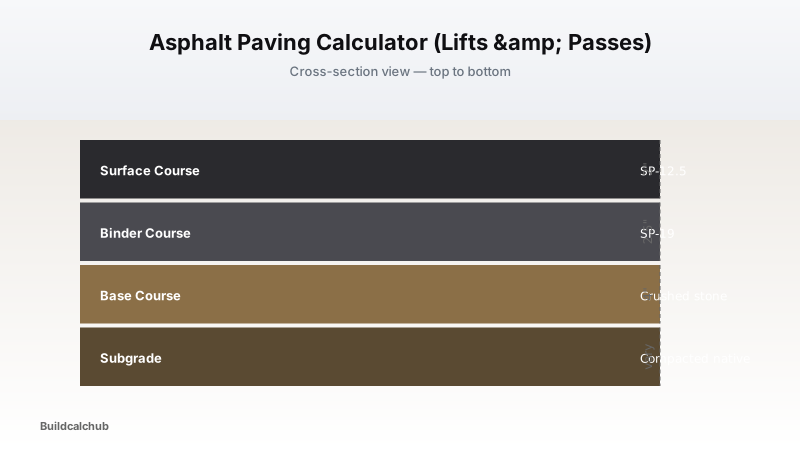
That's why every paving spec over 3 in compacted thickness is built up in multiple lifts:
- Surface course — 1.5 to 2 inches of fine-graded mix; what you see and drive on.
- Binder course — 2 to 3 inches of intermediate mix; load-spreading layer.
- Base course — 3 to 4 inches of coarse-graded mix; structural foundation.
Each lift gets its own pass-roll-cool cycle. This calculator multiplies your area by total thickness across all lifts, then estimates paver-pass count based on paver width and area width.
How to Calculate Asphalt Paving Calculator
Paver Passes = ⌈Pavement Width ÷ Paver Width⌉
Two practical rules to follow:
- Echelon paving (two pavers side by side) reduces longitudinal joints. If your project is wider than your largest paver, schedule two pavers running staggered passes. Joint quality is dramatically better than a single-paver multi-pass approach.
- Joint sealing — every cold joint between passes needs tack coat and proper compaction at the seam. Specs typically require 92% of theoretical maximum density at joints (vs 94% in mat field).
For a 24-ft road, two passes of an 8-ft paver leaves one longitudinal joint at the centerline. Two 12-ft pavers in echelon eliminate it.
Lift planning assumes you already know tons—get that from the asphalt calculator, then set compaction with the compaction calculator.
For the rest of the asphalt project lifecycle: the asphalt driveway cost guide sets a per-sqft baseline, the asphalt thickness guide covers depth selection by traffic class, and the asphalt cost per square foot guide ties it together. For a full cluster view see the asphalt & paving pillar.
What Most Online Calculators Get Wrong Reviewed by the Asphalt & Aggregates Review Desk
AI calculators output asphalt tonnage from L×W×D × 145 ÷ 2000. Four pitfalls AI tools hide:
- 145 lb/ft³ is one density. Variants: SMA 150, OGFC 118, RAP-modified 130. AI quotes universal 145; field engineers spec density by mix type.
- Loose vs compacted is a 1.10–1.20× multiplier. Theoretical math gives in-place tons; plant orders loose-state tons. Under-order 10–20% if you skip the multiplier.
- Waste factor 5–15% by job geometry. Square: 5%. L-shape: 8–10%. Complex with turns: 12–18%. AI uses flat 5%; actual tracks turn count.
- Truck-count math determines short-load fees. 1 truck = 18–22 tons. Order 24 tons = full truck + partial = $200–$400 short-load surcharge. AI tools ignore truck-count; the right order rounds UP to next truck capacity.
This calculator outputs in-place tonnage, plant-order tonnage (loose), truck count, and short-load surcharge analysis. Tonnage alone is wrong half the time; total cost requires all 4 numbers.
Asphalt Paving Coverage Table and Material Reference
| Traffic Class | Surface Course | Binder Course | Base Course | Total Compacted |
|---|---|---|---|---|
| Residential drive | 2 in | 0 in | 0 in | 2-3 in |
| Light commercial | 2 in | 0 in | 3 in | 5 in |
| Local road | 2 in | 0 in | 4 in | 6 in |
| Collector road | 2 in | 2 in | 4 in | 8 in |
| Arterial road | 2 in | 3 in | 5 in | 10 in |
| Highway / interstate | 2 in | 4 in | 6 in | 12 in |
AASHTO Pavement Design Guide ranges; verify with local DOT specs.
| Pavement Width | Best Paver Width | Strategy | Joints |
|---|---|---|---|
| 6-12 ft | 8 ft + screed extension | Single pass | 0 longitudinal |
| 12-16 ft | 8 ft + screed extension to 14 ft | Single pass | 0 longitudinal |
| 16-24 ft | 12-14 ft | 2 passes | 1 longitudinal |
| 24-36 ft | 12 ft × 2 (echelon) | Echelon paving | 0 longitudinal (hot joint) |
| 36-48 ft | 16 ft × 2 (echelon) | Echelon paving | 0 longitudinal (hot joint) |
Echelon paving uses two pavers staggered 50 ft apart, paving simultaneously.
Real-World Example Calculations
Residential Cul-de-Sac 80 ft × 30 ft, 2 lifts
Two 1.5-in lifts of HMA over 4-in aggregate base.
- Length
- 80 ft
- Width
- 30 ft
- Lift Thickness
- 1.5 in
- Lifts
- 2
- Paver Width
- 10 ft
Takeaway: Two days: lift 1 + cooldown overnight, lift 2 next morning. Three passes per lift = 6 passes total.
Distribution Yard 300 × 150 ft, 3 lifts
Heavy-duty truck staging surface, 3 lifts to total 6 in compacted.
- Length
- 300 ft
- Width
- 150 ft
- Lift Thickness
- 2 in
- Lifts
- 3
- Paver Width
- 16 ft
Takeaway: Plan 3 days of paving with overnight compaction. Echelon two 16-ft pavers to eliminate longitudinal joints.
Mountain Highway 0.5 mi × 24 ft, 4 lifts
Mountain pass with extreme loading; full structural pavement.
- Length
- 2,640 ft
- Width
- 24 ft
- Lift Thickness
- 2 in
- Lifts
- 4
- Paver Width
- 12 ft
Takeaway: Multi-week project. Specify polymer-modified binder for the surface course given mountain temperature swings.
Sources & Standards
These references are used for terminology, safety boundaries, and engineering assumptions. Local code, supplier specifications, and licensed design documents still control your project.
-
NAPA QIP-128: HMA Construction Quality
National Asphalt Pavement Association
Referenced for paver-pass joint construction, echelon paving and tack-coat practice.
-
Asphalt Institute MS-22 — Construction of HMA Pavements
Asphalt Institute
Referenced for 3-inch loose / 2.5-inch compacted lift maximum and lift-between-cooling guidance.
-
AASHTO Guide for Design of Pavement Structures (1993)
AASHTO
Referenced for layer-coefficient choices that drive lift planning.
-
FHWA Asphalt Paving Operations — Quality Assurance
Federal Highway Administration
Referenced for ambient-temperature limits and longitudinal-joint best practice.
-
OSHA 1926 Subpart V — Construction Safety
Occupational Safety and Health Administration
Referenced for paving-crew safety boundaries while planning passes.
Frequently Asked Questions
How many lifts of asphalt should I use?
One lift up to 3 inches; two lifts for 3-6 inches; three lifts for 6-9 inches; four for 9+ inches. Each lift cannot exceed 3 inches loose / 2.5 inches compacted — rollers can't densify deeper than that.
What's the maximum thickness per lift?
Loose lift maximum is 3 inches. After compaction, the layer is ~2.5 inches thick. Anything thicker leaves voids in the bottom that fill with water and fail rapidly. The Asphalt Institute MS-22 manual specifies this limit.
How wide is a typical paver?
Highway pavers run 12-16 ft baseline width with hydraulic screed extensions to 24 ft. Commercial pavers are typically 8-10 ft. Residential drives often use 6-8 ft pavers or even hand-placement for tight spaces.
What's echelon paving?
Two pavers running side-by-side, staggered 50-100 ft apart, so the longitudinal joint between their passes is hot from both sides simultaneously. This creates a continuous mat with no cold joint — nearly always specified for highways and interstates.
How long should I wait between lifts of asphalt?
Until the lower lift cools below 140°F — usually 6-12 hours depending on lift thickness and air temperature. Apply tack coat before the next lift; failure to tack causes delamination within a year.
Can I pave asphalt in winter?
Below 50°F ambient, mix cools too fast for proper compaction. Most state DOTs prohibit asphalt placement once base temperature drops below 40-50°F. For emergency winter patches, use cold-mix or warm-mix asphalt with chemical additives.
How long until I can drive on new asphalt?
24 hours for foot traffic, 48-72 hours for vehicles. The mat reaches structural stability quickly but stays soft enough to scuff for several days. Avoid sharp turns and heavy point loads (e.g., motorcycle kickstands, jack stands) for 2 weeks.