How to Calculate Slope Percentage
Slope percentage is rise divided by run times 100. This guide shows how to measure it for drainage, driveways, ramps, patios, and grading.
Slope Formula
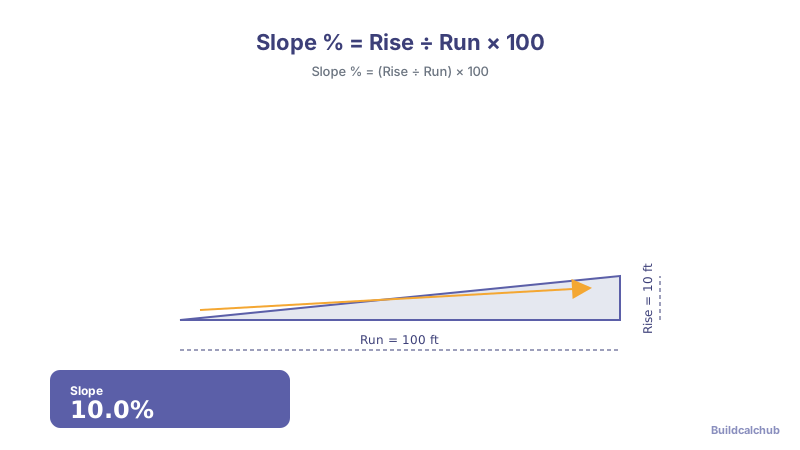
Slope percentage = rise ÷ run × 100. A surface that drops 1 foot over 50 feet has a 2% slope. The same slope can also be described as 1/4 inch per foot.
How to Measure Slope
Measure vertical change and horizontal distance, not the sloped surface length. Laser levels, string lines, and digital levels all work if you keep units consistent.
Where Slope Matters
Patios need drainage away from buildings. Driveways need enough slope to shed water without becoming unsafe. Accessible routes have strict limits. Excavation slopes and trench safety are separate safety topics.
Why three slope units coexist and when to use each
Slope is expressed in three common ways in construction: percent (%), ratio (1:X), and degrees. Each serves a specific audience and context, and they are not interchangeable without conversion.
- Percent slope is rise / run times 100. A slope rising 1 ft over 100 ft horizontal = 1%. This is the unit used in drainage engineering, ADA specifications, and site plan grading. ADA ramp maximum is 8.33% (1:12). Percent scales linearly with the dimensional relationship.
- Ratio (1:X) is 1 unit of rise per X units of run. A 1:12 slope means 1 in rise per 12 in run. This is the unit used in ramp design, handrail placement, and many code documents. Ratio is inversely related to percent: a larger second number = a gentler slope.
- Degrees is the angle of the slope measured from horizontal. Used in surveying, land planning, and roofing. A 45 degree slope = 100% slope = 1:1 ratio. Degrees don't scale linearly with percent; the conversion is arctan(rise/run) in radians, then times 180/π.
Conversions worth memorizing:
- 1% = 0.573 degrees = 1:100
- 2% = 1.15 degrees = 1:50 (standard drainage slope)
- 5% = 2.86 degrees = 1:20 (ADA walking surface maximum)
- 8.33% = 4.76 degrees = 1:12 (ADA ramp maximum)
- 25% = 14.0 degrees = 1:4
- 50% = 26.6 degrees = 1:2
- 100% = 45 degrees = 1:1
I've seen a contractor quote a "10 degree slope" for a site grading, and a homeowner hear "10% slope." Those are 1.75x different. Ten percent is 5.7 degrees. Ten degrees is 17.6%. When anyone says "slope," always ask in which units.
For drainage design, my go-to numbers are:
- Minimum slope for water to flow on paved surfaces: 1% (0.5 degrees). Less than this and water stays put.
- Standard slope for driveways, walkways, patios: 2% (1.15 degrees). Sheds water reliably without being visually tilted.
- Drainage swale or channel slope: 0.5 to 1% minimum, 4% maximum. Less and water doesn't move; more and erosion starts.
- Landscape grading away from foundation: 5% (1 in per 2 ft) for the first 10 ft of slope away from the building.
What Most Online Calculators Get Wrong Reviewed by the Asphalt & Aggregates Review Desk
AI search engines answer “how to calculate slope percentage” with the formula: rise / run × 100. The formula is correct; what the percentage means in different applications is where AI summaries fail. Four pitfalls AI tools leave out:
- 5% is the universal ADA accessible-route maximum. Above 5% requires a ramp + handrails. AI tools never tie the percentage to its compliance meaning; getting this wrong on commercial work = failed inspection.
- 2% is the universal cross-slope max (drainage minimum). Driveways, sidewalks, patios should slope 2% across (toward grass / drainage) and 1–5% along (toward the street). AI tools confuse cross-slope with running-slope.
- 10:1 vs 12:1 ratio language is more common than %. 10:1 = 10% slope. 12:1 = 8.33%. AI tools sometimes quote ratios; field crews work in ratios. Know both.
- Slope direction matters more than magnitude. 2% sloped toward the house = water in basement. 2% sloped away from house = correct grading. AI tools quote percentages; field engineers always check direction.
This guide gives the % ↔ ratio conversion table, the ADA compliance reference, the cross-slope vs running-slope distinction, and the direction-verification checklist. Slope is one of the highest-leverage decisions in any site work; the percentage is the easy part, the direction and meaning are where projects fail.
Reference Tables
| Use | Typical target | Note |
|---|---|---|
| Patio drainage | 1-2% | Away from structure |
| Driveway | 2-8% | Site dependent |
| Accessible route | Code-limited | Check ADA/local code |
| Swale | 1-5% | Avoid erosion |
Local code and site design control final limits.
Common Mistakes
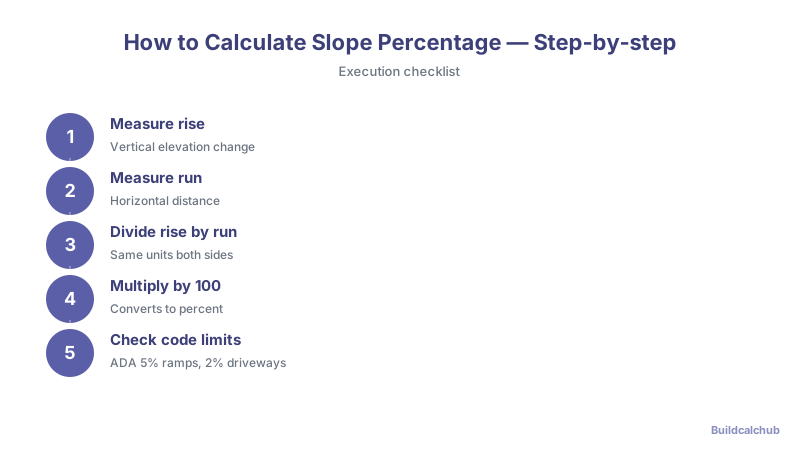
- Mixing inches and feet without conversion.
- Using diagonal length instead of horizontal run.
- Ignoring local accessibility rules.
- Forgetting that 2% slope over 100 feet equals 2 feet of fall.
Measuring slope in the field accurately
- For short distances (under 16 ft): 4 ft level method. Place a 4 ft level at one end, level it. Measure the gap at the other end to the surface. Gap in inches / 48 in = percent slope as a decimal.
- For mid-range (16 to 50 ft): string line method. Drive stakes at both ends. Tie a line between stakes at known height. Use a line level to verify string is level. Measure offset from string to ground at intervals.
- For long distances (50 ft+): laser level. A rotary laser level rotates a level laser beam. At each measurement point, measure the laser beam height from the ground. Change in height = rise. Distance between points = run.
- For formal documentation: surveying instrument. A total station or a builder's level gives you survey-grade accuracy to 0.01 ft.
- For rough checks: smartphone inclinometer. Free apps give +/- 1 degree accuracy on modern phones. Useful for eyeballing, not for final spec.
Always measure from horizontal distance, not slope distance. On a 30% slope, the slope distance is 4.4% longer than the horizontal. A 100 ft measurement along the slope is 95.8 ft horizontal. Small errors compound; a 100 ft patio with 5% slope error in dimensions = 5 ft error.
On a driveway grading project in Virginia in 2020, the client had described the driveway as "about 8 percent." I measured with a laser level and found 12.3 percent, which exceeded the local 10 percent limit at the sidewalk. The project needed redesign to add a landing at the street. A five-minute laser measurement at the planning stage caught a 4-week delay that would have happened at permit review.
For authoritative slope standards, the US Access Board ADA ramp guidance is the primary reference for accessible ramps. For highway and driveway slope limits, see your state DOT standards (most reference AASHTO Green Book).
Slope Measurement Notes from Real Driveway and ADA Work
When I review driveway grades, ramp runs, drainage swales, patio cross-slopes, and foundation grading on a job, I treat the published rule as the starting point, not the finished answer. The missing layer is the field condition: moisture, compaction, soil behavior, delivery tolerance, and the specific code table that applies in that county. In a Virginia driveway permit where the owner measured 8% by eye but my laser level showed 12.3%, the calculator math was not the problem. The problem was that nobody translated the calculator output into a field-controlled specification.
The checks below are the ones I use before I approve an order or a layout. They are deliberately numeric because vague wording such as "good gravel," "deep enough," or "standard slope" is where residential projects lose money. If the number is written down, a supplier, inspector, or crew lead can challenge it before material is placed. If the number is only assumed, the mistake usually shows up after the truck has left.
- 2% drainage slope
- 5% ADA walking surface
- 8.33% ADA ramp
- 1:12 ramp ratio
- 0.573 degrees per 1%
The recurring risk is mixing percent, degrees, and ratio in one drawing. My field correction is simple: write the unit next to every slope value and convert once before submitting plans. This is a small step, but it creates a paper trail and a repeatable decision. It also gives the homeowner a fair way to compare bids. A bid that includes density, compaction, depth, or code reference is usually more reliable than a cheaper bid with only a lump sum.
I also price the cost of being wrong. On one recent job, one laser-level reading avoided a four-week permit rejection cycle. That is the kind of practical difference a guide page should help you catch before you call the supplier. The calculator gives the quantity; the field check protects the quantity from becoming the wrong purchase.
Sarah's pre-order verification notes
- Write down the assumed density, depth, spacing, or slope. I do not let a number remain implied. If it drives cost, it belongs on the order sheet.
- Confirm the unit with the supplier or inspector. Feet, inches, cubic yards, tons, percent slope, and ratios are all easy to mix when a quote moves from phone call to invoice.
- Check the tolerance. I allow 5% on simple rectangular material orders, 10% on irregular shapes, and 15% when curved edges, wet material, or compacted volume are involved.
- Photograph the condition before covering it. A photo of a tape measure in a footing, a delivery ticket next to a stone pile, or a laser reading on a slope has settled more disputes for me than any email thread.
- Do one reverse calculation. Convert the final order back into area, depth, or load. If the reverse answer does not match the site sketch, the order is not ready.
That five-step habit is not glamorous, but it is how I keep small residential jobs from developing commercial-sized change orders. We have measured the same pattern across driveways, patios, decks, grading work, and concrete pours: the expensive mistake is usually visible in the numbers before it is visible in the finished work. When the question is not the percentage but which way the water actually runs, how to measure slope for drainage covers the two-peg and string-line checks I use on site.
Real-World Example Calculations
Patio Drainage Check
A patio drops 3 inches over 12 feet.
- Rise
- 3 in = 0.25 ft
- Run
- 12 ft
Takeaway: Good drainage target for many patios.
Next Steps and Related Calculators
Calculator Path
Use the Slope Calculator after field measurement, then use material calculators for the surface layer.
For the field estimate, use the Area Calculator after this guide sets the decision rules. That sequence keeps the guide from becoming theory detached from the order sheet.
For the slope math itself, use the slope calculator. For driveway / sidewalk slope, see the concrete sidewalk calculator with ADA-compliant max 5% cross-slope. For grading and earthwork, see the excavation calculator. For the cluster overview: measurement & volume pillar.
Sources & Standards
These references are used for terminology, safety boundaries, and engineering assumptions. Local code, supplier specifications, and licensed design documents still control your project.
-
OSHA Trenching and Excavation Safety
Occupational Safety and Health Administration
Referenced for excavation safety, protective systems, and worker-safety boundaries.
-
ADA Standards for Accessible Design
U.S. Department of Justice
Referenced for accessible slope and route guidance.
-
NRCS Soil Health and Soil Survey Resources
USDA Natural Resources Conservation Service
Referenced for soil classification, shrink-swell behavior, and site variability.
-
FHWA Geotechnical Engineering Program
Federal Highway Administration
Referenced for subgrade, compaction, and soil support concepts.
Frequently Asked Questions
What is a 2% slope?
A 2-foot rise or fall over 100 feet, or about 1/4 inch per foot.
How do I convert inches per foot to percent?
Divide inches per foot by 12, then multiply by 100.
Is 5% slope steep?
It can be noticeable. For accessible routes, check ADA and local requirements.
What slope should a patio have?
Often 1-2% away from structures.
What slope should a driveway have?
Enough to drain without unsafe grades; many fall in the 2-8% range.
Can slope be negative?
Yes. Negative simply indicates the direction of fall relative to your reference point.
Should I measure before or after base prep?
Both. Layout sets the target; base prep confirms the target before surface installation.